
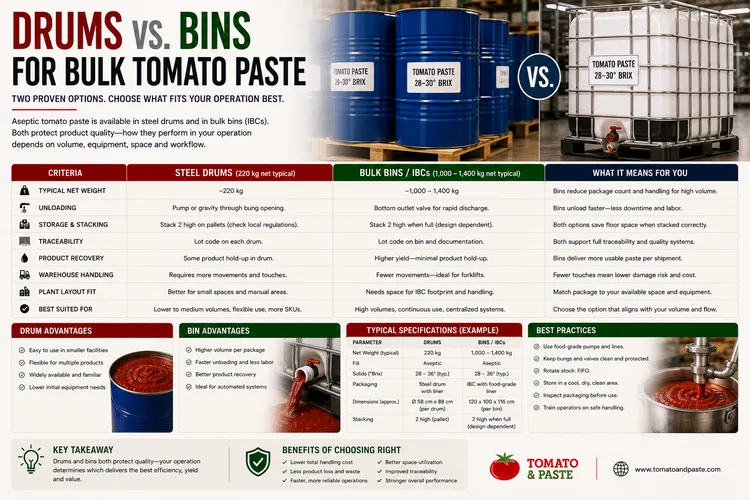
Why this matters
Bulk packaging affects more than freight and storage. The choice between drums and bins influences how tomato paste is unloaded, moved through the warehouse, opened, emptied, traced and incorporated into production.
The paste itself still needs to meet the finished-product specification. Solids, process type, viscosity, color, pH, finish and sensory performance should be approved independently before packaging format becomes the deciding operational variable.
Start with the tomato paste specification
Confirm the paste specification before comparing pack formats. A drum and a bin should contain technically equivalent product if the purpose of the evaluation is to determine which package works better for the plant.
Start with solids/Brix and process type, then add consistency, color, pH or acidity, finish, microbiology, package requirements and lot documentation. This prevents a technical difference between two pastes from being mistaken for a packaging difference.
Ingredient selection
For this topic, a logical first ingredient to evaluate is bulk aseptic tomato paste in the concentration and process style already suitable for the application.
Treat the drum-versus-bin decision as part of the complete sourcing model. The best answer is the format that delivers approved paste reliably while fitting production volume, handling capabilities, storage space, traceability requirements and total landed cost.
Understand the drum format
Drums divide the shipment into relatively smaller handling units. This can be useful when production batches do not require very large quantities of paste at one time or when the plant benefits from greater flexibility in staging inventory.
Smaller individual units can also simplify physical separation of lots and make it easier to consume paste gradually across multiple production runs. The tradeoff is that a larger number of individual packages must be moved, opened and disposed of or otherwise managed.
Understand the bin format
Bins place more paste into each handling unit. For higher-volume production, this can reduce the number of packages opened and handled for a given quantity of tomato solids.
The plant must, however, be able to receive, move, stage and empty the larger unit safely and efficiently. Warehouse aisles, forklifts, lifting capacity, access around the production line and the paste-emptying system should all be reviewed before approving bins.
Match pack size to batch size
One of the most practical questions is how much paste a typical batch consumes. A package that closely matches normal batch demand can reduce partial-container handling and simplify material reconciliation.
If a large bin cannot be fully used within the plant's normal handling procedure, the operational advantage of the larger package may be reduced. Conversely, very large production runs may require opening many drums when a smaller number of bins could be more efficient.
Unloading and product transfer
Compare how each pack will move from receiving to production. Consider whether the paste is manually scooped, pumped, squeezed, discharged through dedicated equipment or transferred using another plant-specific method.
High-viscosity paste can be difficult to recover from a container without suitable equipment. The package and unloading system should therefore be evaluated together rather than as separate purchasing decisions.
Product recovery
Residual paste left inside a drum or bin can affect the real economics of the format. Measure usable recovery during production trials rather than assuming that the full nominal net weight enters the formula.
Even a modest difference in recovery can become commercially important across a high-volume annual program. Record both paste used and residual material remaining after the normal unloading procedure.
Warehouse footprint
Storage efficiency depends on unit dimensions, stacking requirements, aisle space and the plant's normal inventory level. A format that looks efficient on a per-container basis may not be optimal once safe access and handling clearance are considered.
Review both full and empty package handling. If empty drums or bins remain on site before recycling, disposal or return, they also require space and internal movement.
Traceability
Each incoming package should remain connected to the supplier lot and internal receiving record. Drums can provide relatively granular lot segregation because individual units are smaller, while bins reduce the number of units that must be tracked.
Whichever format is selected, lot codes should remain legible through warehouse storage and production use, and the plant should be able to identify which supplier lot entered each finished-product batch.
Mixed-lot shipments
Ask whether a commercial shipment may contain multiple production lots and how those lots are identified. This is particularly important if the plant wants to maintain one supplier lot per production run.
Receiving procedures should record lot-level quantities so quality teams can isolate affected material efficiently if a later question arises.
Package integrity
Bulk aseptic tomato paste depends on the package system protecting the product until use. Inspect outer containers, aseptic liners, closures and visible seals according to the plant's approved receiving procedure.
Any puncture, leakage, abnormal swelling, broken closure or other damage should be assessed before the ingredient is released into production.
Labor and handling
Count the practical handling steps required for each format. More individual drums may mean additional forklift movements, opening operations and empty-container handling, while bins may require more specialized equipment or more careful staging.
Include labor in the comparison when it materially affects production efficiency. The lowest packaging cost may not represent the lowest overall handling cost.
Plant layout
Physical plant constraints can decide the format before commercial economics do. Check door dimensions, elevator or lift access, forklift turning radius, mezzanine restrictions, line-side space and the position of unloading equipment.
A format that works well at the supplier or warehouse may be impractical if it cannot move efficiently to the point of use inside the manufacturing facility.
Freight and container utilization
Compare how many kilograms of usable tomato paste can be moved in each transport configuration. Packaging dimensions, tare weight, palletization and loading efficiency can influence the delivered economics.
Use actual commercial pack configurations when modeling freight rather than comparing only nominal container sizes.
Compare total landed and usable cost
Unit price per kilogram is only one part of the decision. Include freight, packaging, handling, labor, warehouse space, unloading equipment, residual paste and disposal or return requirements.
Where paste concentrations differ, normalize the comparison to usable tomato solids so both ingredient concentration and packaging efficiency are reflected in the economic model.
Practical trial method
Evaluate the tomato paste in the actual formula while also documenting how the pack performs operationally. If the same paste is available in both formats, use equivalent product wherever possible so the packaging comparison remains clean.
- Define the finished-product specification and confirm the paste attributes that cannot change.
- Collect technical data, COAs and pack specifications for the drum and bin options.
- Record net fill, outer dimensions, tare information and normal shipment configuration.
- Review receiving, forklift, warehouse and line-side compatibility for each pack.
- Trial the normal unloading method and record labor, time and equipment required.
- Measure product recovery and residual paste after emptying.
- Run the paste in the actual formula at normalized tomato solids where needed.
- Measure Brix/solids, pH, viscosity or Bostwick, color, yield and sensory profile.
- Compare freight, handling, storage, recovery and packaging-disposal implications.
- Document the approved paste specification, package format and change-control triggers.
What to record during the packaging trial
- Supplier and ingredient lot
- Drum or bin format
- Net weight
- Package dimensions
- Receiving condition
- Unloading method
- Labor and handling steps
- Product recovery
- Residual paste
- Warehouse footprint
- Lot traceability
- Empty-pack handling
Consider partial-container use
If the plant does not consume the full container at once, define how partially used material will be handled. This may affect the attractiveness of a larger package even when the price per kilogram is lower.
The plant should have a documented procedure for product identification, protection, storage and subsequent use after a container is opened.
Check empty-pack handling
Empty drums, bins, liners and related packaging materials still require internal handling. Review whether the packaging is disposed of, recycled, compacted, returned or managed through another approved route.
Include the labor and space associated with empty packaging in the operational comparison, especially at high annual volumes.
Questions to ask the supplier
- Is the same tomato paste specification available in both drums and bins?
- What is the exact net weight for each pack format?
- What are the outer package dimensions and normal pallet or shipment configuration?
- What aseptic liner and closure system is used?
- What unloading methods are commonly used by customers?
- What normal product recovery should buyers expect?
- Can one shipment contain multiple production lots?
- How are lot codes displayed on drums and bins?
- What storage and stacking guidance applies?
- Which parameters are guaranteed versus typical?
- Which food-safety, quality and organic documents are available?
- How are damaged packages or liners handled?
- What pack, liner, specification or manufacturing changes require customer notification?
Define the approved pack specification
Once the preferred format is selected, document more than simply "drum" or "bin." Record net weight, liner or aseptic configuration, labeling and lot-code requirements, stacking or storage expectations and any unloading assumptions that are important to the plant.
Keep the package specification linked to the approved tomato paste specification so a packaging change does not unintentionally introduce a different ingredient grade or handling condition.