
Why this matters
Fire-roasted tomatoes can provide a combination of tomato flavor, visible char and cooked or roasted sensory notes that is difficult to reproduce with plain tomato ingredients alone. In commercial sauces, however, that character needs to remain consistent after mixing, heating, pumping and storage.
Sauce performance is usually controlled by the interaction of tomato insoluble solids, soluble solids, water, acid, sugar, salt, hydrocolloids and thermal or shear history. A change in tomato format, solids, particle size or roasting intensity can therefore affect both sensory quality and physical performance.
Define the intended roasted character
"Fire-roasted" can describe a broad range of sensory profiles. Some applications need a subtle roasted tomato note, while others depend on clearly visible char and a more assertive grilled or smoky impression.
Define the target before requesting samples. Consider roasted aroma, char visibility, tomato sweetness, acidity, bitterness and the amount of visible tomato identity expected in the finished sauce.
Ingredient selection
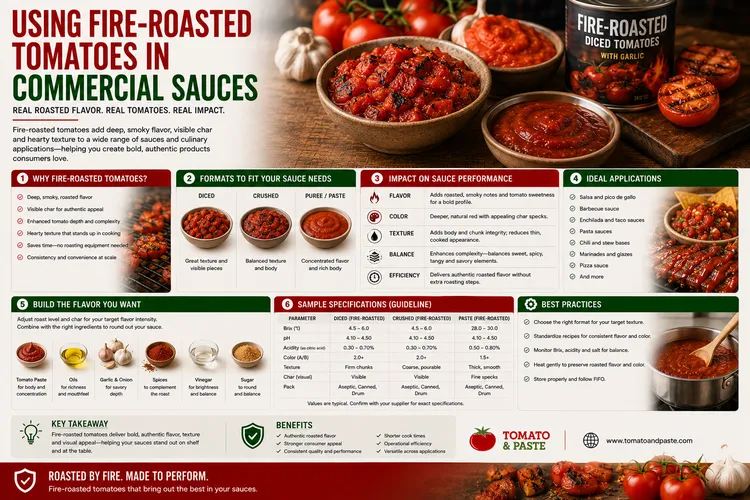
Choose a tomato format for the role it must play: paste for concentrated solids and body, puree for base texture, crushed or diced tomato for piece identity, and clarified concentrate for savory depth with less pulp.
For this topic, a logical first ingredient to evaluate is fire-roasted diced or crushed tomatoes. Treat that as a formulation hypothesis rather than a fixed rule. The preferred product is the one that provides the required roasted character, texture and process performance at an acceptable total cost and with reliable supply.
Diced versus crushed fire-roasted tomatoes
Diced fire-roasted tomatoes are useful when visible tomato pieces and char marks are part of the finished-product identity. They can work well in chunky salsa, culinary sauces and other products where consumers should see recognizable tomato pieces.
Crushed fire-roasted tomatoes provide a more integrated texture while still contributing roasted flavor and some visible particle character. They may be easier to incorporate into sauces where large pieces would interfere with filling, pumping or finished-product consistency.
Char level is a specification variable
The amount and distribution of visible char can influence both appearance and flavor. Too little char may fail to communicate the roasted concept, while excessive char can dominate the sauce or contribute an undesirable bitter impression.
During qualification, compare the ingredient visually and in the finished sauce. Define whether char level should be controlled through a supplier reference, descriptive standard or another agreed quality criterion.
Particle size and piece integrity
Fire-roasted pieces need to survive the actual manufacturing process if visible identity is important. Mixing, pumping and thermal processing can reduce particle size or break soft tomato pieces into the sauce base.
Record the incoming cut or crush style and compare it with the finished-product appearance. If pieces disappear during processing, review addition point, pump type, mixer intensity and hold conditions before simply moving to a larger cut.
Normalize tomato solids
Candidate products may contain different proportions of tomato solids and juice. Comparing them at the same ingredient percentage can therefore create misleading differences in body, yield and tomato intensity.
Normalize the initial comparison to equivalent tomato solids where practical. After the preferred product is selected, optimize the exact usage rate and water balance for the finished formula.
Build the tomato system deliberately
Fire-roasted tomatoes do not always need to provide all of the tomato solids in the sauce. A formulation may combine them with paste or puree so roasted pieces provide sensory identity while another ingredient controls solids, body and cost.
This approach can make it easier to tune roasted flavor independently from viscosity. It can also reduce the risk that increasing fire-roasted tomato solely for flavor creates an unintended texture or water-balance change.
Flavor balance
Roasted tomato character interacts with sweetness, acidity, salt, chile, smoke, spices and savory ingredients. Evaluate the complete seasoning system rather than tasting the tomato ingredient in isolation.
In barbecue sauces, roasted tomato may support caramelized or smoky notes. In salsa, it may need to remain balanced with chile, onion, herbs and acid. The ideal profile depends on the intended product positioning.
Watch for excessive bitterness
Char can contribute complexity, but an overly intense roasted profile may also increase perceived bitterness or burnt character. This may become more apparent after the sauce is heated or concentrated.
Evaluate both aroma and aftertaste. A sample that smells appealing at the bench may become too aggressive once additional thermal processing amplifies roasted notes.
Color and visual identity
Fire-roasted ingredients introduce darker spots and uneven color by design. Decide how much variation is acceptable and whether the finished sauce should look distinctly roasted or merely slightly darker than a conventional tomato base.
When visible char is a key product cue, check distribution throughout the package so the first and last portions of the batch have a reasonably consistent appearance.
Viscosity and sauce structure
Piece-containing sauces can behave differently from smooth systems. Tomato pulp, particles and added hydrocolloids all contribute to flow, and the measured consistency can change substantially after cooling.
Measure hot and cooled viscosity or Bostwick where appropriate. Use the same sample temperature and test procedure for each candidate so comparisons remain meaningful.
Consider pumping and filling
Large tomato pieces can affect pump selection, transfer lines, valves and fillers. During pilot production, observe whether the ingredient moves through the process without excessive breakage, blockage or uneven piece distribution.
The preferred cut should support both the visual target and the practical equipment used on the commercial line.
Heat treatment changes the result
Commercial sauces may be cooked, pasteurized, hot-filled or otherwise thermally processed after fire-roasted tomatoes are added. Heat can soften pieces, change color and alter the intensity of roasted aroma.
Approve the ingredient after the complete thermal process rather than from an unheated bench mixture. Where relevant, repeat the assessment after representative storage.
Practical trial method
Bench trials should normalize tomato solids first, then tune water and seasonings. Record both hot and cooled sauce performance because structure and roasted character can change through processing and cooling.
- Define the finished-product target, including roasted flavor intensity, visible char, particle size, viscosity and color.
- Collect current technical data and representative samples from each candidate source.
- Record ingredient lot, diced or crushed format, solids information and supplier description of roasting or char characteristics.
- Normalize tomato solids before comparing usage rates where candidate products differ materially.
- Run a controlled bench or pilot batch using the actual addition order and process conditions.
- Observe mixing, pumping and piece integrity through the process.
- Measure Brix or solids, pH, viscosity or Bostwick, color, yield and other relevant finished-product parameters.
- Evaluate roasted aroma, char perception, bitterness, tomato flavor and seasoning balance after the intended thermal process.
- Repeat after representative storage to check texture, color and sensory stability.
- Document the approved supplier, cut style, char target, usage rate, specification and change-control triggers.
What to record during trials
- Ingredient lot & COA
- Diced or crushed format
- Particle-size description
- Visible char level
- Tomato solids normalization
- Batch weights and water
- Addition order
- Process temperature and time
- Mixing / shear conditions
- Hot and cooled viscosity
- pH & Brix
- Piece integrity
- Color & sensory
- Post-storage result
Compare after storage
Roasted flavor, color and sauce texture can evolve during storage. If the product has a meaningful shelf life, evaluate representative retained samples rather than approving the ingredient only on production day.
Pay particular attention to char perception, piece softness, separation, color and overall flavor balance after storage.
Questions to ask the supplier
- What exact product definition and cut or crush style apply?
- How is the fire-roasted character produced and controlled?
- How is visible char level described or monitored?
- What normal variation in char distribution should buyers expect?
- What solids, Brix, pH and particle specifications apply?
- Which parameters are guaranteed versus typical?
- How well do pieces typically retain integrity through heating and pumping?
- What product process and crop/origin apply to this lot?
- What is the pack configuration, net weight and storage guidance?
- Which food-safety, quality and organic documents are available?
- How are lots identified and traced?
- What process, cut, char, origin or packaging changes require customer notification?
Define the approved reference
Once the preferred fire-roasted tomato is selected, document the attributes that drove approval rather than relying only on the product name. This may include particle size, char appearance, roasted flavor intensity, solids, pH, piece integrity and sensory profile.
Keep the approved ingredient lot and finished-sauce trial results as a reference for future crop, supplier or process changes.