
Why this matters
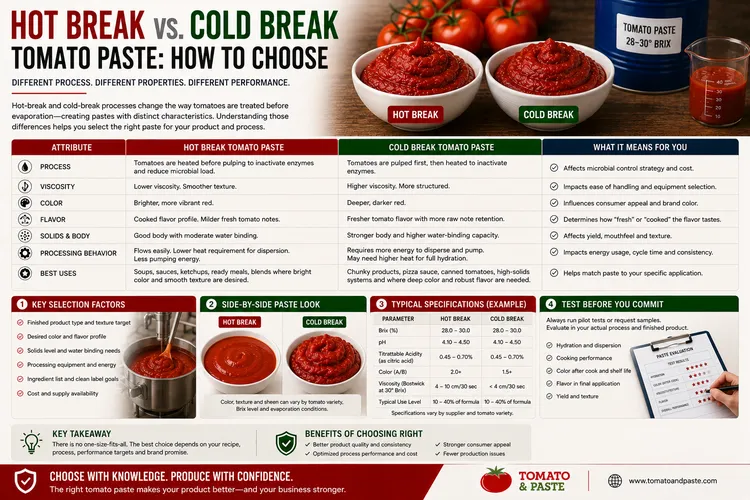
The tomato paste specification is the commercial translation of finished-product performance. Hot-break and cold-break pastes may have similar concentration while behaving differently in viscosity, flow, color, flavor and downstream processing.
Normalize comparisons before approving a source. An apparently small change in solids, consistency or process history can alter finished yield, pumping behavior, sensory profile and the amount of water, starch or other texture adjustment required.
Start with the finished product
Do not begin with the assumption that one break type is universally better. Start with the finished product and define which characteristics matter most: body, pourability, cling, color, tomato flavor, process tolerance, filling behavior or another measurable performance target.
The preferred paste is the one that consistently delivers those characteristics under the manufacturer's actual process conditions and at an acceptable total cost.
Ingredient selection
Start with solids/Brix and process type, then add consistency, color, pH/acidity, finish, microbiology, package and lot documentation. For this topic, a logical first comparison is hot-break paste versus cold-break paste at similar concentration and specification.
Treat the break type as a formulation variable rather than a fixed rule. Two pastes carrying the same general process description can still differ in viscosity, color, flavor or normal lot-to-lot range.
What hot break means in practice
Hot-break processing applies a relatively rapid heat treatment early in tomato processing. In commercial ingredient selection, hot-break paste is commonly evaluated when stronger consistency or body is important to the finished formulation.
The actual result still depends on the processor, tomato variety, crop conditions, concentration and final specification. Buyers should therefore compare measured performance rather than assuming that every hot-break paste will behave identically.
What cold break means in practice
Cold-break processing uses a different early processing profile and can produce a paste with different consistency, color and flavor characteristics. It may be useful in applications where the buyer prefers a more fluid consistency or a different sensory profile.
As with hot-break material, the process name alone does not fully describe the ingredient. The supplier specification and actual application trial should drive the final decision.
Viscosity and consistency
Consistency is often the first reason manufacturers compare hot-break and cold-break paste. If the finished product depends on tomato solids for body, the paste can materially affect flow and the amount of additional thickener needed.
Use the viscosity or consistency method relevant to the commercial application. Bostwick, laboratory viscosity measurements and finished-product flow tests can each provide useful information when they are performed under controlled conditions.
Measure at equal tomato solids
A higher-Brix paste introduces more tomato solids at the same ingredient weight. Comparing two samples at equal weight can therefore make one product appear thicker, darker or more flavorful simply because more solids were added.
Normalize the first comparison to equivalent tomato solids. After the preferred ingredient is identified, optimize its actual use rate and water balance in the finished formula.
Color differences
Color can be an important purchasing criterion for ketchup, sauces, soups and other tomato-forward foods. Evaluate both the incoming paste and the finished product because dilution, heating and other ingredients can change visual perception.
If color is commercially important, define the approved target using the supplier's analytical data, an internal measurement, an approved finished-product reference or a combination of these tools.
Flavor and aroma
Break process and overall processing history can influence the sensory character of the paste. Compare tomato aroma, sweetness, acidity perception, cooked character, freshness, bitterness and overall tomato intensity.
Sensory evaluation should be performed in the intended finished product whenever possible. Differences that are obvious in diluted paste may become less important after seasoning, cooking or blending with other ingredients.
Consider the complete formulation
Tomato paste interacts with water, starches, gums, sugars, salts, acids, oils, vegetable solids and other ingredients. A change in paste consistency can therefore affect more than one part of the formula.
During trials, note whether switching break type requires adjustments to added water, thickener, mixing time or process conditions to reproduce the existing finished product.
Processing behavior
Evaluate how each candidate handles during dilution, pumping, mixing and heating. A paste that delivers excellent final viscosity may still create unnecessary operational difficulty if it is substantially harder to empty, pump or disperse.
Processing observations should be included in the commercial comparison alongside finished-product measurements.
Shear can change the comparison
Mixing, pumping and homogenization can affect apparent viscosity. Bench samples prepared gently may therefore behave differently from material processed through a commercial plant.
Where viscosity is critical, reproduce representative shear conditions during pilot or plant trials and measure the product after the process step that matters most.
Heat treatment matters
The finished product may undergo pasteurization, hot filling, retorting or another thermal process after the tomato paste is incorporated. Evaluate consistency, color and sensory profile after that process rather than approving the paste solely from an unheated bench sample.
This is particularly important when changing both supplier and break type at the same time because process interactions can be more visible after commercial heating.
Practical trial method
Run candidate ingredients in the actual formula at equal tomato solids whenever possible. Record batch and process conditions carefully so viscosity, yield, color and sensory comparisons remain meaningful.
- Define the finished-product target and identify which attributes cannot change.
- Collect current specifications, COAs and representative hot-break and cold-break samples.
- Record Brix, viscosity or Bostwick, pH/acidity, color, finish and other relevant supplier data.
- Normalize the candidates to equivalent tomato solids before the first formulation comparison.
- Run controlled bench or pilot batches using the actual water ratio, addition order and process conditions.
- Record mixing, pumping, dilution and handling observations.
- Measure relevant finished-product attributes such as Brix, pH, viscosity or Bostwick, color and yield.
- Conduct a controlled sensory comparison after the intended thermal process.
- Repeat after representative storage where shelf-life behavior is important.
- Document the approved supplier, break type, specification and change-control triggers.
What to record during the comparison
- Supplier and ingredient lot
- Hot-break or cold-break designation
- Brix / total solids
- Viscosity / Bostwick
- pH / acidity
- Color
- Finish or screen information
- Formula usage rate
- Water adjustment
- Mixing and shear conditions
- Finished yield
- Sensory observations
Compare total formulation cost
The lowest price per kilogram is not necessarily the lowest-cost paste in the finished formula. Concentration, yield, thickener requirement, water adjustment, product recovery, freight and handling can all affect the total economics.
Compare offers on usable tomato solids and finished-product performance rather than quoted unit price alone.
Supplier consistency matters
Once a technically suitable break type is selected, review the supplier's normal specification range and expected crop-to-crop or lot-to-lot variation. A narrow, well-managed range can be more valuable than an exceptional sample that is difficult to reproduce consistently.
Ask which parameters are guaranteed and which are typical, and define notification expectations for meaningful process or specification changes.
Questions to ask the supplier
- Is the product manufactured as hot break or cold break?
- What Brix or total-solids range applies?
- What viscosity or Bostwick specification applies?
- Which color parameters are guaranteed versus typical?
- What pH or acidity range applies?
- What finish or screen specification applies?
- What normal lot-to-lot variation should buyers expect?
- What product definition, crop and origin apply to the lot?
- What is the pack configuration, net weight and storage guidance?
- Which food-safety, quality and organic documents are available?
- How are lots identified and traced?
- What break-process, specification, site or packaging changes require customer notification?
Define the approved specification
Once trials are complete, document the technical attributes that produced acceptable performance rather than approving only a generic phrase such as "hot break" or "cold break."
The commercial specification should capture the relevant Brix, viscosity, color, acidity, finish, sensory, packaging and documentation requirements along with the approved process type where that distinction is important.
Keep an approved reference
Retain the approved trial record and, where useful, a representative ingredient or finished-product reference. This gives purchasing, quality and product-development teams a common baseline when future lots or alternate suppliers are evaluated.