
Why this matters
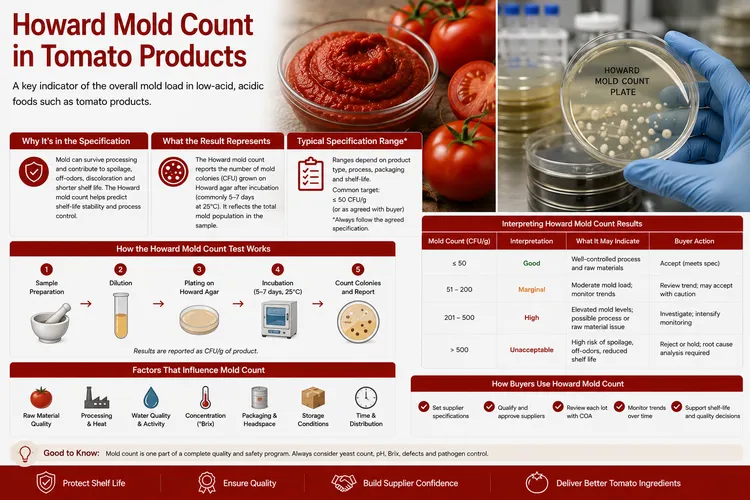
Howard mold count is a long-established microscopic quality measurement associated with certain processed tomato products. Buyers may encounter it on specifications, certificates of analysis, customer requirements or historical purchasing standards.
The value is most useful when it is interpreted in context. It should be connected to the exact tomato product, agreed analytical method, supplier process, applicable specification limit and the buyer's broader quality program rather than treated as a stand-alone measure of total ingredient quality.
What the measurement represents
The Howard mold count method evaluates prepared tomato material microscopically and records the proportion of examined fields in which mold filaments are observed. The result is therefore a microscopic quality indicator rather than a simple visual inspection of the finished paste or crushed product.
When reviewing supplier data, buyers should make sure the reported result and its units or expression are understood consistently by both parties and are tied to the specification being used for the commercial program.
Ingredient selection
Use product-specific specifications rather than copying a generic paste requirement onto diced, dry or clarified tomato ingredients. For this topic, a logical starting point is tomato paste and crushed tomatoes or another processed tomato product for which Howard mold count forms part of the agreed specification.
Treat the test as one component of qualification rather than a substitute for finished-product performance. The preferred ingredient still needs to meet solids, consistency, color, flavor, processing, packaging, documentation and cost targets.
Why it appears in specifications
Buyers use specifications to translate raw-material and process expectations into measurable acceptance criteria. Howard mold count may appear in tomato specifications because it provides an additional microscopic indicator related to the condition of the tomato material used in processing.
Whether it belongs in a particular specification depends on the tomato product, customer expectations and applicable commercial or regulatory program. Requirements should therefore be reviewed product by product rather than inherited automatically from an unrelated specification.
Do not evaluate the number in isolation
An incoming tomato ingredient is normally approved against several characteristics. Howard mold count should therefore be reviewed together with the other parameters that determine suitability for the finished product.
- Product definition and process type
- Brix or total solids
- pH and acidity where relevant
- Viscosity or Bostwick
- Color
- Finish or particle characteristics
- Sensory profile
- Microbiological requirements
- Howard mold count where specified
- Packaging and lot documentation
Check the analytical method
When a numerical requirement is part of a purchasing specification, both supplier and buyer should understand which analytical method is expected. Method details can influence how results are generated and compared.
If supplier and customer laboratories are both testing the product, confirm that sample preparation, method reference and reporting conventions are sufficiently aligned before interpreting a difference as a true product-quality change.
Sampling matters
As with other laboratory measurements, the result relates to the sample submitted for analysis. Buyers should understand how the supplier defines the production lot, how representative samples are collected and how the sample remains linked to the commercial lot.
Independent testing should preserve the same traceability. Record the package or lot sampled, sampling date, sample condition and laboratory reference so any later discussion can be tied to the correct material.
Review the certificate of analysis
If Howard mold count is a required lot-release parameter, the COA or supporting report should clearly connect the result to the ingredient received.
- Correct product name or code
- Correct supplier lot
- Reported Howard mold count result
- Applicable acceptance limit where shown
- Analytical method or reference where relevant
- Test or report date
- Lot disposition or conformance status
Understand normal lot variation
Tomato ingredients originate from agricultural raw material, and analytical values can vary between lots while still remaining within the approved specification. Buyers should distinguish expected variation from a meaningful shift requiring investigation.
Historical lot data can be useful for understanding the supplier's normal range. A trend moving steadily toward the specification limit may justify discussion even before an actual out-of-specification result occurs.
Use trends during supplier review
Looking at results across multiple lots can provide more information than reviewing each COA independently. Supplier qualification teams can track whether Howard mold count remains stable through a crop season and whether changes correspond with other quality indicators.
Trending should not replace individual lot acceptance, but it can help identify changes in incoming raw material or processing performance that deserve additional technical discussion.
Connect the result to supplier controls
Ask the processor how raw tomatoes are received, sorted and managed before processing and which operating controls support the finished-product specification. The laboratory result is more useful when buyers understand the process behind it.
Supplier qualification should therefore consider both analytical results and the broader agricultural, receiving and processing controls used to produce the tomato ingredient.
Practical qualification method
Define the applicable specification, analytical method, sampling expectations, acceptance limit, retain-sample approach, escalation rules and document ownership before routine commercial deliveries begin.
- Define the exact tomato product and confirm whether Howard mold count belongs in the approved specification.
- Collect the supplier's current specification and representative COAs.
- Confirm the agreed test method, reporting format and acceptance criterion.
- Understand how supplier lots are defined, sampled and released.
- Review representative historical results where available to understand normal variability.
- Confirm the candidate ingredient also meets solids, pH, consistency, color, sensory and packaging requirements.
- Run a controlled bench or pilot batch using the actual formulation and process conditions where technical qualification is required.
- Record relevant finished-product measurements and sensory observations.
- Define escalation and disposition procedures for unexpected or out-of-specification results.
- Document the approved supplier, specification, testing expectations and change-control triggers.
Handling an unexpected result
If a reported result does not meet the agreed specification, identify and hold the affected lot according to the buyer's quality procedure before making a disposition decision.
Review lot identity, sampling, method, laboratory information and supporting supplier records. Where additional testing or investigation is appropriate, define it through the established quality process rather than changing the acceptance criterion after the result is known.
Keep specification language clear
The purchasing specification should make it clear whether Howard mold count is a guaranteed lot-release requirement, a typical parameter, a reporting requirement or another type of quality criterion.
Clear language reduces disputes and prevents purchasing, supplier and laboratory teams from applying different interpretations to the same numerical result.
Questions to ask the supplier
- Which tomato products in your portfolio are routinely tested for Howard mold count?
- What analytical method or method reference is used?
- Is the result tested on every lot or at another defined frequency?
- How is the production lot defined and sampled?
- What limit or reporting expectation applies to this product?
- Is the parameter guaranteed or reported as typical?
- What normal lot-to-lot variation should buyers expect?
- How are unexpected results investigated?
- What product definition, process and crop/origin apply to the lot?
- Which additional quality parameters are included on the COA?
- How are lots identified and traced?
- What is the pack configuration, net weight and storage guidance?
- What process, specification or testing changes require customer notification?
Keep the test in context
Howard mold count can be a useful specification parameter when it is relevant to the tomato product and commercial program, but it should remain part of a broader supplier-quality system.
Combine the result with product identity, analytical specification, supplier controls, lot traceability and finished-product performance so approval decisions reflect the complete ingredient rather than a single laboratory number.