
Why this matters
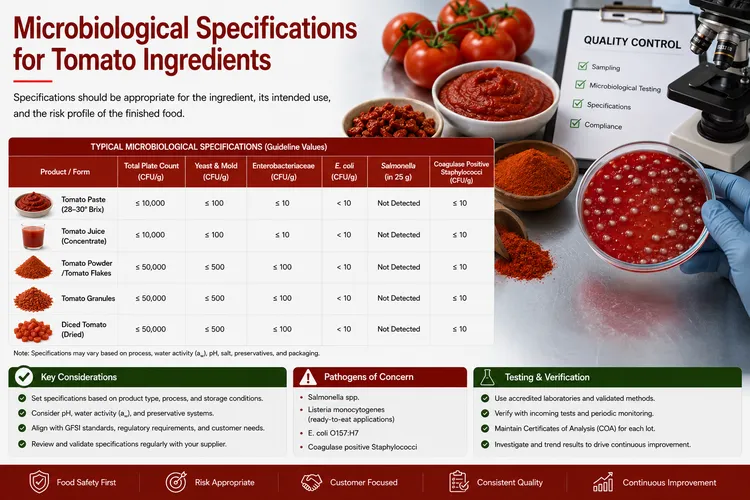
Microbiological specifications are most useful when they reflect the actual product, process and finished-product risk. Tomato paste, puree, diced products, dry tomato ingredients and other formats can have very different manufacturing and handling histories, so a single generic set of limits may not be appropriate for every application.
A robust control plan links measurable incoming criteria to supplier process controls, packaging integrity, lot traceability and the downstream manufacturing process. The objective is to define requirements that are technically meaningful rather than simply adding tests to a specification without considering how the ingredient will actually be used.
Start with product type and intended use
Begin by identifying the exact tomato ingredient and how it enters the finished product. An ingredient used in a product that receives a validated thermal process may be managed differently from one added after the main kill step or used in a minimally processed system.
Packaging, storage temperature, shelf life and whether the package is opened and partially used can also influence the practical microbiological control plan.
Ingredient selection
Use product-specific specifications rather than copying a generic paste sheet onto diced, dry or clarified tomato ingredients. For this topic, the logical starting point is the actual tomato ingredient used in the manufacturing process.
Treat technical selection and microbiological qualification as connected decisions. The best ingredient is the one that meets the finished-product target, process, packaging and safety expectations at an acceptable total cost and with reliable supply.
Consider the supplier process
Microbiological expectations should be reviewed in the context of how the ingredient is manufactured. Ask the supplier to explain the relevant heating, concentration, drying, filling or other controls applied to the product.
The goal is to understand what process supports the microbiological condition of the ingredient at release and how that condition is protected through packaging and shipment.
Packaging is part of the control system
A microbiologically controlled ingredient can still become unsuitable if package integrity is lost. Aseptic bags, drums, bins, cans, pouches and dry-product bags all require handling appropriate to their design.
Receiving procedures should therefore include checks for damaged packaging, leakage, swelling, broken seals, moisture intrusion or other conditions that could compromise the basis for the original supplier release.
Define meaningful microbiological parameters
The microbiological specification should reflect the product and application. Depending on the ingredient and manufacturing program, buyers may review indicators, spoilage organisms or specified microorganisms relevant to the product's risk assessment and process controls.
Avoid adding parameters simply because they appear on another ingredient specification. Each requirement should have a clear reason and an agreed test method or interpretation where necessary.
- Product-specific microbiological parameters
- Defined acceptance limits or reporting expectations
- Relevant analytical methods where required
- Sampling frequency or lot-testing basis
- Lot-release responsibility
- Escalation procedure for unexpected results
Understand lot testing versus process control
Laboratory testing is one verification tool, but it should not be treated as a substitute for manufacturing controls. Ask whether microbiological results are available for every commercial lot, on a defined frequency or as part of a broader process-verification program.
Understanding that distinction helps buyers interpret certificates of analysis and determine what supporting supplier information is needed for qualification.
Sampling matters
Test results are only meaningful when the sample can be related to the material being evaluated. Confirm how the supplier defines a lot, where samples are taken and how sample identity is maintained through testing.
When the buyer conducts independent testing, document sampling location, package identity, lot code and sample-handling conditions so results remain traceable to the affected ingredient.
Review the certificate of analysis carefully
A COA should be reviewed as a lot document rather than filed automatically. Confirm that the product name, supplier lot and analytical results correspond with the material being received.
- Correct supplier and ingredient identity
- Supplier lot or production code
- Relevant microbiological parameters
- Reported values or pass/fail status
- Applicable specification limits
- Test method reference where relevant
- Report or release date
Match requirements to downstream processing
The finished-product process is part of the microbiological risk assessment. Heating, acidification, hot filling, retorting, refrigeration, drying or other controls can influence how the incoming ingredient specification should be defined.
The ingredient specification should complement those controls, not replace them. The food manufacturer remains responsible for validating the complete finished-product process.
Dry and liquid ingredients may need different approaches
Dry tomato powders, granules or flakes behave differently from aseptically packed paste or puree. Moisture control, package protection and environmental handling can be especially important for dry ingredients.
Likewise, liquid products may depend heavily on thermal processing and package integrity. Separate specifications by product family where those distinctions are meaningful.
Define receiving controls
Receiving inspection should confirm that the incoming lot matches the approved supplier and product and that the package condition supports continued use of the supplier's microbiological release.
- Approved supplier and product
- Correct lot identity
- COA or required release documentation
- Package integrity
- Storage condition on arrival where relevant
- Any signs of leakage, swelling, damage or moisture intrusion
Control opened containers
The microbiological status of an unopened ingredient is not automatically maintained after opening. If a drum, bin, bag or other pack is partially used, define how remaining material is covered, identified, stored and used.
Internal procedures should also define maximum open-container holding conditions where relevant to the ingredient and process.
Practical qualification method
Define sampling, acceptance limits, retain samples, escalation rules and documentation ownership before the first commercial delivery. Keep microbiological review connected to the broader technical qualification.
- Define the exact tomato ingredient, intended use and finished-product process.
- Collect the current specification, microbiological criteria and representative supplier documentation.
- Review the supplier manufacturing process and relevant package system.
- Confirm how lots are defined, sampled, tested and released.
- Review representative COAs and confirm how microbiological results are reported.
- Define receiving, package-integrity and lot-document checks.
- Run the normal technical bench or pilot evaluation to confirm the ingredient also meets formulation and process requirements.
- Measure relevant attributes such as Brix/solids, pH, viscosity or Bostwick, color, yield and sensory profile.
- Document escalation and disposition procedures for unexpected microbiological findings.
- Record the approved supplier, specification, microbiological criteria and change-control triggers.
Handle unexpected results consistently
The specification should be supported by a defined escalation process. When an unexpected or out-of-specification result occurs, the affected lot should be clearly identified and placed under the appropriate review before use.
Define who evaluates the result, whether confirmatory or additional testing is appropriate, how the supplier is involved and who has authority to release, reject or otherwise disposition the material.
Keep microbiological and technical approval connected
A microbiologically acceptable ingredient may still be unsuitable if it fails the required viscosity, color, flavor or process-performance targets. Likewise, a technically strong ingredient should not bypass microbiological qualification.
Keep both approval streams linked to the same supplier, product specification and lot-management system so purchasing and quality teams share one approved sourcing baseline.
Questions to ask the supplier
- What exact product definition and manufacturing process apply to this ingredient?
- What microbiological parameters are included in the product specification?
- Which microbiological limits are guaranteed versus monitored?
- Which analytical methods are used where relevant?
- Is microbiological testing performed for every lot or on another defined frequency?
- How is a production lot defined and sampled?
- How is lot release documented?
- What packaging system protects the product after processing?
- What storage conditions apply before and after opening?
- What is the pack configuration and net weight?
- Which food-safety, quality and organic documents are available?
- How are lots identified and traced?
- How are microbiological deviations investigated?
- What process, packaging or specification changes require customer notification?
Review changes before implementation
Changes in manufacturing site, thermal process, drying process, package format, microbiological specification or analytical method may affect the basis for the original approval.
Define which changes require customer notification and technical review before the changed material is introduced into routine production.