
Why this matters
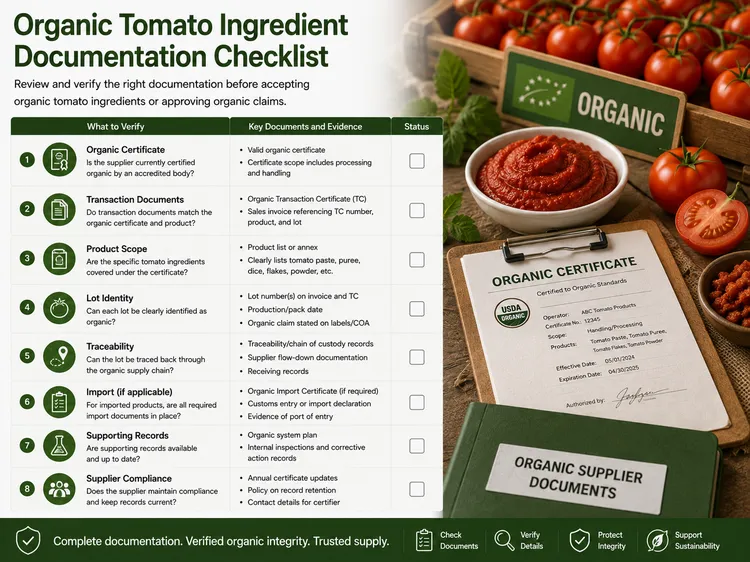
Organic approval requires more than seeing the word "organic" on a specification or supplier quotation. The documentation should support the specific supplier, ingredient and commercial program being purchased and should remain connected to the material through receiving and production.
A robust control plan links documentation, lot identity and measurable incoming criteria to finished-product risk and supplier change management. In a tomato-based formulation, technical characteristics such as solids, finish, color or viscosity still matter even when the ingredient also carries an organic designation.
Start with the intended organic program
Before requesting documents, define the organic requirement for the finished product and destination market. This gives purchasing and quality teams a clearer basis for deciding which supplier records need to be reviewed before approval.
Avoid treating all organic documents as interchangeable. The relevant paperwork should support the actual product, supplier relationship and supply chain used for the commercial program.
Ingredient selection
Use product-specific specifications rather than copying a generic tomato paste sheet onto diced, dry or clarified tomato ingredients. For this topic, a logical first ingredient to evaluate is organic tomato ingredients intended for the actual manufacturing application.
Treat organic status as one part of the approval rather than a substitute for technical qualification. The best ingredient is still the one that meets the finished-product target at an acceptable total cost and with reliable supply, supported by the documentation required for the organic program.
Review the organic certificate
The certificate is an important starting document, but it should be reviewed rather than simply filed. Confirm that the certified operation and supplier relationship are clear and that the certificate is relevant to the product or activity being represented.
- Certified company or operation name
- Certifier or certification body
- Current certification status
- Applicable dates or validity information
- Product or activity scope where shown
- Manufacturing or handling operation where relevant
- Consistency with the supplier identity used on commercial documents
Confirm product scope
A supplier may handle multiple products, formats and certification programs. Verify that the organic documentation actually supports the tomato ingredient being purchased rather than assuming a general company certificate automatically covers every product.
Match the product name, form and relevant supplier references across the specification, certificate, COA and commercial paperwork. If terminology differs, resolve the relationship before approving the ingredient.
Check transaction and shipment records
Commercial documentation can help connect certified status to the material being delivered. Depending on the applicable program, buyers may need transaction, shipment or other supporting documents in addition to the supplier's general certificate.
The internal procedure should define which documents are required before shipment, which are reviewed at receiving and which must be retained with the ingredient approval record.
Lot identity and traceability
Lot identity is the link between the physical ingredient and its supporting records. Confirm that the supplier lot appearing on the package, COA and shipment records can be connected clearly enough for receiving and quality teams to verify the material.
Where practical, retain the relevant lot references with the organic documentation so a later traceability exercise does not depend on reconstructing the relationship from separate systems or emails.
Identity preservation
If a supplier handles both organic and conventional tomato ingredients, ask how the two programs are identified and controlled through processing, filling, storage and shipment.
Internal warehouse and production controls should also preserve identity after receipt. Labels, lot codes, inventory records and production instructions should make the approved organic material distinguishable from conventional stock.
Review the technical specification separately
Organic status does not replace normal technical specification review. Confirm the parameters required for the application, such as Brix or solids, pH, viscosity, color, finish, particle size, microbiological criteria, packaging and storage.
This is particularly important when moving from a conventional ingredient to an organic alternative. The sourcing program may change while the finished-product performance target remains the same.
Normalize solids before comparing candidates
When organic and conventional or multiple organic candidates have different concentration levels, compare them on equivalent tomato solids before judging formulation performance.
A higher-solids ingredient may require a lower usage rate and different water adjustment. Normalizing the comparison makes yield, flavor and texture evaluation more meaningful.
Practical approval method
Define document ownership, technical acceptance criteria, retain samples, escalation rules and approval responsibilities before the first commercial delivery.
- Define the finished-product organic requirement and the technical attributes that cannot change.
- Collect the supplier's current organic certificate and confirm the relevant operation and product scope.
- Collect the product specification, COA and representative sample from the candidate source.
- Confirm which transaction, shipment or lot-specific documents are required for the commercial program.
- Verify that product identity and supplier lot references are consistent across packaging and supporting records.
- Normalize tomato solids or concentration before comparing usage rates where candidate products differ.
- Run a controlled bench or pilot batch using the actual addition order and process conditions.
- Measure relevant attributes such as Brix/solids, pH, viscosity or Bostwick, color, yield, piece integrity and sensory profile.
- Repeat after the relevant thermal process and storage condition where needed.
- Document the approved supplier, specification, organic documentation, lot-control expectations and change-control triggers.
Build a document checklist
A concise checklist reduces the risk that organic approval depends on one document being reviewed while other important records are missed. The exact package should reflect the buyer's program and destination-market requirements.
- Current organic certificate
- Relevant product or operation scope
- Product specification
- Certificate of analysis
- Supplier and manufacturing-site identity where relevant
- Transaction or shipment documentation where required
- Lot identity and traceability information
- Pack labels or coding information where useful
- Food-safety and quality documentation
- Internal technical approval record
Control document versions
Organic certificates and supplier documents can be renewed or revised. Keep the current approved version identifiable and avoid relying indefinitely on documents collected during the original supplier qualification.
Define who is responsible for monitoring document updates and how superseded versions are retained. Purchasing should be able to determine whether the supplier's current documentation remains acceptable before new commercial commitments are made.
Check consistency across documents
Product names, company names, manufacturing sites and lot references should make sense when documents are reviewed together. Differences may be legitimate, but they should be understood rather than ignored.
If the commercial supplier, certified operation and manufacturing location are different entities, document how they relate within the approved supply program.
Receiving controls
Receiving teams should know what to check when organic tomato ingredients arrive. Package identity, lot coding and the expected supplier should match the approved purchase and supporting records.
- Correct supplier and ingredient
- Organic designation where expected
- Supplier lot or production code
- Pack condition and net-weight configuration
- Required COA or shipment documentation
- Internal inventory identification
Change control
Changes in supplier, manufacturing site, product scope, organic certification status, ingredient specification, origin or packaging may affect the original approval. Define which changes require notification and re-review.
A product should not remain approved automatically if the documentation or supply chain changes in a way that affects the basis for the original organic or technical qualification.
Questions to ask the supplier
- Which organic program applies to this tomato ingredient?
- Which certified operation produces or handles the product?
- Does the current certificate clearly cover the relevant product or activity?
- Which transaction or shipment documents are available for commercial lots?
- How is organic product identity preserved through processing and storage?
- How are organic and conventional lots distinguished?
- What product definition, process and crop/origin apply to this lot?
- Which technical parameters are guaranteed versus typical?
- What is the pack configuration, net weight and storage guidance?
- How are lots identified and traced?
- Which food-safety and quality documents are available for this program?
- How are certificate renewals or status changes communicated?
- What supplier, site, product or certification changes require customer notification?
Keep organic and technical approval connected
The strongest approval record combines the organic-document review with the technical qualification. This prevents a situation where an ingredient is approved commercially for organic status but has not been fully evaluated for manufacturing performance, or vice versa.
Keep the approved supplier, product specification, relevant certificate references, lot-control expectations and plant-trial results together so future reviewers can understand the complete basis for approval.