
Why this matters
Tomato processing is closely linked to agricultural production and a defined processing season, so commercial resilience depends on planning, specification discipline and realistic logistics. Procurement decisions made before and during the crop can influence ingredient availability for many months afterward.
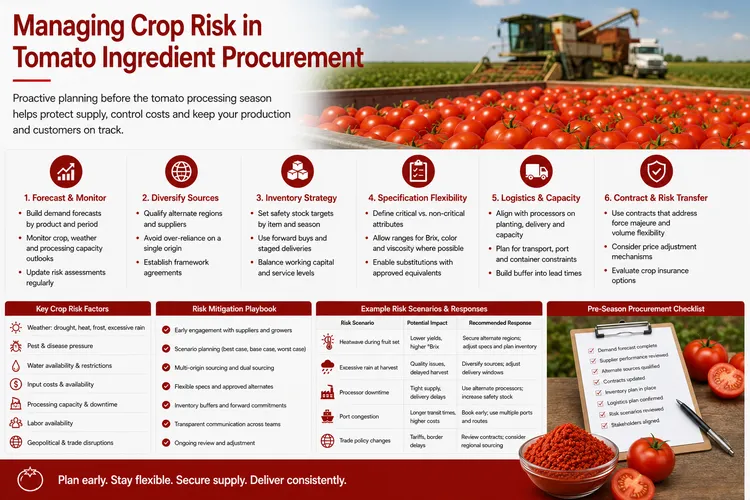
A crop-risk program helps purchasing and technical teams prepare for changes in availability, quality, capacity, timing or logistics without compromising critical finished-product requirements. The objective is to create options before a shortage or disruption makes those options urgent.
In a tomato-based formulation, an apparently small change in solids, finish, particle size or process history can alter yield, pumping behavior, sensory profile and the amount of water or thickener required. Alternate sourcing therefore needs technical preparation as well as commercial planning.
Build the forecast before the season
Start with a realistic demand forecast expressed in both finished-product demand and tomato ingredient requirements. Monthly or quarterly consumption is more useful than annual volume alone because it shows when inventory will actually be needed.
Include expected growth, promotions, new customer programs and reasonable demand variability. If the ingredient is concentrated, translate demand into usable tomato solids so products with different Brix levels can be compared on a common basis.
Separate committed and flexible demand
Not every kilogram of forecast demand carries the same risk. Some volumes may support long-standing contracts or high-volume production lines, while others may relate to seasonal products, new launches or forecasts with greater uncertainty.
Distinguishing committed demand from flexible demand helps buyers determine how much volume should be secured early and how much can reasonably remain open for later purchasing decisions.
Ingredient selection
Separate must-have technical requirements from negotiable preferences. This creates alternate-source flexibility without compromising critical finished-product attributes. For this topic, a logical first group to evaluate is contract tomato ingredients used in high-volume or strategically important products.
Treat that as a sourcing hypothesis rather than a fixed rule. The best answer is the ingredient that meets the finished-product target at an acceptable total cost and with reliable supply. A slightly different specification may be commercially useful if technical trials show that it performs acceptably without creating excessive formulation or process complexity.
Identify the non-negotiable specification limits
Crop-risk flexibility does not mean removing important technical controls. Define which characteristics directly affect product safety, legal requirements, customer commitments or critical finished-product performance.
Then separate those attributes from preferences that may have more room for adjustment. This makes alternate-source qualification more practical and prevents the specification from becoming unnecessarily narrow.
- Product definition and ingredient type
- Target solids or Brix range
- pH and acidity requirements where relevant
- Viscosity or Bostwick range
- Color requirements
- Finish or particle-size requirements
- Sensory acceptance criteria
- Pack format and net weight
- Food-safety and program-specific documentation
Qualify alternates before they are needed
Alternate suppliers are most valuable when technical approval has already been completed. Waiting until the primary source becomes constrained can force development, purchasing and production teams to evaluate new material under unnecessary time pressure.
Where the ingredient is business-critical, consider approving more than one technically acceptable source or product configuration in advance. Keep the approval current through periodic document review and representative trials when appropriate.
Understand supplier capacity
A supplier may be technically approved but still have limited commercial value if production capacity is unavailable during the period when demand is highest. Ask about expected campaign timing, product capacity, committed volume and storage availability for the specific ingredient and pack format.
Capacity discussions are particularly important before the processing season, when processors are planning raw-material commitments and production campaigns.
Build inventory around lead time
Safety stock should reflect how long it would realistically take to replenish the ingredient if a shipment is delayed or a source becomes unavailable. International programs may need to account for production scheduling, booking, freight transit, port handling and inland delivery rather than looking only at nominal supplier lead time.
Inventory targets should also consider shelf life and storage capacity. Holding more stock can reduce short-term supply risk but may increase working capital, warehouse demand and exposure to aging inventory.
Track coverage, not just inventory
Inventory measured in kilograms does not immediately show whether supply is comfortable or tight. Converting stock into weeks or months of forecast consumption gives purchasing teams a clearer view of coverage.
Coverage should consider inventory already received, confirmed inbound shipments, contracted production and expected consumption. This makes emerging gaps easier to identify before they become production emergencies.
Consider geographic diversification
Where technically and commercially practical, sourcing from more than one processor or production region can reduce dependence on a single crop or logistics lane. Geographic diversification should still be supported by technical qualification, traceability and consistent specification management.
Different origins can also involve different lead times, packaging practices and normal product characteristics. Evaluate the complete supply program rather than assuming that geographic diversification is automatically equivalent.
Compare landed usable solids
Compare offers on landed usable solids, approved quality, packaging efficiency, lead time, documentation and continuity—not unit price alone. A higher-concentration ingredient may require less weight for the same finished-product tomato solids and can therefore change freight and storage economics.
Normalizing the commercial comparison helps purchasing teams understand whether a lower unit price actually produces a lower finished-formula cost.
Practical qualification method
Alternate-source preparation should combine commercial risk review with technical validation. The goal is to know in advance which products can be used, under which conditions and with what formula or process adjustments.
- Define annual demand, monthly consumption and the finished-product attributes that cannot change.
- Identify primary and alternate tomato ingredient sources or product formats that could support the program.
- Collect current technical data, specifications and representative samples from each candidate source.
- Normalize tomato solids or concentration before comparing usage rates and landed economics.
- Run a controlled bench or pilot batch using the real addition order and process conditions.
- Measure relevant attributes such as Brix/solids, pH, viscosity or Bostwick, color, yield, piece integrity and sensory profile.
- Repeat after the relevant thermal process and storage condition where needed.
- Compare pack configuration, lead time, available capacity, documentation and logistics requirements.
- Define inventory coverage and escalation triggers for the approved sourcing plan.
- Document the approved suppliers, specifications, formula adjustments and change-control triggers.
Set escalation triggers
Crop-risk planning works best when teams know when to act. Define practical triggers that prompt additional sourcing review rather than waiting until supply is already insufficient.
- Inventory coverage falls below the agreed planning threshold
- Supplier production is delayed
- Contracted volume is reduced or uncertain
- Expected crop quality moves outside the normal range
- Freight lead times materially increase
- A planned alternate source becomes unavailable
- Demand materially exceeds the current forecast
Keep technical and purchasing teams aligned
Procurement teams need to know which alternates are technically approved, while technical teams need visibility into commercial availability and timing. Keeping these decisions connected avoids situations where purchasing secures material that production cannot use or technical teams approve an ingredient that cannot be supplied at the required scale.
Maintain a simple approved-source matrix showing the product, supplier, manufacturing site where relevant, specification, pack format, approval status and any formula or process conditions attached to use.
Plan for crop-to-crop variation
Even when the supplier and specification remain unchanged, agricultural variation can affect attributes such as color, viscosity and sensory character. Identify which parameters deserve closer monitoring during crop transition and whether reference samples or additional trial work are useful.
The objective is not to assume that every new crop creates a problem, but to know which characteristics matter enough to monitor as routine commercial supply shifts from one season to another.
Questions to ask the supplier
- What product definition, process and crop/origin apply to this program?
- When does the relevant processing campaign normally begin and end?
- Which parameters are guaranteed versus typical?
- What annual or seasonal capacity is available for this product and pack format?
- How early should forecast and contract volumes be communicated?
- What is the pack configuration, net weight and storage guidance?
- How much finished-product storage is available?
- Which food-safety, quality and organic documents are available for this program?
- How are lots identified and traced?
- How are customers informed if crop availability or output differs from plan?
- Are alternate manufacturing sites or product formats available?
- What changes require customer notification?
Review the plan throughout the year
Crop-risk management should not end once the annual contract is signed. Update forecasts, inventory coverage and inbound schedules as actual demand develops. Review whether the original crop and supply assumptions still support the remaining requirement.
A concise monthly or periodic review can compare forecast demand, contracted volume, inventory, inbound shipments, supplier status and alternate-source readiness. This keeps the procurement plan useful after the processing season has ended.