
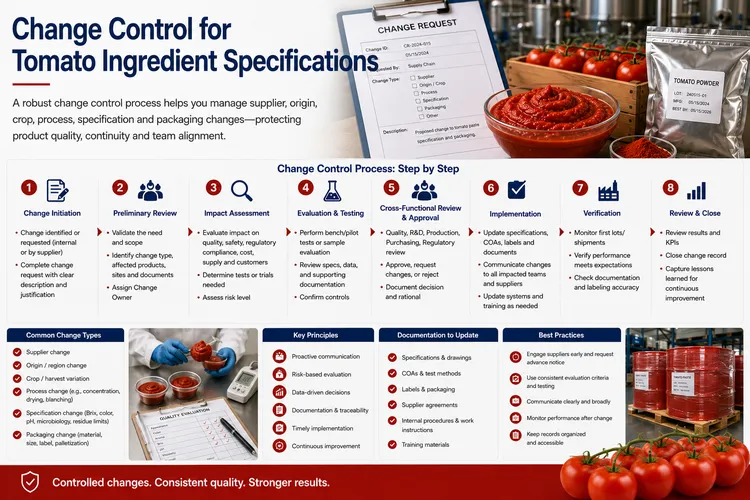
Why this matters
Tomato ingredients are agricultural and processed products, so some variation between crops, production campaigns and suppliers is expected. The purpose of change control is not to eliminate every difference, but to make significant changes visible early enough for quality, technical, purchasing and production teams to evaluate their effect before commercial use.
A robust control plan links measurable incoming criteria to finished-product risk and supplier change management. In a tomato-based formulation, an apparently small change in solids, finish, particle size or process history can alter yield, pumping behavior, sensory profile and the amount of water or thickener required.
Establish an approved baseline
Effective change control starts with a clearly documented approved state. The ingredient specification should identify the product definition and the technical attributes that matter to the application. The supplier, manufacturing location, pack configuration and other program details should also be recorded where they are relevant to approval.
Without a baseline, teams may know that something is different but not be able to determine exactly what changed or whether the change requires technical evaluation. Keep current approved specifications accessible to both purchasing and quality teams so new documents can be compared against the correct version.
Ingredient selection
Use product-specific specifications rather than copying a generic paste sheet onto diced, dry or clarified tomato ingredients. For this topic, a logical starting point is specification-controlled tomato ingredients with clearly defined product characteristics, supplier responsibilities and change-notification expectations.
Treat that as a formulation hypothesis rather than a fixed rule. The best ingredient remains the one that meets the finished-product target at an acceptable total cost and with reliable supply. Change control protects that approved performance when the supply program evolves.
Define what counts as a change
Not every update carries the same technical risk. Build a list of changes that require notification and identify which ones trigger documentation review, sample evaluation, pilot testing or formal reapproval.
- Supplier or manufacturing facility change
- Country, region or crop-origin change where relevant
- Product definition or ingredient composition change
- Brix, solids or concentration-range change
- Finish, particle-size or screen specification change
- Significant process or equipment change
- Thermal process or concentration-method change
- Packaging material, pack size or net-weight change
- Specification limit or analytical-method change
- Organic or other program-status change where applicable
Separate administrative and technical changes
Some supplier updates may be administrative and have little or no effect on the ingredient itself. Others can change the way the ingredient behaves in production even if the product name remains unchanged.
Classifying changes by potential impact helps avoid unnecessary plant trials while still giving high-impact changes the review they deserve. The classification method should be documented so that similar changes are handled consistently over time.
Use a risk-based review
Evaluate the likely effect of the change on the finished product and manufacturing process. A change to an invoice address is fundamentally different from a change in processing site, concentration, finish or packaging system.
Relevant questions include whether the change could affect solids, viscosity, color, flavor, microbiological quality, pumping behavior, yield, shelf life, labeling, customer requirements or legal status. The greater the potential impact, the more evidence should be required before approval.
Define notification expectations
Supplier agreements should state which changes require communication and, where practical, how far in advance notification is expected. Advance notice gives purchasing teams time to manage inventory while technical teams determine whether a revised specification, supporting documentation or sample is needed.
Change notifications should identify the current state, proposed state, reason for the change, expected implementation timing and affected products or manufacturing locations. Vague notifications create unnecessary investigation and can delay approval.
Review specifications line by line
When a revised specification is received, compare it with the currently approved version rather than reviewing it as a standalone document. Small edits can otherwise be missed, particularly when the layout or wording of the supplier specification has changed.
- Product name and definition
- Solids or Brix range
- pH and acidity parameters
- Viscosity or Bostwick requirements
- Color parameters
- Finish or particle-size requirements
- Microbiological requirements
- Packaging and net weight
- Storage and shelf-life guidance
- Analytical methods or test references
Use samples when documents are not enough
A specification review may determine that a proposed change is technically acceptable on paper but still needs a representative sample. This is particularly useful when sensory profile, viscosity behavior, color or physical appearance is important to the application.
Confirm that the evaluation sample represents the proposed commercial product and record its supplier lot or production reference. Otherwise, the sample may not be a reliable basis for approving the actual change.
Practical trial method
Define sampling, acceptance limits, retain samples, escalation rules and documentation ownership before the first commercial delivery of changed material. Where a trial is required, compare the proposed change against the currently approved ingredient under controlled conditions.
- Identify the exact proposed change and compare it with the currently approved specification and supply program.
- Define the finished-product attributes and process parameters that could be affected by the change.
- Collect current technical data, revised documentation and a representative sample where needed.
- Normalize tomato solids or concentration before comparing usage rates if the proposed ingredient differs in concentration.
- Run a controlled bench or pilot batch using the real addition order and process conditions.
- Measure relevant attributes such as Brix/solids, pH, viscosity or Bostwick, color, yield, piece integrity and sensory profile.
- Record any formula or process adjustments required to make the changed ingredient perform like the approved baseline.
- Repeat after the relevant thermal process and storage condition where the change could affect longer-term performance.
- Document the technical conclusion, approval status, implementation date and any restrictions attached to the approval.
Control the implementation date
Technical approval and commercial implementation should be coordinated. If old and new material may be present in inventory at the same time, define how receiving, warehouse and production teams will distinguish them.
The implementation record should identify the first affected supplier lot, shipment or production date where practical. This makes later investigation easier if finished-product performance changes around the transition.
Preserve traceability through the change
Change-control records should remain linked to supplier lots and receiving records. If a change is introduced gradually, traceability helps determine which ingredient version was used in a particular finished-product batch.
Keep the supplier's change notification, revised specification, trial results, approval decision and effective date together or linked within the quality system. This creates a clear history of why the change was accepted.
Manage crop transitions
Tomato ingredients can move from one crop season to another while remaining within the same formal specification. Even when crop transition is expected, buyers may choose to monitor relevant characteristics such as color, viscosity or sensory profile if those attributes are particularly important to the finished product.
Define whether crop transitions require routine notification, additional COA review, reference samples or other checks. The appropriate level of control depends on the product and the sensitivity of the application.
Packaging changes deserve technical review
Packaging changes can affect handling, warehouse efficiency, product recovery and line compatibility even when the tomato ingredient itself is unchanged. Confirm net weight, dimensions, pallet configuration, liner or bag construction and any changes to storage guidance before approving a new format.
Production and warehouse teams should be included in the review when a change affects unloading, opening, dispensing, lifting or disposal procedures.
Document approval responsibilities
Specify which functions must approve different types of change. Purchasing may own commercial coordination, while quality, regulatory, technical or operations teams may need to review changes affecting their areas.
The objective is to prevent changed material from entering routine use before the required review is complete. The approval record should make the responsible reviewers and final disposition visible.
Questions to ask the supplier
- What product definition, process and crop/origin apply to this lot?
- Which parameters are guaranteed versus typical?
- Which changes do you normally communicate to customers?
- How far in advance can significant changes usually be communicated?
- Will manufacturing-site changes be notified?
- Will changes in concentration, finish or process be notified?
- How are crop or origin changes communicated where relevant?
- What is the pack configuration, net weight and storage guidance?
- Will packaging-material or pack-format changes be notified?
- Which food-safety, quality and organic documents are available for this program?
- How are lots identified and traced?
- Can representative samples be provided before a significant change is implemented?
Maintain a change history
Retaining a concise history of approved changes makes supplier performance easier to understand over time. The record can show when specifications, manufacturing sites, packaging formats or other relevant program details changed and what validation was completed.
This history is particularly valuable when a later quality issue appears gradually rather than immediately. Teams can compare the timing of ingredient changes with finished-product observations instead of reconstructing the supply history from separate emails and documents.