
Why this matters
A new tomato ingredient should not be qualified from a specification sheet or a single tasting alone. The ingredient must work inside the actual formulation and manufacturing process, where differences in concentration, viscosity, finish, particle size, color or thermal history can become much more visible.
A robust trial plan links measurable incoming criteria to finished-product risk and supplier change management. In a tomato-based formulation, an apparently small change in solids, finish, particle size or process history can alter yield, pumping behavior, sensory profile and the amount of water, starch, gum or other adjustment required to reach the target product.
Define the objective before the trial
Start by stating exactly why the new ingredient is being evaluated. The objective may be supplier diversification, cost reduction, improved color, higher solids, better texture, a different pack format or additional supply security. A clear objective prevents the trial from becoming a general tasting exercise with no defined decision.
Identify the finished-product characteristics that must remain unchanged and those where some flexibility is acceptable. These become the basis for trial acceptance criteria and help technical, purchasing and operations teams evaluate the result using the same expectations.
Ingredient selection
Use product-specific specifications rather than assuming that all tomato concentrates, purees, diced products, powders or clarified ingredients behave the same way. For this topic, a logical starting point is the new tomato ingredient that most closely matches the current approved source in product definition and relevant technical characteristics.
Treat that as a formulation hypothesis rather than a fixed rule. The best answer is the ingredient that meets the finished-product target at an acceptable total cost and with reliable supply. A technically different product may still be suitable if the formula and process can be adjusted without creating unacceptable complexity or risk.
Establish a control batch
Whenever practical, run a control batch using the currently approved ingredient under the same trial conditions. This gives the team a current reference for normal process behavior rather than relying only on historical records or memory.
The control is particularly useful for viscosity, yield, color and sensory comparisons because these attributes can vary with processing conditions as well as ingredient characteristics. A candidate should therefore be compared with both the written target and the control batch.
Normalize tomato solids
Comparing two tomato ingredients at the same weight can be misleading when their solids concentrations differ. A higher-Brix ingredient introduces more tomato solids per kilogram and may appear stronger in color, flavor and body simply because the formulation contains more tomato material.
Normalize the trial to equivalent tomato solids where appropriate before judging ingredient performance. Once the candidate has been evaluated fairly, optimize the actual usage rate and water balance for the proposed commercial formula.
Keep the process controlled
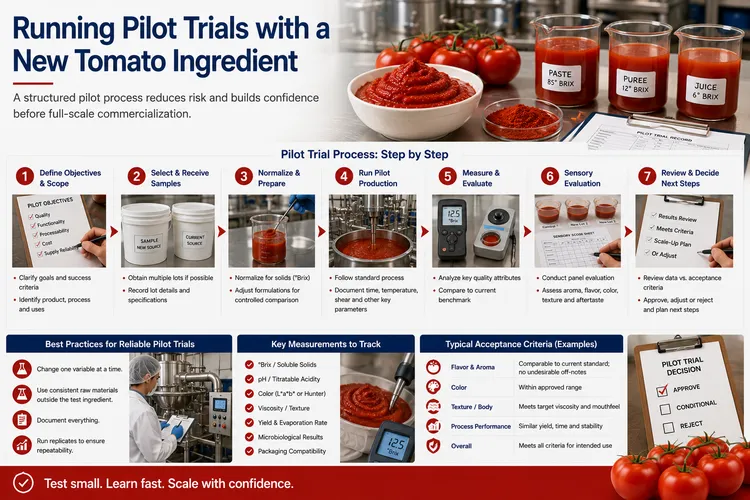
A pilot trial is easier to interpret when the ingredient is the main variable. Maintain the same addition sequence, mixing or shear conditions, heating profile, batch size and hold times wherever practical. If a process adjustment is required for the candidate ingredient, document it explicitly rather than allowing the adjustment to disappear into normal operator practice.
- Use the same batch scale for the control and candidate where practical.
- Record actual ingredient and water weights rather than nominal recipe values.
- Maintain a consistent addition order.
- Record mixing speed, shear conditions or equipment settings where relevant.
- Record heating temperatures and hold times.
- Record any unusual pumping, transfer or hydration behavior.
- Document every intentional formula or process adjustment.
Practical trial method
Define sampling, acceptance limits, retain samples, escalation rules and documentation ownership before the first commercial delivery. The trial should generate enough information to support a clear approve, reject or further-test decision.
- Define the finished-product target and identify attributes that cannot change, such as solids, viscosity, color, flavor, yield or processing behavior.
- Collect the current specification, certificate of analysis and representative sample from each candidate source.
- Record the supplier, ingredient lot, crop or production reference and pack format associated with each trial sample.
- Run a control batch using the current approved ingredient where practical.
- Normalize tomato solids or concentration before comparing ingredient usage rates.
- Run the candidate batch using the same addition order, batch scale and process conditions as the control wherever possible.
- Measure relevant attributes such as Brix/solids, pH, viscosity or Bostwick, color, yield, piece integrity and sensory profile.
- Record processing observations such as pumpability, mixing behavior, hydration, foaming, scorching tendency or unusual equipment response where relevant.
- Repeat the evaluation after the relevant thermal process and storage condition.
- Compare the candidate with the control, specification limits and agreed finished-product targets.
- Document the decision, any required formula adjustment and any additional production-scale validation before approval.
Measure more than the final product
Final sensory acceptance is important, but in-process measurements help explain why a candidate behaves differently. Record relevant data at defined points during the trial rather than measuring only the finished batch.
For example, an ingredient may reach the correct final viscosity but require a longer cook or a different water addition to get there. That difference may affect throughput, energy use or manufacturing simplicity even if the final product is acceptable.
Evaluate yield and usable solids
Ingredient price per kilogram is only one part of the comparison. A more concentrated product may require a lower usage rate, while a product with different viscosity behavior may require changes to water or other formulation components.
Record actual finished yield and calculate the candidate's effect on usable tomato solids and formula economics. This provides a more meaningful commercial comparison than comparing supplier prices without considering concentration and process performance.
Check sensory performance
Evaluate the candidate for tomato aroma, cooked character, sweetness, acidity balance, bitterness, color and any atypical flavor or aroma. Where possible, use a consistent sensory method and compare the candidate directly with the control.
Ingredient differences may become more or less noticeable after seasoning, thermal processing and storage. For applications where shelf life matters, do not rely only on sensory observations taken immediately after manufacture.
Repeat under relevant storage conditions
Some differences appear only after the product has been processed and stored. Re-evaluate the trial after the normal thermal treatment and at meaningful storage intervals where practical. Monitor the attributes that matter most to the finished product, such as viscosity, separation, color and flavor.
The appropriate storage program depends on the application, pack format and commercial shelf life. The objective is to confirm that the candidate remains acceptable throughout the stages that matter to the manufacturer's product.
Define approval criteria before reviewing results
Trial results are easier to interpret when acceptance criteria are agreed in advance. Define which measurements must fall within specification, which sensory differences are acceptable and which process adjustments are permitted.
- Target finished-product Brix or total solids
- Target pH or acidity range where relevant
- Viscosity or Bostwick acceptance range
- Color target or approved visual comparison
- Finished yield requirement
- Sensory acceptance criteria
- Maximum acceptable formula adjustment
- Maximum acceptable process-time or handling impact
Document every adjustment
A common pilot-trial mistake is allowing operators or developers to make small corrections without recording them. Added water, longer mixing, increased cook time, extra thickener or seasoning adjustments can make a candidate appear equivalent even though the process required significant intervention.
Record these changes because they may affect cost, throughput and repeatability. An ingredient that works after a minor planned adjustment may still be a strong candidate, but the adjustment should become part of the approved formulation or operating instruction.
Questions to ask the supplier
- What product definition, process and crop/origin apply to this lot?
- Which parameters are guaranteed versus typical?
- How does this product compare with our current ingredient in solids, viscosity and finish?
- Which analytical methods are used for key specification parameters?
- What is the pack configuration, net weight and storage guidance?
- Which food-safety, quality and organic documents are available for this program?
- How are lots identified and traced?
- How much normal lot-to-lot variation should we expect?
- Can representative commercial-production samples be supplied for validation?
- What changes require customer notification?
Move from pilot to commercial approval
A successful pilot does not automatically mean the ingredient should enter routine production without further controls. Confirm that the commercial specification, packaging, supplier documentation and lot-identification system match what was evaluated during development.
Depending on the application and scale difference, a production-scale validation may also be appropriate. Larger equipment can change heating, mixing, pumping and hold-time behavior, so the commercial trial should verify that conclusions from the pilot scale remain valid.
Keep an approval record
The final trial record should make it possible for another technical or purchasing team member to understand why the source was approved. Preserve the candidate lot, control results, formula version, process conditions, analytical measurements, sensory observations and final disposition.
Also document the approved supplier, product specification, manufacturing location where relevant, packaging format and change-control triggers. This creates a clear baseline if future lots or crop seasons perform differently.