
Why this matters
Instrumental specifications such as Brix, pH, viscosity and color are important, but they do not fully describe how a tomato ingredient will taste and smell in a finished food. Two lots can meet the same basic analytical limits while still differing in fresh tomato character, cooked intensity, sweetness, bitterness, acidity perception or overall flavor balance.
A robust control plan therefore links measurable incoming criteria to sensory performance, finished-product risk and supplier change management. In a tomato-based formulation, an apparently small change in solids, finish, particle size or process history can alter yield, pumping behavior, sensory profile and the amount of water or thickener required.
Define the sensory target first
Start with the finished product rather than creating a generic definition of "good tomato flavor." A pizza sauce, soup, ketchup, cooking sauce and beverage base may require very different tomato profiles even when they use ingredients with similar analytical specifications.
Decide which attributes should be prominent, which should remain in the background and which are unacceptable. This turns sensory language into a practical sourcing tool and helps suppliers understand what consistency means for the specific application.
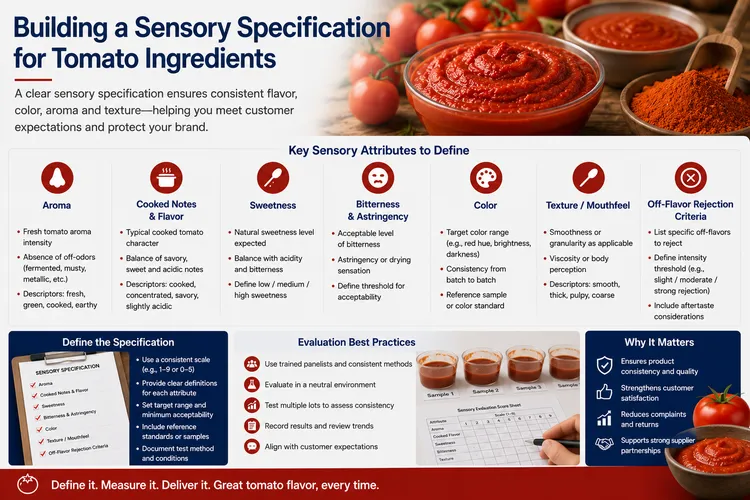
Core attributes to describe
The most useful sensory specification uses a limited number of terms that technical, purchasing and supplier teams can interpret consistently. Avoid creating a long vocabulary that cannot be applied reliably during routine receiving or approval.
- Tomato aroma: intensity and character of the expected tomato note.
- Cooked character: degree of processed, concentrated or heat-developed flavor.
- Sweetness: perceived sweetness relative to the intended finished-product profile.
- Acidity balance: whether acidity is clean, sharp, muted or out of balance.
- Bitterness: acceptable background bitterness versus objectionable intensity.
- Color: visual redness, brightness and consistency under controlled viewing conditions.
- Texture: smoothness, graininess, body or particulate perception where relevant.
- Aftertaste: character and persistence after swallowing or expectoration.
- Off-notes: any atypical aroma or flavor that makes the lot unsuitable for the application.
Ingredient selection
Use product-specific specifications rather than copying a generic paste sheet onto diced, dry or clarified tomato ingredients. For this topic, a logical first group to evaluate is tomato paste, puree and powder, because each can contribute tomato character differently depending on concentration, processing history and how it is used in the formula.
Treat that as a formulation hypothesis rather than a fixed rule: the best answer is the ingredient that meets the finished-product target at an acceptable total cost and with reliable supply. Sensory acceptance should be considered alongside solids, viscosity, color, yield, packaging and process performance.
Standardize sample preparation
Sensory comparisons become less useful when one sample is tasted warm, another cold, one is heavily diluted and another is tasted directly from the pack. Define the preparation method before comparing suppliers or lots so that differences in handling do not become mistaken for ingredient differences.
Depending on the ingredient and application, the protocol can specify sample weight, dilution or solids level, water source, mixing method, preparation time, serving temperature, serving vessel and the time between preparation and evaluation.
Compare at equivalent tomato solids
When candidate ingredients differ in concentration, tasting them at identical ingredient percentages can create a misleading comparison. A higher-Brix paste may appear stronger simply because more tomato solids are present in the sample.
Normalize samples to an equivalent tomato-solids basis where appropriate before comparing tomato intensity, cooked notes, bitterness, sweetness or overall flavor. After the preferred ingredient is identified, optimize its actual usage rate in the finished recipe.
Create reference samples
Written descriptors become more useful when they are supported by physical references. A retained approved lot, an agreed target sample or a finished-product benchmark can help evaluators understand what terms such as "moderate cooked note" or "clean tomato aroma" mean in practice.
Reference samples should be stored and handled in a way appropriate to the product, and their age should be considered when they are used for comparison. The goal is to improve consistency of judgment rather than to assume that a physical reference remains unchanged indefinitely.
Define acceptance and rejection criteria
A specification should make the decision process clear. Some sensory differences may be acceptable within normal lot-to-lot variation, while other characteristics may justify additional review or rejection. Define these categories before the first commercial delivery whenever possible.
- Which sensory attributes must remain within a defined target range?
- Which variations are acceptable but should be recorded?
- Which observations trigger a second evaluation or technical review?
- Which off-notes or defects result in rejection?
- Who has authority to make the final disposition decision?
Practical trial method
Define sampling, acceptance limits, retain samples, escalation rules and documentation ownership before the first commercial delivery. Use the same preparation and evaluation method for each candidate so the comparison reflects the ingredient rather than differences in handling.
- Define the finished-product target and identify the sensory attributes that cannot change.
- Collect current technical data and a representative sample from each candidate source.
- Record the supplier, ingredient lot, production information and specification associated with every sample.
- Normalize tomato solids or concentration before comparing usage rates where products differ materially in concentration.
- Prepare samples using a consistent dilution, mixing method, temperature and holding time.
- Run a controlled bench or pilot batch using the real addition order and process conditions expected in commercial production.
- Measure relevant attributes such as Brix/solids, pH, viscosity or Bostwick, color, yield, piece integrity and sensory profile.
- Record aroma, tomato character, cooked notes, sweetness, acidity perception, bitterness, texture, aftertaste and any atypical notes.
- Repeat after the relevant thermal process and storage condition where those stages may materially alter flavor or color.
- Document the approved supplier, sensory target, reference sample where used, specification and change-control triggers.
Use a simple scoring approach
Sensory records do not need to be unnecessarily complicated. A practical worksheet can use a short intensity scale or clearly defined categories such as below target, acceptable, target and above target. The important point is that the same terms and decision rules are used consistently.
Separate descriptive observations from preference whenever possible. For example, "strong cooked tomato note" describes the sample, while "too cooked for this sauce" expresses whether that characteristic fits the application. Keeping those concepts separate makes supplier discussions more precise.
Evaluate after processing
The ingredient that tastes best before processing is not always the ingredient that performs best in the finished product. Heating, evaporation, dilution, seasoning, fat, sugar, acid and storage can change the way tomato aroma, bitterness and sweetness are perceived.
For applications with meaningful thermal processing or shelf life, assess the sensory profile at the relevant stages rather than approving solely from an incoming raw-ingredient tasting.
Questions to ask the supplier
- What product definition, process and crop/origin apply to this lot?
- Which sensory characteristics does the supplier routinely evaluate?
- Which parameters are guaranteed versus typical?
- Are approved sensory references or internal standards used during lot release?
- How is unusual flavor or aroma investigated?
- What is the pack configuration, net weight and storage guidance?
- Which food-safety, quality and organic documents are available for this program?
- How are lots identified and traced?
- How is crop-to-crop or process-related sensory variation managed?
- What changes require customer notification?
Document supplier and lot changes
Sensory specifications are particularly useful during supplier changes, crop transitions and process changes. If a new source meets analytical requirements but produces a noticeably different sensory profile, the difference can affect seasoning requirements, usage rate or consumer perception.
Keep approved samples, trial results and sensory observations linked to the corresponding ingredient lots. This creates a useful record when later production teams need to understand whether a flavor shift originated in the tomato ingredient, the manufacturing process or another formulation variable.