
Why this matters
Tomato processing is crop-linked and highly seasonal, so supplier approval should address more than whether a processor can produce a sample that meets specification. Commercial resilience depends on raw-material planning, food-safety controls, specification discipline, manufacturing consistency, realistic capacity and dependable logistics throughout the crop cycle.
In a tomato-based formulation, an apparently small change in solids, finish, particle size or process history can alter yield, pumping behavior, sensory profile and the amount of water or thickener required. A structured supplier audit helps buyers and technical teams understand how these variables are controlled before a processor becomes a critical source.
Start with risk, not paperwork
An audit is most useful when it focuses on the risks that could materially affect the finished product or continuity of supply. Certificates and questionnaires are important, but they should support a broader understanding of how the processor actually receives tomatoes, controls production, releases finished product, manages deviations and communicates change.
Separate must-have technical requirements from negotiable preferences. This creates alternate-source flexibility without compromising critical finished-product attributes. For this topic, the logical unit of evaluation is the tomato processor and the specific product program, rather than the processor name alone.
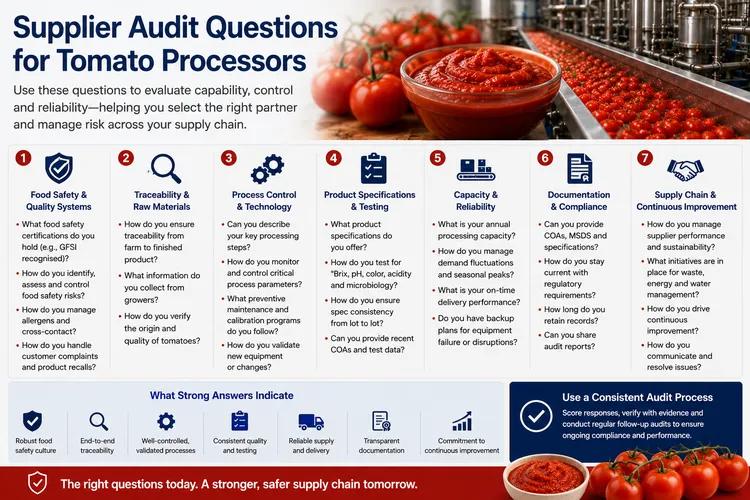
Food-safety and quality systems
Review which documented food-safety and quality systems apply to the facility and product being purchased. The objective is to understand how hazards are identified, controlled, verified and escalated during routine production as well as during unusual events.
- Which food-safety management system applies to the production site?
- What is the scope of current third-party certifications?
- How are incoming tomatoes and other applicable materials inspected or accepted?
- How are critical or preventive process controls monitored and documented?
- How are sanitation effectiveness and hygienic conditions verified?
- What environmental, microbiological or chemical testing is relevant to the product?
- How are deviations, holds, investigations and product dispositions documented?
- How are corrective and preventive actions followed through to closure?
Traceability and lot control
A processor should be able to explain what its lot code means and how records can be traced backward to relevant production information and forward into storage and shipment. The exact traceability structure varies by facility, but lot identities should remain clear enough to support an effective investigation.
- How is a production lot or batch defined?
- Which code appears on drums, bins, totes, cartons or other finished packs?
- Can certificates of analysis be matched directly to the supplied lot?
- How are rework, product transfers or mixed lots controlled where applicable?
- How are finished lots linked to production dates, lines or relevant process records?
- How are warehouse and shipment records connected to production lots?
- How frequently is the traceability system challenged or tested internally?
Process control and product consistency
Buyers should understand which parts of the process are actively controlled to maintain the agreed specification. Ask how the processor manages variation in raw tomato quality throughout the season and how process conditions are adjusted when necessary to maintain finished-product consistency.
Depending on the tomato ingredient, relevant areas can include concentration, evaporation, screening or finishing, thermal treatment, aseptic filling, particle-size management and final release testing. The audit should focus on the parameters that matter to the actual purchased product rather than using a generic checklist for every tomato ingredient.
Specification management
Clarify which characteristics are guaranteed specification limits and which are merely typical values. This distinction matters when comparing suppliers because a narrow typical range is not equivalent to a contractual acceptance limit.
- Which physical and chemical parameters are guaranteed?
- What analytical methods are used for Brix, pH, viscosity, color or other key tests?
- Which parameters are tested on every lot versus periodically?
- What happens when an analytical result is close to or outside a specification limit?
- How are certificates of analysis generated, reviewed and released?
- How are specification revisions approved and communicated?
Capacity and crop-season planning
Tomato supply is linked to agricultural conditions and a concentrated processing season. A strong commercial review therefore includes the processor's ability to support demand through normal crop variation, peak production periods and unexpected disruptions.
Ask about normal production capacity, expected utilization, storage strategy and how customer allocations are handled when crop or processing conditions are constrained. Capacity claims are more useful when discussed alongside the specific product, pack format and timing required by the buyer.
- What is the expected crop and processing campaign period?
- What capacity is available for the specific product and packaging format?
- What portion of that capacity is normally committed before the season starts?
- How much finished-product storage is available?
- How is demand planned against expected crop availability?
- What happens if yields, raw-material availability or production output fall below plan?
Packaging and storage
The package is part of the ingredient specification because it affects handling, product protection, usable yield and logistics. Confirm the exact pack construction, nominal and net weight, pallet configuration and storage conditions rather than assuming these details are standardized across processors.
- What pack sizes and net weights are standard for this product?
- What packaging materials directly contact the product?
- How are aseptic bags, closures or other critical packaging components controlled?
- What storage temperature and handling guidance applies?
- What shelf-life basis is used and how is it supported?
- How are damaged packs or warehouse handling incidents managed?
Business continuity
A technically strong processor can still represent supply risk if the program depends on a single line, single utility source, limited storage or an inflexible logistics route. Ask how the facility responds to major production interruptions and which contingency measures are realistic for the product being purchased.
Continuity planning can include spare processing capacity, preventive maintenance, critical-parts availability, backup utilities, alternate warehouses, logistics options and production recovery procedures. The objective is to understand whether a disruption would be measured in hours, days or an entire crop season.
Change control
Supplier approval should establish which changes require customer notification. Relevant changes may include processing location, significant equipment changes, product definition, concentration range, finishing conditions, packaging, specification limits or other factors that could affect finished-product performance.
The buyer should also understand who owns change communication, how much advance notice is normally provided and whether a revised sample, specification or plant trial may be required before the changed product enters routine supply.
Practical trial method
Compare offers on landed usable solids, approved quality, packaging efficiency, lead time, documentation and continuity—not unit price alone. Commercial approval should follow technical validation rather than relying only on specification sheets.
- Define the finished-product target and identify attributes that cannot change, including critical solids, texture, color, flavor and processing performance.
- Collect current specifications, technical documentation and a representative sample from each candidate processor.
- Confirm the supplier lot and COA relationship so the material evaluated can be connected to the corresponding production records.
- Normalize tomato solids or concentration before comparing usage rates and ingredient economics.
- Run a controlled bench or pilot batch using the actual addition order and processing conditions expected in commercial production.
- Measure relevant attributes such as Brix/solids, pH, viscosity or Bostwick, color, yield, piece integrity and sensory profile.
- Repeat the evaluation after the relevant thermal process and storage condition where these can change the finished product.
- Compare technical performance together with documentation, packaging, lead time, supply resilience and landed usable cost.
- Document the approved processor, product specification, pack format and change-control triggers.
Core questions to ask the supplier
- What product definition, process and crop/origin apply to this program?
- Which manufacturing facility will produce the contracted product?
- Which parameters are guaranteed versus typical?
- How are analytical methods standardized and verified?
- What is the pack configuration, net weight and storage guidance?
- Which food-safety and quality documents are available for this program?
- Which organic or other program-specific documents are available where applicable?
- How are production lots identified and traced?
- How are nonconforming lots controlled and released or rejected?
- What production capacity is realistically available for this program?
- How is crop-season demand allocated if supply becomes constrained?
- What contingency plans apply to major processing or utility interruptions?
- What changes require customer notification?
- Who handles urgent quality, technical and supply-continuity issues?
What to record after the audit
Audit notes should end with clear actions rather than a collection of observations. Record any documentation still required, technical gaps, agreed corrective actions, responsible parties and target completion dates. Where approval is conditional, identify exactly what must be closed before routine commercial supply begins.
The final supplier record should also identify the approved product specification, manufacturing site, packaging format and any restrictions or conditions attached to the approval. This makes future sourcing decisions easier when personnel, crop conditions or market availability change.