
Why this matters
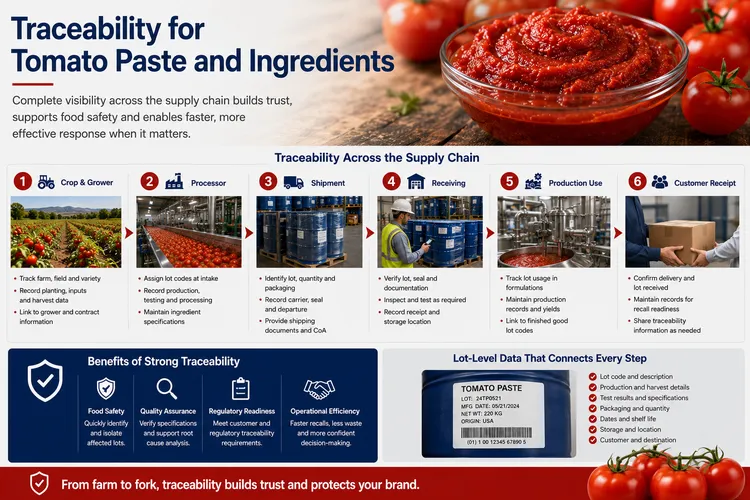
Traceability is more than keeping a supplier lot number on a certificate. A useful system connects the physical tomato ingredient received at the plant with its technical documentation, warehouse movement, production use and subsequent finished-product lots. When records are connected consistently, quality teams can investigate questions faster and purchasing teams can evaluate supplier performance with better context.
A robust control plan also links measurable incoming criteria to finished-product risk and supplier change management. In a tomato-based formulation, an apparently small change in solids, finish, particle size or process history can alter yield, pumping behavior, sensory profile and the amount of water or thickener required. Traceability makes it possible to determine which incoming lot was used when those differences are observed.
What a useful traceability chain looks like
The exact record structure depends on the supply program, but the objective is to maintain an unbroken reference from the incoming ingredient to its commercial and production records. Each handoff should preserve a unique lot or batch identifier rather than relying only on product name, shipment date or supplier name.
- Processor or supplier identification and manufacturing lot code
- Product specification and certificate of analysis associated with the lot
- Purchase order, container, seal, bill of lading or shipment reference where applicable
- Receiving date, quantity, condition and internal receiving record
- Warehouse location and any internal lot or inventory identifier
- Production batch or finished-product lots in which the ingredient was used
- Finished-product shipment and customer delivery references where required
Ingredient selection
Use product-specific specifications rather than copying a generic paste sheet onto diced, dry or clarified tomato ingredients. For this topic, a logical first ingredient to evaluate is traceable tomato ingredients supported by clear lot coding, relevant technical documents and a defined supplier communication process.
Treat that as a formulation hypothesis rather than a fixed rule: the best answer is the ingredient that meets the finished-product target at an acceptable total cost and with reliable supply. Traceability should complement—not replace—evaluation of solids, viscosity, color, flavor, microbiological requirements, packaging, processing behavior and overall commercial suitability.
Define the lot before the first shipment
One of the most useful questions during supplier qualification is simple: what exactly does the lot code identify? Ask how the supplier defines a production lot or batch and which records can be retrieved from that identifier. Where multiple production dates, lines or processing campaigns may be combined in a shipment, determine how those relationships are documented.
The customer's internal receiving and manufacturing systems should preserve the original supplier lot even when an additional internal inventory code is assigned. Keeping both identifiers together reduces ambiguity during later review.
Practical trial method
Define sampling, acceptance limits, retain samples, escalation rules and documentation ownership before the first commercial delivery. The trial should test both ingredient performance and whether the records required to identify that ingredient can be captured consistently in normal plant operations.
- Define the finished-product target and the attributes that cannot change, including relevant solids, texture, color, flavor, yield and processing requirements.
- Collect current technical data, lot-identification information and a representative sample from each candidate source.
- Review how the supplier's lot number appears on the pack, COA, shipping documents and other records that will be used at receiving.
- Normalize tomato solids or concentration before comparing usage rates between products with different Brix or solids levels.
- Run a controlled bench or pilot batch using the real addition order, mixing sequence and process conditions expected in commercial production.
- Measure relevant attributes such as Brix/solids, pH, viscosity or Bostwick, color, yield, piece integrity and sensory profile.
- Repeat the evaluation after the relevant thermal process and storage condition where those steps can materially affect the finished product.
- Confirm that trial documentation connects the ingredient lot to the corresponding test or production batch without relying on memory or informal notes.
- Document the approved supplier, specification, lot-record requirements and change-control triggers before routine purchasing begins.
Receiving and warehouse controls
Traceability can be weakened at receiving even when supplier documentation is complete. The lot shown on the physical pack should be reconciled with the lot on the accompanying documentation. If an internal barcode, pallet label or ERP lot is created, the relationship between the internal identifier and supplier identifier should remain available.
For drums, totes, aseptic bins or other multi-unit shipments, define how mixed lots are handled and whether individual pallets or containers require separate identification. Warehouse procedures should also prevent unidentified material from being issued to production before required records are completed.
Retain samples and investigation readiness
A documented retain-sample program can provide a useful physical reference if a later question arises about color, texture, flavor or another quality characteristic. Define which lots are retained, how much material is kept, storage conditions, labeling requirements and the retention period appropriate to the manufacturer's quality program.
Traceability records are most valuable when they can be retrieved quickly. Periodic internal trace exercises can test whether teams can move backward from a finished product to the relevant ingredient lots and forward from an ingredient lot to the production batches or shipments associated with it.
Supplier change control
Traceability should also support change management. Agree in advance which changes require notification or re-evaluation. Depending on the ingredient and application, relevant changes may include processing location, product definition, concentration range, finish, packaging configuration, key specification limits or other attributes that could affect the customer's process or finished product.
The purpose is not to prevent all change, but to make significant change visible early enough for technical and commercial teams to assess its impact before routine production is affected.
Questions to ask the supplier
- What product definition, process and crop/origin apply to this lot?
- How is a production lot or batch defined in your system?
- Which lot identifier will appear on the physical pack and commercial documents?
- Which parameters are guaranteed versus typical?
- Can the COA and specification be linked directly to the supplied lot?
- What is the pack configuration, net weight and storage guidance?
- Which food-safety, quality and organic documents are available for this program?
- How are lots identified and traced through processing, storage and shipment?
- How are mixed-lot shipments identified and communicated?
- What records are available if a traceability investigation is required?
- What changes require customer notification?
- Who should be contacted for urgent quality or traceability questions?
Information to include in a sourcing brief
A clear sourcing brief helps suppliers understand both the technical requirement and the traceability expectations attached to the program. Along with product type and target specification, consider providing the intended application, annual demand, pack format, receiving location, required documentation and any lot-coding or change-notification expectations that are important to your operation.