
Why this matters
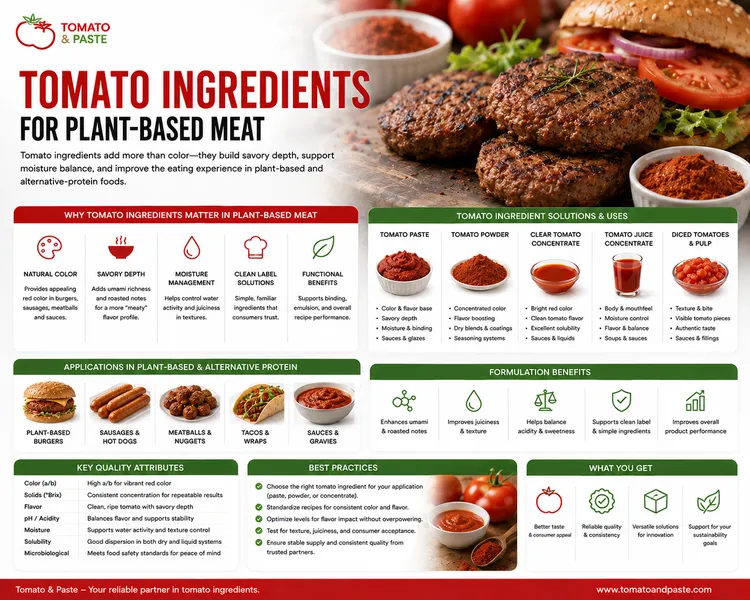
Plant-based meat and alternative-protein products often rely on carefully balanced proteins, fats, starches, fibers, flavors and water. Tomato ingredients can contribute color, acid balance, savory depth, sauce adhesion and moisture management around these systems.
In a tomato-based formulation, an apparently small change in solids, finish, particle size or process history can alter yield, pumping behavior, sensory profile and the amount of water or thickener required. In protein-rich systems, those effects can also influence binding, perceived juiciness and the balance between tomato flavor and the underlying protein base.
The best tomato ingredient is therefore not simply the strongest or most concentrated option. It is the one that performs the intended technical and sensory role without creating unwanted acidity, excess moisture, masking of seasonings or processing difficulty.
Define the role of tomato first
Before selecting a tomato ingredient, identify what it needs to contribute. In some plant-based foods, tomato is primarily a color and savory component. In others, it forms part of a sauce, glaze, filling, marinade or moisture system.
Clarifying the role makes ingredient selection easier because paste, powder and clear concentrate provide different combinations of water, solids, color, pulp and flavor intensity.
Ingredient selection
Match the tomato format to the process: paste for concentrated tomato solids and body, powder where low added water and dry blending are useful, puree for sauce systems, and clear concentrate where savory tomato intensity is wanted with less visible pulp.
For this topic, a logical first ingredient set to evaluate is tomato paste, powder or clear concentrate. Treat that as a formulation hypothesis rather than a fixed rule.
The best answer is the ingredient that meets the finished-product target for flavor, color, moisture, texture and processing at an acceptable total cost and with reliable supply.
Tomato paste for concentrated body
Tomato paste can contribute concentrated tomato solids, red color, acidity and savory character while also adding some body to sauces and formed products.
Because paste contributes both solids and moisture, its usage should be considered within the total water balance. A change in paste concentration may require adjustment of added water or other liquid components to preserve the same formulation solids.
Tomato powder for low-water systems
Tomato powder can be useful where the formulation needs tomato flavor or color without adding the same amount of water associated with liquid ingredients. It can also fit dry seasoning systems, coatings, premixes and some formed products.
Powder still needs to be evaluated for dispersion, hydration and flavor development in the actual process. The stage at which it is added can affect how evenly it incorporates into proteins, fats and other dry ingredients.
Clear tomato concentrate for savory depth
Clear or low-pulp tomato concentrates can be useful where formulators want tomato-derived savory intensity and acidity without adding the visible pulp or body associated with paste or puree.
This can be helpful in products where the final texture is controlled primarily by the protein, fat and binder system rather than by tomato solids.
Color development
Tomato ingredients can influence the red or reddish-brown appearance of plant-based meat systems. The desired color depends on the product concept and whether the tomato is part of the base matrix, an exterior seasoning or a sauce.
Color should be evaluated after the full thermal process because heat, fats, proteins, browning ingredients and seasonings can alter the appearance significantly compared with the uncooked mix.
Savory depth and flavor balance
Tomato can reinforce savory and cooked flavor profiles while contributing natural acidity and sweetness. In alternative-protein formulations, it may help integrate spices, smoke notes, yeast-based flavors and other savory components.
Evaluate the complete flavor system rather than the tomato ingredient in isolation. Too much tomato can shift the product toward an obvious sauce profile, while too little may provide no meaningful sensory benefit.
Acidity and protein systems
Tomato ingredients contribute acidity, which may influence the sensory balance and processing behavior of a protein-rich formulation. The actual effect depends on the type of protein, buffering capacity, other acids and the complete recipe.
Measure pH where relevant to the product-development program and evaluate texture after the intended cook. Avoid assuming that the same tomato usage rate will behave identically across soy, pea, wheat, pulse or mixed-protein systems.
Moisture management
Water balance is critical in many plant-based meat products. Paste and liquid concentrates bring moisture into the formulation, while powder contributes solids with much less water.
When changing tomato format or concentration, recalculate both tomato solids and total formula water. A substitution that preserves flavor but changes moisture can affect binding, cooking yield, juiciness and firmness.
Interactions with starches and fibers
Starches, gums and fibers can absorb water and develop viscosity during mixing and cooking. Tomato solids and acidity may influence how the overall system feels, even when the tomato ingredient itself is not intended as the primary binder.
Evaluate candidate tomato ingredients with the real binder system and addition order. A bench test in water alone may not predict performance in the final protein matrix.
Interactions with fats
Fats influence richness, lubrication and flavor release in plant-based foods. Tomato acidity and savory notes can balance fatty perception, while color may disperse differently depending on the fat phase and mixing process.
Compare samples after the complete emulsification, forming and cooking process where those steps are part of the application.
Sauce and coating applications
Tomato ingredients are also widely useful outside the core plant-based protein matrix. They can form the base of barbecue-style sauces, meatless pasta sauces, glazes, fillings and prepared-meal components served with alternative proteins.
In these systems, assess sauce adhesion, viscosity, color, flavor intensity and stability after heating, cooling and reheating.
Thermal processing
Cooking can change tomato color, acidity perception, aroma and texture. It can also change the behavior of proteins, starches and fats surrounding the tomato ingredient.
Compare supplier candidates after the full thermal process rather than approving them only in the uncooked mix. Where the product is frozen, chilled or reheated, include that additional sequence in the trial.
Normalize tomato solids before comparing suppliers
Supplier samples should not automatically be compared at equal ingredient weight when concentration differs. Normalize paste or concentrate candidates to equivalent tomato solids before judging flavor, color, moisture balance and cost.
Powder should also be compared on a functionally equivalent basis rather than simply replacing a liquid tomato ingredient gram for gram.
Practical trial method
Assess interactions with salt, proteins, starches, fibers and fats. Thermal processing can change perceived acidity, color and texture, so compare candidates after the complete cook and any relevant storage or reheat sequence.
- Define the finished-product target and identify the specific role expected from the tomato ingredient.
- Collect current technical data, specifications and representative samples from each candidate source.
- Record tomato solids, Brix or concentration and normalize liquid candidates before comparing usage rates.
- Recalculate total formulation water when changing between paste, concentrate and powder formats.
- Run a controlled bench or pilot batch using the actual proteins, fats, starches, fibers, seasonings and addition order.
- Record mixing, hydration, forming, pumping or filling behavior as applicable.
- Measure relevant attributes such as pH, Brix/solids where applicable, color, moisture balance, yield and texture.
- Evaluate savory impact, tomato character, acidity, juiciness, firmness and overall sensory balance.
- Repeat the evaluation after the intended thermal process.
- Where relevant, repeat after chilling, freezing, storage or reheating.
- Document the approved supplier, ingredient format, specification and change-control triggers.
What to compare between candidate ingredients
- Tomato solids / concentration
- Water contribution
- Color impact
- Savory flavor intensity
- Perceived acidity
- Protein-system compatibility
- Mixing / dispersion behavior
- Binding and firmness
- Juiciness / moisture retention
- Cooking yield
- Post-cook texture
- Reheat or storage performance
- Finished-product cost
Questions to ask the supplier
- What product definition, process and crop/origin apply to this lot?
- What Brix, solids or moisture range applies to the ingredient?
- Which color, pH/acidity and sensory parameters are guaranteed versus typical?
- For powder, what particle size, moisture and storage guidance apply?
- For paste or concentrate, what consistency or finish characteristics apply?
- Does the product contain salt or other added ingredients?
- What is the pack configuration, net weight and storage guidance?
- What shelf life applies under the recommended storage conditions?
- Which food-safety, quality and organic documents are available for the program?
- How are lots identified and traced?
- What changes in crop origin, process, concentration, ingredient composition or packaging require customer notification?
Commercial evaluation
Tomato formats should be compared on total formulation economics rather than price per kilogram alone. Paste, powder and clear concentrate can contribute different amounts of tomato solids, water, color and functional value.
Include delivered cost, usage rate, water adjustment, yield, processing efficiency, pack format, storage requirements and supply reliability when evaluating approved options.