
Why this matters
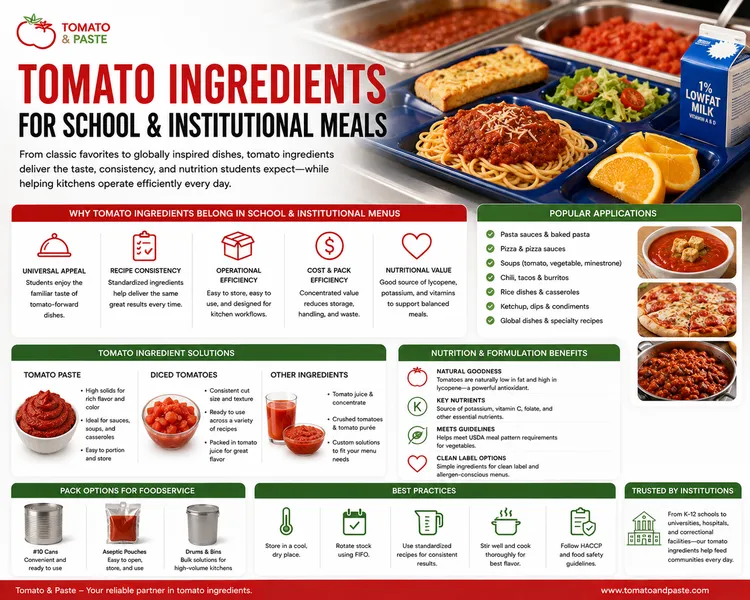
School, healthcare, workplace and other institutional kitchens depend on standardized recipes that can be reproduced across large batches, multiple locations and different production teams. Tomato ingredients often provide color, acidity, savory depth, sauce body and moisture in familiar menu items such as pasta sauces, soups, stews, chili and casseroles.
Tomato ingredients can also contribute sauce adhesion and moisture management around protein systems. In a tomato-based formulation, an apparently small change in solids, finish, particle size or process history can alter yield, pumping behavior, sensory profile and the amount of water or thickener required.
For institutional buyers, consistency has a direct operational value. A predictable ingredient helps standardized recipes produce similar portion yield, texture and appearance from one delivery to the next.
Ingredient selection
Match the tomato format to the menu and process. Paste provides concentrated tomato solids and flavor, puree can simplify sauce production, and diced tomatoes provide visible tomato pieces where piece identity is part of the finished dish.
For this topic, a logical first ingredient combination to evaluate is tomato paste and diced tomatoes. Paste can provide body and concentrated tomato character, while diced tomatoes can add recognizable pieces and visual appeal.
Treat that as a formulation hypothesis rather than a fixed rule. The best answer is the ingredient or combination that meets the standardized recipe target at an acceptable total cost and with reliable supply.
Recipe standardization
Institutional recipes should be written around measurable ingredient quantities, expected yield and defined process conditions. If tomato paste concentration changes, a direct weight-for-weight substitution may alter both tomato solids and water balance.
Record the Brix or concentration used in the standardized recipe and normalize replacement ingredients to equivalent tomato solids whenever practical. This helps preserve sauce strength, yield and flavor when suppliers or paste concentrations change.
Batch consistency
High-volume kitchens may prepare the same recipe repeatedly during the week or across multiple sites. Variability in tomato solids, viscosity or diced-piece characteristics can create noticeable differences in portioning and final presentation.
Define the tomato attributes that materially affect the menu item and include those in purchasing specifications and supplier approval rather than relying only on a generic product description.
Pack efficiency
Pack format should fit batch size, storage capacity and kitchen handling practices. Large packs may reduce packaging and opening labor, while smaller packs may improve flexibility where production volumes vary.
Compare usable product per pack, net weight, storage requirements, opening and dispensing effort, partial-pack handling and the amount of ingredient needed per standardized batch.
Yield and portion control
Finished yield is especially important when meals are produced to a planned number of portions. Changes in tomato concentration or sauce viscosity can change the amount of finished food available for service.
During trials, record total batch yield and actual portion yield rather than evaluating flavor alone. This creates a better basis for both nutrition and cost calculations.
Texture and sauce body
Tomato paste, puree and diced products contribute different forms of texture. The correct balance depends on whether the meal requires a smooth coating sauce, a spoonable stew or a dish with clearly visible tomato pieces.
Assess tomato ingredients with the actual starches, proteins, vegetables and fats used in the standardized recipe. These ingredients interact during cooking and can change apparent viscosity and sauce adhesion.
Diced tomato piece integrity
Where diced tomatoes are used, piece size and integrity may matter to finished appearance. Excessive breakdown during cooking can make a dish appear more like puree, while pieces that remain too firm may not match the intended eating experience.
Evaluate diced tomatoes after the complete cook, hold and reheat sequence rather than judging the incoming package alone.
Salt and nutritional formulation
Institutional formulations may need close control of sodium and other nutritional targets. Confirm whether incoming tomato products contain added salt and account for that contribution before setting additional seasoning levels.
Supplier substitutions should be reviewed against the standardized nutritional formulation because a change in incoming salt, concentration or pack size can affect both recipe calculations and label or menu documentation.
Acidity and flavor balance
Tomato naturally contributes acidity, which can support brightness and savory balance. In institutional meals, perceived acidity is influenced by salt, starches, proteins, fats and the length of cooking or hot holding.
Evaluate the finished dish at service temperature. A sauce that tastes balanced immediately after cooking may taste different after an extended hold or reheating cycle.
Color and menu appearance
Consistent tomato color supports familiar appearance across batches and service locations. Long cooking or reheating can darken sauces, while dilution and other ingredients may reduce perceived redness.
Compare candidate tomato products after the real cook and holding sequence, using the complete recipe rather than evaluating color only in the incoming ingredient.
Holding and reheating performance
Many institutional meals are produced before service, held hot, chilled for later use or reheated. These steps can change viscosity, water distribution, tomato-piece integrity and perceived seasoning.
Trials should reproduce the expected service pathway as closely as practical. Record whether the sauce thickens, thins, separates or loses visible tomato identity after holding and reheating.
Protein and starch interactions
Tomato sauces are frequently combined with meat, poultry, legumes, pasta, rice, grains or alternative proteins. These ingredients can absorb moisture or contribute starch and fat, changing the apparent body of the sauce during holding.
Evaluate the tomato ingredient inside the complete menu item rather than assuming that performance in a simple tomato sauce will transfer unchanged to every institutional recipe.
Practical trial method
Assess interactions with salt, proteins, starches and fats. Thermal processing can change perceived acidity, viscosity and color, so compare candidates after the full cook, hold and reheat sequence.
- Define the standardized recipe, target number of portions and finished-product attributes that cannot change.
- Collect current technical data, specifications and representative samples from each candidate source.
- Record Brix or concentration and normalize tomato solids before comparing paste usage rates.
- Confirm salt status, pack size and any relevant diced-piece specification.
- Run a controlled bench, pilot or kitchen batch using the real recipe and addition order.
- Measure relevant attributes such as Brix/solids, pH, viscosity or Bostwick, color, total yield and piece integrity.
- Evaluate flavor, sauce adhesion, texture and portioning at the intended service temperature.
- Hold the product under the normal service condition and repeat the evaluation.
- Where applicable, cool and reheat the meal using the intended operational sequence.
- Record finished batch yield, number of portions and any change in sauce body or piece integrity.
- Document the approved supplier, specification, standardized recipe and change-control triggers.
What to compare between supplier samples
- Brix / tomato solids
- Salt contribution
- pH / acidity
- Color
- Consistency / viscosity
- Diced piece size where applicable
- Piece integrity after cooking
- Sauce adhesion
- Hot-hold performance
- Reheat performance
- Finished batch yield
- Portion yield
- Flavor at service temperature
Questions to ask the supplier
- What product definition, process and crop/origin apply to this lot?
- What Brix or solids range is guaranteed?
- Does the product contain added salt, and what specification applies?
- What consistency, color, pH/acidity and finish requirements apply?
- For diced products, what piece size and piece-integrity specifications apply?
- Which parameters are guaranteed versus typical?
- What is the pack configuration and net weight?
- What storage guidance and shelf life apply?
- Which food-safety, quality and organic documents are available for the program?
- How are lots identified and traced?
- What changes in crop origin, process, concentration, piece size or packaging require customer notification?
Commercial evaluation
Compare tomato ingredients on the basis of usable recipe yield and institutional operating cost rather than unit price alone. Concentration, pack size and piece integrity can all affect how many finished portions are produced from each case or container.
Include delivered cost, equivalent tomato solids, actual usage rate, packaging efficiency, labor, waste, batch yield, portion yield and supply reliability when comparing approved options.