
Why this matters
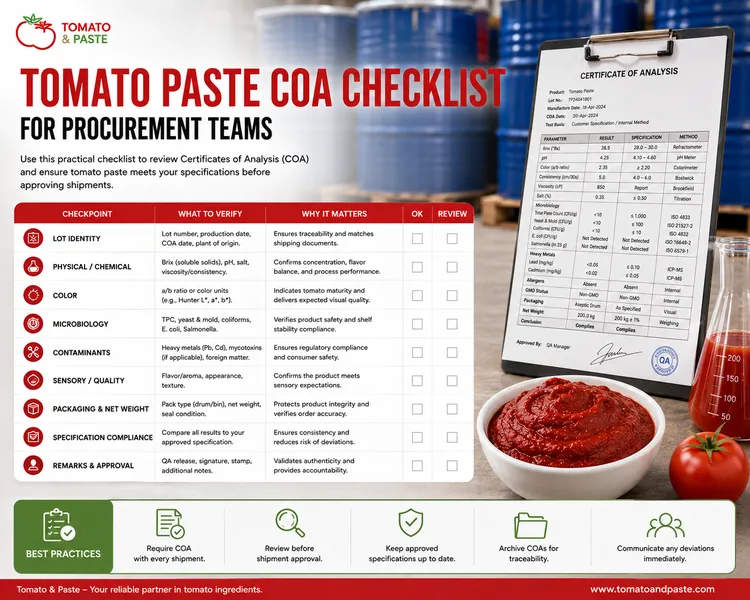
A certificate of analysis is one of the key links between the approved tomato paste specification and the physical lot received by the customer. Procurement, quality and technical teams should be able to use it to confirm that the shipment identity and reported analytical values align with the agreed purchasing requirements.
The specification is the commercial translation of finished-product performance. A COA should therefore be reviewed against the approved specification rather than as a stand-alone document. A value that appears acceptable in isolation may still fall outside the customer's agreed range.
In a tomato-based formulation, an apparently small change in solids, consistency, color, finish or process history can alter yield, pumping behavior, sensory profile and the amount of water or thickener required. Consistent COA review helps identify variation before the material reaches routine production.
Start with document identity
Before reviewing analytical values, confirm that the certificate belongs to the material being received. The supplier name, product description, lot or batch number and other shipment identifiers should correspond with the purchase order, packing list and physical package markings.
If identifiers do not match, resolve the discrepancy before relying on the analytical data. A technically acceptable COA is not useful if it cannot be linked confidently to the delivered lot.
Product description and specification reference
Confirm that the product description matches the approved tomato paste grade. Where the purchasing program distinguishes concentration, process type, organic status, finish, color class or another technical category, those distinctions should be reflected consistently across the specification, purchase order and supplier documentation.
Where possible, the COA or accompanying quality documentation should also make clear which specification or product standard applies to the lot.
Brix or soluble solids
Brix or another agreed solids measure is one of the first values buyers should review because concentration affects usage rate, yield and commercial comparison.
Confirm that the reported value falls within the approved range and that the measurement basis is consistent with the purchasing specification. If candidate suppliers use different concentration ranges, compare them on equivalent tomato solids rather than kilogram-for-kilogram usage.
pH and acidity
pH and acidity can influence sensory balance and application behavior. The purchasing specification should define which parameter is controlled and, where relevant, the associated analytical method or reporting convention.
Procurement teams should not assume that pH and titratable acidity are interchangeable. Review whichever parameter or combination of parameters is actually defined in the approved specification.
Color
Color can be a critical purchasing attribute where finished-product redness or visual consistency matters. Review the reported color value or ratio against the approved limit and confirm that supplier testing follows the agreed method.
Instrumental color is useful for lot control, but it should remain connected to application performance. For sensitive products, an approved reference or finished-product color check may supplement routine COA review.
Consistency and viscosity
Consistency can affect pumping, dilution, sauce body and downstream formulation requirements. Confirm that the supplier reports the agreed consistency or viscosity parameter using the expected method and conditions.
A COA value within specification does not necessarily guarantee identical application behavior from every lot, but it provides an important control point for identifying unusual variation.
Finish and particle-related information
Finish or screen-related characteristics may influence smoothness, insoluble solids and mouthfeel. Not every purchasing program requires a finish value on each COA, but where finish is a critical attribute it should be controlled through the product specification and supplier change-management process.
Procurement should know whether finish is guaranteed, reported as typical information or controlled only through the product definition.
Microbiological review
Microbiological requirements should be reviewed according to the approved product specification and food-safety program. The exact parameters reported may vary by product, process, supplier and customer requirements.
Procurement teams should confirm which microbiological results are required for release and which are managed through broader supplier verification or process-control documentation.
Ingredient selection
Start with solids/Brix and process type, then add consistency, color, pH/acidity, finish, microbiology, package and lot documentation. For programs built around repeatable incoming controls, a logical first ingredient to evaluate is specification-controlled tomato paste.
The goal is not simply to choose the paste with the longest specification. Focus on parameters that connect directly to finished-product performance, regulatory requirements, manufacturing control and commercial risk.
Treat the recommended starting point as a technical framework rather than a fixed rule. The best answer is the ingredient that meets the finished-product target at an acceptable total cost and with reliable supply.
Guaranteed versus typical values
One of the most important distinctions in supplier documentation is whether a value is guaranteed or merely typical. A typical value can help describe expected product behavior but may not constitute a contractual acceptance limit.
Procurement and quality teams should clearly identify which parameters determine lot acceptance and which are provided only for information. This avoids rejecting acceptable material based on non-guaranteed descriptive data or accepting material that misses a true contractual requirement.
Lot identity and traceability
The COA should support traceability from the delivered package back to the supplier lot. Lot numbers on drums, bins or other packages should be reconcilable with the COA and shipment documentation.
Where one shipment contains multiple production lots, the receiving and quality teams should be able to determine which packages belong to each lot and which analytical results apply.
Package and shipment information
The COA is primarily a quality document, but procurement should also reconcile it with commercial and logistics information. Product description, lot, pack type and shipment identity should be consistent across the relevant documents.
If organic, conventional or another program designation is commercially important, confirm that the required supporting documentation is available and correctly linked to the shipment.
Review out-of-specification or unusual results
A value outside the approved range should be escalated before routine use. Do not resolve a specification deviation by silently changing the formulation or accepting the lot without the appropriate technical and quality review.
Results that remain technically within range but are unusually close to a limit or substantially different from normal historical values may also justify review when the parameter strongly influences finished-product performance.
Normalize before comparing suppliers
When reviewing multiple supplier offers, concentration should be normalized before comparing usage rate, yield and commercial value. A higher-solids paste may require less ingredient mass to provide the same tomato-solids contribution.
After solids are normalized, compare consistency, color, flavor, finish and application performance under controlled conditions.
Practical COA review method
- Confirm supplier name, product description and purchase-order alignment.
- Match the COA lot number to the shipment and package markings.
- Confirm the correct approved specification or product grade applies.
- Review Brix or solids against the guaranteed range.
- Review pH and/or acidity against the approved requirement.
- Check color results and confirm the relevant measurement method.
- Check consistency or viscosity results against the specification.
- Review required microbiological results and food-safety documentation.
- Confirm any finish, process-type or program-specific requirements.
- Identify values that are guaranteed versus typical.
- Escalate discrepancies before lot release.
- Retain the COA with receiving, traceability and supplier records according to the company's document-control procedure.
When an application trial is still needed
A compliant COA confirms that selected analytical parameters meet specification, but it does not replace application validation when a supplier, crop, origin, process or specification changes materially.
Run the candidate ingredient in the actual formula at equal tomato solids whenever possible and record batch conditions so sensory, color, viscosity and yield comparisons are meaningful.
- Define the finished-product target and the attributes that cannot change.
- Collect the current specification, COA and a representative sample from each candidate source.
- Normalize tomato solids or concentration before comparing usage rates.
- Run a controlled bench or pilot batch using the real addition order and process conditions.
- Measure relevant attributes such as Brix/solids, pH, viscosity or Bostwick, color, yield and sensory profile.
- Repeat the evaluation after the relevant thermal process and storage condition.
- Document the approved supplier, specification and change-control triggers.
Procurement COA checklist
- Supplier identity
- Product description
- Lot / batch number
- Specification reference
- Brix / solids
- pH / acidity
- Color result
- Consistency / viscosity
- Finish where applicable
- Microbiological results
- Program status where applicable
- Guaranteed vs typical values
- Document approval / release status
Questions to ask the supplier
- Which approved product specification applies to this lot?
- What product definition, process and crop/origin apply?
- Which COA parameters are guaranteed versus typical?
- What Brix or solids method is used?
- What consistency or viscosity method is used?
- What color method and sample preparation are used?
- Which pH, acidity and microbiological parameters are routinely reported?
- How are lot numbers linked to individual drums, bins or packages?
- What is the pack configuration, net weight and storage guidance?
- Which food-safety, quality and organic documents are available for the program?
- What is the procedure if a reported value falls outside specification?
- What changes in origin, process, specification or packaging require customer notification?
Commercial evaluation
Reliable COA review supports more than quality control. It can reduce receiving disputes, improve supplier comparisons and help procurement understand whether a lower-priced offer is genuinely equivalent to the current approved ingredient.
Compare suppliers on approved quality, equivalent tomato solids, usable yield, documentation quality, pack efficiency, lead time, landed cost and supply reliability rather than unit price alone.