
Why this matters
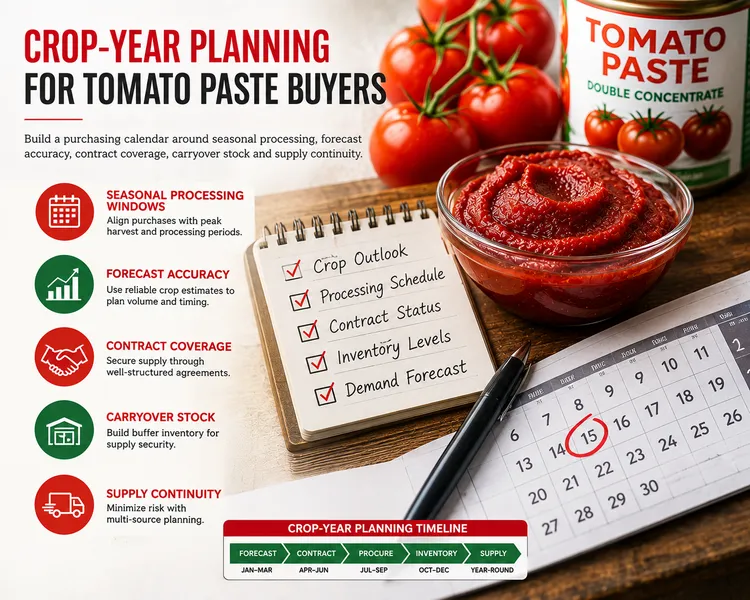
Tomato paste is produced within seasonal agricultural and processing cycles, while many food manufacturers consume it throughout the year. That creates a planning gap between when product is made and when buyers actually need it.
A sound crop-year plan connects annual demand, expected monthly usage, approved specifications, supplier capacity, inventory policy and logistics. Buyers who treat tomato paste as a purely spot-purchased ingredient may have less flexibility when crop availability, freight timing or demand changes.
The specification is also the commercial translation of finished-product performance. Normalize comparisons before approving a source. In a tomato-based formulation, an apparently small change in solids, finish, particle size or process history can alter yield, pumping behavior, sensory profile and the amount of water or thickener required.
Start with annual demand
Crop-year planning begins with a realistic estimate of how much tomato paste the business expects to consume. Use historical usage, current sales plans, known customer programs, planned launches and operational changes rather than relying only on the previous year's purchase volume.
Break annual demand into monthly or quarterly requirements. This helps identify seasonal peaks, periods of low consumption and the amount of inventory needed to bridge the gap between production timing and customer demand.
Forecast in equivalent tomato solids
When different concentrations may be purchased, it can be useful to translate demand into equivalent tomato solids rather than only kilograms or metric tons of paste. This creates a more consistent basis for comparing supply options.
A higher-solids paste generally requires a lower usage weight to deliver the same tomato-solids contribution. Forecasting solely in physical paste tonnage without accounting for concentration can therefore distort supplier comparisons and annual coverage calculations.
Understand the seasonal processing window
Tomato paste production depends on the processing season in each origin. Buyers do not necessarily need to purchase all volume during harvest, but they should understand when new-season product is expected to be produced, released, stored and shipped.
This timing affects contracting, sample approval, production allocation, logistics and the transition from previous-crop inventory to new-crop material.
Carryover stock
Carryover stock is inventory from the previous production cycle that remains available as the next crop approaches or begins. It can serve an important operational role when demand continues year-round.
Buyers should understand how much approved carryover inventory is available, how old it is, where it is stored and whether its remaining shelf life is compatible with expected consumption.
Carryover should not automatically be viewed as undesirable. Properly managed inventory can provide continuity during the transition between crop years, but age, storage condition, specification and remaining shelf life should be reviewed before allocation.
Ingredient selection
Start with solids/Brix and process type, then add consistency, color, pH/acidity, finish, microbiology, package and lot documentation. For crop-year planning, a logical first supply model to evaluate is contract tomato paste tied to an approved specification.
Contracting can help align expected demand with supplier capacity and planned production, but it should still be supported by technical approval, commercial terms, delivery schedules and agreed change-control requirements.
Treat that as a sourcing framework rather than a fixed rule. The best purchasing model is the one that meets finished-product requirements at an acceptable total cost while providing dependable supply.
Contract coverage versus spot purchases
Many buyers use a combination of committed volume and flexible purchases rather than relying entirely on one method. Contract volume can provide greater planning visibility, while uncommitted volume may offer flexibility when demand is uncertain.
The appropriate balance depends on forecast confidence, inventory capacity, customer commitments, supplier relationships and the cost of a shortage versus the cost of excess inventory.
Build a coverage model
A practical supply model should show expected demand, contracted volume, open volume, current inventory, carryover stock and planned receipts by period.
Review that model regularly rather than treating the annual plan as fixed. Forecast changes, production delays, shipment timing and customer demand can all change the amount of coverage required.
Plan the crop-year transition
The transition from one crop year to the next deserves specific attention. A buyer may have remaining old-crop inventory while new-crop material is entering the supply chain.
Decide how old and new lots will be sequenced, whether new-crop samples require technical approval, and how much overlap is needed to avoid a supply gap. Where relevant, evaluate whether sensory, color or consistency differences between crop years require a controlled plant trial.
Forecast accuracy and review cadence
A forecast is most useful when it is refreshed. Track actual consumption against forecast and update expected demand as new customer information becomes available.
A rolling forecast can help identify over-coverage and under-coverage early. Significant deviations should trigger a review of purchase commitments, planned shipment timing and inventory targets.
Inventory and storage planning
Purchasing decisions should reflect available warehouse space, storage conditions, pack format and inventory carrying cost. A large early purchase may improve supply certainty but can also increase working capital and storage exposure.
Review lot age and shelf life alongside physical inventory. Inventory that cannot realistically be consumed within the appropriate period should not be counted as equivalent to fresh, unrestricted stock.
Logistics timing
Crop-year planning should include more than production availability. Inland transport, port schedules, ocean freight, customs clearance, warehouse receiving and final delivery can add significant time between supplier release and plant availability.
Build a buffer appropriate to the route and operating model. The objective is to avoid placing production continuity entirely on the assumption that every shipment will arrive exactly on schedule.
Supplier diversification
Depending on the program, buyers may qualify more than one origin or supplier so that the business is not dependent on a single production source. Dual or multi-source strategies should still be technically controlled because different approved pastes may require different usage rates or minor formula adjustments.
If multiple sources are approved, document the specification and application performance for each one rather than assuming they are operationally identical.
Practical planning method
Crop-year planning is primarily a supply exercise, but technical validation remains important whenever a new crop, supplier, origin or specification is introduced.
- Calculate expected annual demand and break it into monthly or quarterly consumption.
- Translate demand into equivalent tomato solids where supplier concentrations may differ.
- Record current inventory, lot age, remaining shelf life and expected carryover stock.
- Map contracted volume, open purchase requirements and planned receipts against forecast demand.
- Identify the expected transition period between current-crop and new-crop material.
- Collect current technical data and representative samples from any new supplier, crop or origin requiring approval.
- Normalize tomato solids or concentration before comparing candidate ingredients.
- Run a controlled bench or pilot batch when a technical change could affect finished-product performance.
- Measure relevant attributes such as Brix/solids, pH, viscosity or Bostwick, color, yield and sensory profile.
- Review actual consumption against forecast regularly and revise the coverage plan as needed.
- Document approved suppliers, specifications, contract coverage and change-control triggers.
Useful purchasing checkpoints
- Annual forecast by product
- Monthly or quarterly demand
- Equivalent tomato-solids requirement
- Current inventory by lot
- Carryover stock and shelf life
- Contracted volume
- Open volume requirement
- Planned shipment schedule
- Approved alternate suppliers
- New-crop approval status
- Forecast versus actual usage
Questions to ask the supplier
- What crop year, product definition, process and origin apply to the proposed supply?
- What production and availability window is expected for the crop?
- What Brix, consistency, color, pH/acidity and finish specifications apply?
- Which parameters are guaranteed versus typical?
- What contract or production allocation is available for the expected annual demand?
- How much approved carryover stock is available, and what shelf life remains?
- What is the pack configuration, net weight and storage guidance?
- What lead time should be assumed from order release to delivery?
- Which food-safety, quality and organic documents are available for the program?
- How are lots identified and traced?
- What changes in crop year, origin, process, specification or packaging require customer notification?
Commercial evaluation
The lowest spot price is not always the lowest-cost supply strategy. Buyers should consider delivered price, concentration, freight, inventory carrying cost, storage, contract flexibility, minimum order quantities and the financial impact of a production interruption.
A useful comparison considers total cost per equivalent tomato solids together with supply reliability and the operational value of having approved inventory available when the plant needs it.