
Why this matters
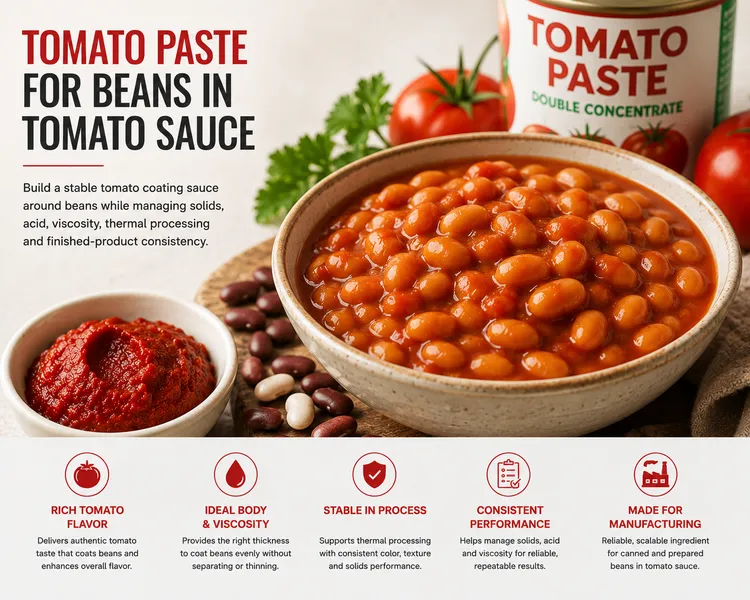
Beans in tomato sauce require the sauce and the beans to perform as one finished product. The sauce must be fluid enough for mixing, pumping and filling, yet have enough body to coat the beans and remain visually uniform after processing and storage.
Tomato ingredients in prepared foods must perform through pumping, filling, cooking, chilling, freezing or retort, storage and consumer reheating. In a tomato-based formulation, an apparently small change in solids, finish, particle size or process history can alter yield, pumping behavior, sensory profile and the amount of water or thickener required.
For beans in sauce, these changes can also affect how much free liquid is visible in the pack, how well the sauce remains distributed around the beans and how the product looks and tastes after the full thermal cycle.
Role of the tomato paste
Tomato paste provides concentrated tomato solids, flavor and color while helping create the continuous sauce phase around the beans. Its contribution should be evaluated together with water, acid, sweeteners, salt, seasonings and any starches or hydrocolloids used in the formulation.
The target is usually a sauce that coats rather than simply surrounds the beans. Too little body can lead to a watery appearance or separation, while excessive body can make filling and pumping more difficult and may create a heavy finished texture.
Ingredient selection
Use high-body tomato ingredients where water separation is a risk; combine paste with puree or tomato pieces when both sauce body and recognizable tomato character are required.
For this application, a logical first ingredient to evaluate is hot break tomato paste. Its role is to provide concentrated tomato solids and support the body of the surrounding sauce through processing.
Treat that recommendation as a formulation hypothesis rather than a fixed rule. The best answer is the ingredient that meets the finished-product target at an acceptable total cost and with reliable supply. Concentration, finish, color, viscosity behavior and process history should all be reviewed when comparing candidates.
Why hot break paste is a useful starting point
Where the formulation needs body and reduced tendency toward visible water separation, a hot break tomato paste can be a practical candidate for initial trials. The relevant question is not simply whether the paste is described as hot break, but whether its actual specification and finished-product performance fit the sauce system.
Supplier samples should therefore be evaluated under the intended commercial process. Differences that appear small before heating may become more noticeable after cooking, retort, cooling and storage.
Managing solids and sauce body
Tomato solids influence sauce concentration, texture, yield and the amount of added water available in the formula. Comparing two pastes at the same weight can be misleading when their concentrations differ.
Normalize trials to equivalent tomato solids first. Once the tomato contribution is comparable, adjust water and other formulation components to reach the required fill behavior, coating performance and finished consistency.
If starches or hydrocolloids are also used, evaluate them as part of the complete sauce system. Tomato solids, added thickeners and thermal processing can all influence the final texture.
Acid and flavor balance
Acid affects both the sensory profile and the technical design of the finished product. It should be evaluated together with tomato solids, sweetness, salt and seasonings rather than adjusted independently.
A supplier change can alter perceived tomato intensity, acidity or cooked flavor even when the formula weights remain unchanged. For that reason, analytical measurements should be paired with sensory comparison after processing.
Bean and sauce interaction
The bean component also affects the way the finished sauce behaves. Sauce should be evaluated around the actual bean type and preparation used in production rather than as a separate tomato sauce whenever possible.
During trials, observe coating, free liquid, bean integrity and overall pack appearance. A technically acceptable sauce before filling may behave differently once it has been processed and stored together with the beans.
Thermal processing considerations
The full heating and storage cycle can change viscosity, color, flavor and separation. Pilot work should therefore reproduce the relevant cooking, filling and thermal process as closely as practical.
Measure the product at consistent points in the process. Comparing one sample immediately after heating with another after cooling or storage can give a misleading result because sauce structure can continue to develop after processing.
Practical trial method
Pilot the full thermal and storage cycle. Evaluate separation, bean integrity, color, flavor and viscosity after the same hold time used in commercial production.
- Define the finished-product target and identify the attributes that cannot change, including sauce body, bean-to-sauce appearance, color, flavor and fill performance.
- Collect current technical data, specifications and a representative sample from each candidate tomato source.
- Record concentration or Brix and normalize tomato solids before comparing usage rates.
- Adjust added water so candidate tomato ingredients are compared on a meaningful solids basis.
- Run a controlled bench or pilot batch using the real addition order and process conditions as closely as practical.
- Evaluate the sauce together with the actual beans intended for commercial production.
- Measure relevant attributes such as Brix/solids, pH, viscosity or Bostwick, color, yield, bean integrity and sensory profile.
- Record pumping, mixing and filling behavior where these are important to the production line.
- Repeat measurements after the relevant cooking or retort process and after cooling.
- Review sauce separation, coating and sensory performance again after the relevant storage condition.
- Document the approved supplier, specification and change-control triggers.
What to compare between samples
Compare supplier samples in the finished bean product rather than judging tomato paste alone. The most useful comparison includes the amount of tomato solids required, finished yield, sauce viscosity, free liquid, coating behavior, color and sensory profile.
Also note any formulation adjustments needed to achieve the same result. A paste that requires less added thickener or produces a more stable sauce at equivalent tomato solids may have a different commercial value than its purchase price alone suggests.
Questions to ask the supplier
- What product definition, concentration, process and crop/origin apply to this lot?
- Is the product produced using a hot break process, and how is that identified in the specification?
- What Brix or soluble-solids range is specified?
- What viscosity, finish or particle characteristics are controlled?
- Which color parameters are guaranteed or routinely monitored?
- Which parameters are guaranteed versus typical?
- What is the pack configuration, net weight and storage guidance?
- What shelf life applies under the recommended storage conditions?
- Which food-safety, quality and organic documents are available for this program?
- How are lots identified and traced?
- What changes in origin, process, specification or packaging require customer notification?
Commercial evaluation
Once technical performance is acceptable, compare candidates on the basis of finished-product economics. Concentration affects the quantity of paste required, the amount of water introduced to the formula and the number of finished units produced from each shipment.
Delivered cost, pack efficiency, minimum order quantities, storage requirements, supply reliability and any resulting change in thickener or formulation usage should all be considered alongside ingredient price.