
Why this matters
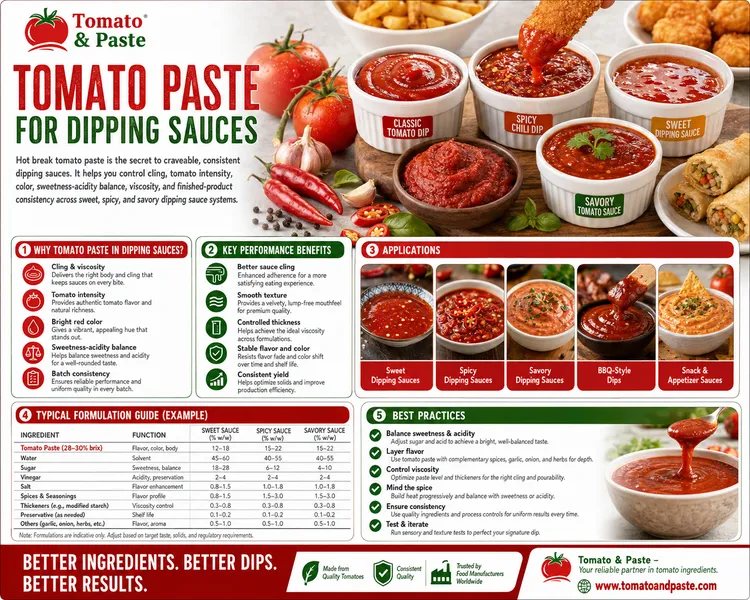
Dipping sauces need a carefully controlled balance between flow and adhesion. The sauce should transfer easily from a cup, bottle or pouch, coat the dipped food and remain in place long enough to deliver flavor without becoming stringy, pasty or excessively thin.
Tomato paste can contribute body, red color, tomato flavor and soluble and insoluble solids in one ingredient. Its performance depends on how those solids interact with water, sugar, acid, salt, spices, fats and any starch or hydrocolloid system used in the formula.
Define the dipping style first
Tomato-based dipping sauces cover a wide range of products, from sweet and tangy sauces to hot pepper dips, barbecue-style systems and savory foodservice condiments. The role of tomato should be defined before the paste specification is selected.
In some products, tomato is the main flavor base. In others, it mainly provides color, structure and a background savory note that supports chile, garlic, smoke, sweetness or other dominant flavors.
Why hot break paste is a practical starting point
Hot break tomato paste is a useful starting point where the dipping sauce requires relatively high body and water-holding performance. Its pulp structure can help the sauce coat food effectively without relying entirely on added thickeners.
The best paste is not necessarily the highest-body option available. Excessive structure can make a sauce difficult to dispense or create a heavy, pasty eating texture, so final selection should reflect the intended package and serving behavior.
Normalize tomato solids
Tomato pastes with different Brix values should be compared on an equivalent tomato-solids basis. Equal usage rates can create misleading conclusions because the products may contribute different amounts of solids and water.
Normalize tomato solids first, then adjust process water and compare finished cling, viscosity, color, flavor and yield. This makes supplier-to-supplier differences easier to interpret.
Cling is different from simple thickness
A dipping sauce can be thick without coating food effectively. Useful cling depends on how the sauce flows under movement, how it breaks away from the dip cup and how it remains on the product surface after dipping.
Tomato pulp can contribute this structure, but sugar concentration, starches, hydrocolloids and fats may also influence adhesion. Evaluate the complete sauce using the intended food rather than relying only on a single viscosity number.
Viscosity and pourability
Dipping sauces must usually be easy to portion while still maintaining enough body to resist running off the food. The correct viscosity depends on whether the sauce is supplied in portion cups, retail bottles, squeeze pouches or bulk foodservice containers.
Measure consistency under standardized temperature conditions and confirm dispensing behavior with the actual or representative package.
Hot and cooled viscosity
Sauce body can change significantly as the product cools. A batch that seems relatively fluid during cooking may become considerably thicker after filling and equilibrium storage.
Record both hot-process behavior and cooled finished-product consistency. The latter is especially important for sauces served at ambient or refrigerated temperature.
Sweet dipping systems
In sweeter sauces, tomato paste needs to remain identifiable despite high sugar or syrup levels. Sugar can increase total solids and apparent viscosity while also softening the perception of tomato acidity.
Evaluate whether tomato character remains clear enough after the sweetness target is reached and whether the combined solids produce excessive stickiness.
Spicy dipping systems
Tomato solids, natural sweetness and acidity can change the way chile heat is perceived. The same pepper level may taste rounder or less sharp when the tomato content is increased.
Evaluate heat onset, peak intensity, persistence, tomato flavor and chile aroma together. The objective is to achieve the intended balance rather than maximizing either tomato or pepper independently.
Savory dipping systems
In savory dipping sauces, tomato paste can provide umami-like depth, color and body that support garlic, onion, herbs, smoke, spice blends or meat-style flavors.
The tomato level should still be controlled carefully so it does not overwhelm the target savory profile or create a ketchup-like character where that is not intended.
Acidity and sweetness balance
Tomato paste contributes both natural acidity and soluble solids, while many dipping sauces also contain vinegar, food acids, sugar or syrup. The balance between these components shapes the overall flavor profile.
Evaluate pH analytically where relevant to the product, but also judge sensory sharpness in the finished formula. Similar pH values do not necessarily produce identical perceived acidity.
Color
Tomato paste often establishes the red or red-brown foundation of a dipping sauce. It can also help reduce visual variation when spice, chile or sweetener systems vary slightly between batches.
Finished color should be evaluated after the complete thermal process and storage period because heating and ingredient interactions may deepen or shift the shade.
Serum separation
Dipping sauces should remain visually uniform during storage. Excess serum separation can lead to watery liquid at the top or around the sauce and may produce inconsistent dipping performance.
Where separation occurs, review tomato pulp structure, total solids, shear history and the complete texture system rather than assuming that one ingredient alone is responsible.
Interaction with starches and hydrocolloids
Tomato paste may provide enough natural body for some formulations, while others rely on starches or hydrocolloids for additional control. These systems can interact with tomato pulp and may continue developing structure during cooling.
Supplier trials should therefore keep the texture system constant so differences in tomato paste performance can be judged fairly.
Interaction with fats and oils
Some savory or creamy dipping systems contain oil or other fat components. These can influence mouthfeel, tomato flavor perception and visual stability.
Evaluate the complete sauce after processing and storage for oiling-off or separation, particularly if the formulation contains meaningful levels of added fat.
Ingredient selection
Tomato paste is generally the most direct tomato format for dipping sauces where concentrated body, color and flavor are desired. Key variables include Brix, process style, consistency, color, acidity, flavor and screen finish.
For this topic, a logical first ingredient to evaluate is hot break tomato paste. Treat that as a formulation hypothesis rather than a fixed rule. The best paste is the one that delivers the intended cling, flavor, color and dispensing behavior at an acceptable total cost and with reliable supply.
Practical trial method
Bench trials should normalize tomato solids first, then tune water, sweetener, acid, salt and seasoning. Final approval should reproduce the actual cooking, shear, cooling and packaging conditions because sauce structure can change throughout production.
- Define the target dipping style, tomato intensity, sweetness, acidity, spice level, cling and serving temperature.
- Identify attributes that cannot change, such as sweetener system, acid source, spice profile, package or process.
- Collect current technical data, certificates of analysis and representative tomato paste samples.
- Confirm paste Brix, process type, consistency, color, pH/acidity and finish.
- Normalize candidate pastes to equivalent tomato solids.
- Adjust process water so trials begin on a comparable basis.
- Run a controlled sauce batch using the actual sugar, acid, salt and seasoning system.
- Use the real ingredient addition order, mixing, shear and heat treatment.
- Measure Brix/solids, pH, viscosity or Bostwick and final yield.
- Evaluate pourability through the intended package or dispenser.
- Perform a practical cling test using the intended food or a representative substrate.
- Evaluate tomato intensity, sweetness, acidity, spice, savory balance and aftertaste.
- Check color and serum separation after cooling.
- Repeat viscosity and sensory evaluation after representative storage.
- Document the approved supplier, specification, usage rate and change-control triggers.
What to evaluate in the finished dipping sauce
- Appropriate cling to the intended food
- Controlled pourability
- Target tomato intensity
- Balanced sweetness and acidity
- Appropriate spice or savory character
- Stable red or red-brown color
- Minimal serum separation
- Consistent pH and solids
- Reliable package dispensing
- Stable sensory performance during storage
Portion-cup applications
Single-serve dipping cups place additional emphasis on visual stability and portion consistency. The sauce should fill cleanly, remain uniform in the cup and release readily when the consumer dips food into it.
Evaluate sauce depth, surface appearance and cling using the actual cup geometry where practical.
Squeeze-bottle applications
Squeeze bottles require a balance between body and easy dispensing. A sauce that is too thick may require excessive force, while one that is too thin may dispense uncontrollably.
Include the intended bottle, closure and orifice size in final development trials because packaging can materially change the perceived viscosity target.
Foodservice dipping sauces
Bulk foodservice products may be pumped, portioned or held in dispensing equipment for extended periods. The tomato system should remain stable during the intended hold and service period.
Check for viscosity drift, surface drying, separation and changes in flavor after representative foodservice handling.
Chilled dipping sauces
Refrigerated serving temperature can increase apparent viscosity and change flavor release. A sauce that performs correctly at room temperature may become noticeably firmer when chilled.
Where the product is intended for refrigerated use, evaluate cling and dispensing at the actual serving temperature.
Cost and formulation yield
Compare tomato pastes on equivalent tomato solids and finished-sauce performance rather than purchase price per kilogram alone. A higher-body or more concentrated paste may allow a different usage rate and water addition.
Total economics should include finished yield, water adjustment, thickener demand, packaging performance, processing losses and any rework required to correct sauce thickness or separation.
Questions to ask the supplier
- What Brix or tomato-solids range is guaranteed?
- Is the paste hot break, cold break or another process style?
- Which consistency or Bostwick parameters are guaranteed versus typical?
- What color specification applies?
- What pH and acidity ranges are typical or guaranteed?
- What screen finish or particle-size specification applies?
- What crop/origin and production plant apply to this lot?
- Which microbiological parameters are included in the specification?
- What pack configuration, net weight and storage guidance apply?
- Which food-safety, quality and organic documents are available for the program?
- How are production lots identified and traced?
- What crop, plant, process or specification changes require customer notification?
Commercial takeaway
Tomato paste can provide dipping sauces with body, cling, color and a concentrated flavor foundation across sweet, spicy and savory formulations. Hot break paste is a useful first candidate when strong structure and water-holding performance are priorities.
Compare suppliers at equivalent tomato solids, reproduce the actual sweetener, acid and seasoning system, and evaluate the sauce at its intended serving temperature and package. This provides a stronger basis for consistent cling, sensory quality, yield and long-term sourcing approval.