
Why this matters
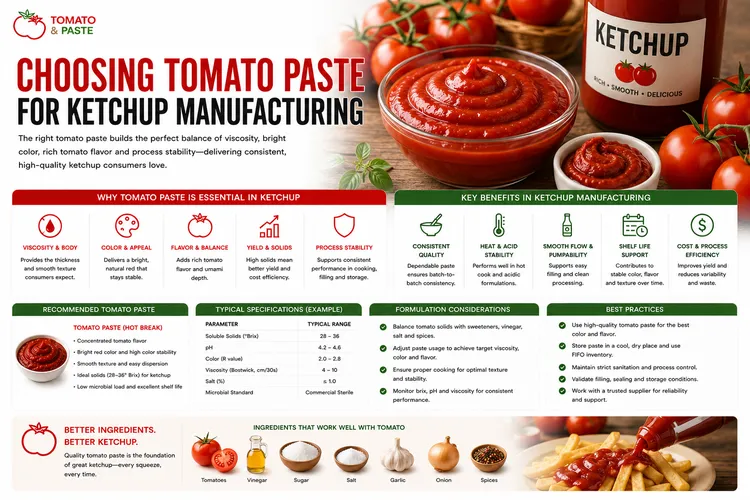
Tomato paste is one of the main structural and sensory ingredients in ketchup. It contributes tomato solids, red color, acidity, flavor and a substantial part of the finished product's body. Because ketchup typically has a tightly controlled texture and flavor profile, relatively small differences between tomato paste lots can become noticeable in production.
Ketchup performance is controlled by the interaction of tomato insoluble solids, soluble solids, water, acid, sugar, salt, spices and thermal or shear history. Changes in paste concentration, pulp structure, finish or process type can alter yield, pumping behavior, viscosity, serum separation and the amount of formulation adjustment required.
Why hot break paste is a practical starting point
Hot break tomato paste is a logical starting point where high body and water-holding performance are important. Its pulp structure can contribute useful viscosity to ketchup and may reduce dependence on other texture-building approaches.
That does not mean hot break is automatically the best paste for every ketchup. The correct choice depends on the target mouthfeel, manufacturing process, sensory profile, cost model and whether the ketchup relies mainly on tomato solids or additional texture systems for its final consistency.
Tomato solids and formulation yield
Tomato paste concentration directly affects how much paste and water are required to reach the intended ketchup formulation. A higher-Brix paste delivers more tomato solids per kilogram, while a lower-concentration product introduces more water.
Supplier comparisons should therefore begin with equivalent tomato-solids calculations. This creates a fair basis for evaluating viscosity, flavor, color, yield and finished cost rather than comparing equal kilograms of products that do not contain the same amount of tomato solids.
Viscosity and flow behavior
Ketchup must be thick enough to remain on food while still dispensing reliably from bottles, pouches, pumps or foodservice containers. Tomato pulp is a major contributor to this structure.
Similar-Brix pastes can produce different finished viscosities because their insoluble solids and pulp structures may behave differently. For this reason, Brix should be considered together with consistency measurements and finished-ketchup testing.
Bostwick and other consistency measurements
Bostwick or other established consistency measurements can help compare tomato paste and finished ketchup, but the test conditions should be tightly controlled. Temperature, sample preparation and elapsed time can influence results.
The most useful internal specification is one that correlates with the actual dispensing, pumping and eating behavior required from the finished ketchup.
Hot and cooled viscosity
Ketchup can change in apparent viscosity as it moves through cooking, homogenization, filling and cooling. A product that appears relatively fluid while hot may develop substantially more body after cooling.
Record viscosity at standardized temperatures and evaluate the finished product after it has reached the intended equilibrium condition. This improves repeatability between trials and commercial batches.
Serum separation
Visible serum separation can reduce consumer perception of quality and create inconsistent dispensing. Tomato pulp structure and total solids influence the ability of the ketchup matrix to hold water.
Separation should be evaluated after processing and during representative storage. Where instability occurs, review the tomato paste, total-solids balance, shear history and complete formulation rather than assuming that one variable alone is responsible.
Color
Tomato paste establishes most of the characteristic red color of ketchup. Crop, processing history, concentration and thermal treatment can influence the incoming paste color and how it develops in the finished product.
Evaluate color after the complete ketchup process because cooking and storage may deepen or shift the apparent red tone. The chosen paste should provide stable, repeatable color without requiring unnecessary formulation correction.
Tomato flavor
Ketchup combines tomato flavor with acid, sweetness, salt and spice. The paste needs enough tomato intensity to remain identifiable within this strong seasoning system while avoiding excessive cooked, bitter or unbalanced notes.
Sensory comparisons should use the complete ketchup formula rather than diluted paste alone. Differences between suppliers may become more or less apparent once sugar, vinegar, salt and spices are incorporated.
Acid and sweetness balance
Tomato paste contributes natural acidity and soluble solids to the formula, while vinegar or other food acids and sweeteners establish much of the final ketchup balance. Differences in incoming paste pH and titratable acidity can shift the amount of adjustment required.
Compare candidate pastes in the same finished formulation and evaluate both analytical values and sensory balance. Similar pH does not necessarily mean that two ketchup batches will taste equally acidic.
Interaction with sugar and salt
Sugar and salt change both flavor perception and the concentration of the continuous phase. The same tomato paste may appear different in a low-sugar formulation compared with a conventional ketchup formula.
Supplier approval should therefore use the actual or representative commercial sugar and salt levels rather than an oversimplified tomato-and-water test system.
Process and shear stability
Mixing, pumping, homogenization and other shear-producing operations can change the structure of tomato pulp. Excessive or inconsistent shear may change viscosity even when the ingredient specification and formulation remain unchanged.
When comparing tomato suppliers, keep shear conditions as consistent as possible. A plant trial should reproduce the real process sequence so ingredient differences are not confused with equipment or process variation.
Cooking and thermal history
Ketchup may undergo heating for ingredient dissolution, flavor development, microbial control and filling. Time and temperature can influence color, flavor and viscosity.
Candidate paste should therefore be evaluated after the same representative cook and hold conditions. Long bench-scale evaporation or excessive heating can make a sample appear different from commercial production.
Ingredient selection
For ketchup, tomato paste is generally the primary tomato format because it efficiently delivers concentrated solids, color and body. The key selection variables include Brix, process type, consistency, color, acidity, flavor, finish and lot-to-lot repeatability.
A logical first ingredient to evaluate is hot break tomato paste, particularly where viscosity and water-holding performance are important. Treat this as a practical starting point rather than a fixed rule: the best paste is the one that meets the finished-ketchup target at an acceptable total cost and with reliable supply.
Practical trial method
Bench and pilot trials should normalize tomato solids first, then adjust water, sugar, acid, salt and seasonings. Final approval should reproduce the actual thermal and shear process because viscosity, color and flavor can change significantly during ketchup manufacture.
- Define the finished-ketchup target for Brix, pH, viscosity, color, tomato flavor, acidity and yield.
- Identify attributes that cannot change, such as sweetener system, acid source, spice profile, packaging or process conditions.
- Collect current technical data, certificate of analysis and representative samples from each tomato paste candidate.
- Confirm paste Brix, process type, consistency, color, pH/acidity and finish.
- Normalize each paste to equivalent tomato-solids contribution.
- Adjust process water to maintain a comparable formulation basis.
- Run a controlled ketchup batch using the actual sugar, acid, salt and seasoning system.
- Use representative addition order, mixing, shear, heating and hold conditions.
- Measure in-process and finished Brix and pH.
- Measure viscosity, Bostwick or the plant's preferred consistency metric at a defined temperature.
- Evaluate serum separation after a standardized hold period.
- Measure or visually compare finished color under consistent conditions.
- Evaluate tomato flavor, sweetness-acidity balance, salt, spice and aftertaste.
- Repeat measurements after the finished ketchup has cooled.
- Evaluate again after representative packaged storage.
- Document the approved supplier, paste specification, usage rate and change-control triggers.
What to evaluate in finished ketchup
- Target Brix / total solids
- Target pH and acid balance
- Consistent viscosity or Bostwick
- Good bottle or pouch dispensing behavior
- Minimal serum separation
- Stable red color
- Balanced tomato flavor
- Appropriate sweetness and acidity
- Repeatable batch yield
- Stable storage performance
Packaging and dispensing
Ketchup may be filled into retail bottles, squeeze packs, sachets, pouches or foodservice containers. The target viscosity should be compatible with the selected package and dispensing method.
A ketchup that performs well in a laboratory cup may dispense differently through a narrow bottle opening or foodservice pump. Include the intended package in the final qualification trial where practical.
Batch repeatability
Industrial ketchup programs depend on tight lot-to-lot consistency. A tomato paste supplier should be evaluated not only on one strong sample but also on the repeatability of Brix, consistency, color, acidity and flavor across commercial lots.
Define which parameters are guaranteed and which are only typical. This helps procurement and quality teams understand the appropriate incoming controls and change-notification requirements.
Cost and formulation yield
Compare tomato paste on equivalent tomato solids and finished-ketchup yield rather than purchase price per kilogram alone. A more concentrated or higher-body paste may require a different usage rate and may alter water or texture adjustments.
Total formulation cost should include paste usage, added water, processing losses, yield, any additional texture adjustment and the commercial impact of batch correction or rework.
Questions to ask the supplier
- What Brix or tomato-solids range is guaranteed?
- Is the paste hot break, cold break or another process style?
- Which consistency or Bostwick parameters are guaranteed versus typical?
- What color specification applies?
- What pH and titratable-acidity ranges are typical or guaranteed?
- What screen finish or particle-size specification applies?
- What crop/origin and production plant apply to this lot?
- Which microbiological parameters are included in the specification?
- What pack configuration, net weight and storage guidance apply?
- Which food-safety, quality and organic documents are available for the program?
- How are lots identified and traced?
- What crop, plant, process or specification changes require customer notification?
Commercial takeaway
Choosing tomato paste for ketchup requires more than matching Brix. The selected paste should provide repeatable viscosity, color, flavor and water-holding performance in the actual ketchup formulation and process.
Normalize supplier samples to equivalent tomato solids, reproduce commercial shear and thermal conditions, and evaluate the finished ketchup after cooling and storage. This provides a stronger basis for yield control, sensory consistency and long-term sourcing approval.