
Why this matters
Industrial lasagna is a layered system in which tomato sauce, pasta sheets, cheese, meat or vegetable fillings and added water continue to interact during baking, cooling, storage and reheating. The tomato sauce therefore needs to do more than provide flavor and color: it also helps control how moisture moves through the finished product.
An apparently small change in tomato solids, pulp structure, finish or process history can alter sauce viscosity, pasta hydration, layer definition, finished yield and the amount of free liquid visible after reheating. Tomato ingredients should therefore be selected as part of the complete lasagna system.
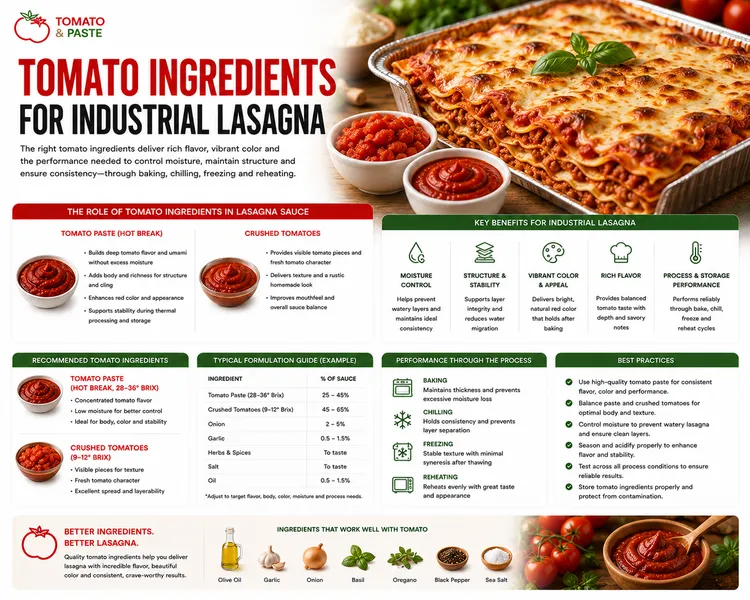
Why hot break paste is a practical starting point
Hot break tomato paste is often useful in industrial lasagna because it can provide concentrated tomato solids and a relatively high-body sauce base. This can help reduce excessive free water while still allowing the formulation to be adjusted with puree, crushed tomato or process water.
The objective is not simply maximum viscosity. A sauce that is too heavy may be difficult to pump or spread evenly between layers, while a sauce that is too thin may migrate excessively into pasta or collect at the bottom of the tray.
Crushed tomatoes for texture
Crushed tomatoes can add a softer, more culinary texture to the sauce and help prevent the finished lasagna from appearing overly homogeneous. They may also provide a fresher tomato impression than a formula built entirely from reconstituted paste.
Particle size and finish should match the desired product style. Coarser crushed tomatoes can create more visible texture, while finer crushed products can behave closer to a textured puree.
Control moisture migration
Moisture moves between layers during baking and continues to redistribute during chilled or frozen storage. Pasta sheets absorb water, cheese systems may release or retain moisture, vegetables can release additional liquid and meat fillings can contribute both water and fat.
The tomato sauce should therefore be formulated with enough available moisture to support the intended pasta hydration, but not so much that the finished product becomes watery or loses layer definition.
Pasta hydration
Pasta condition is central to lasagna quality. Dry, pre-cooked and fresh pasta sheets can have different hydration requirements, so a sauce that works with one pasta system may not transfer directly to another.
Evaluate the tomato sauce with the actual commercial pasta. Too little available moisture can leave sheets firm or dry, while too much can lead to soft, weak or poorly defined layers after baking and reheating.
Normalize tomato solids
Supplier samples should be compared on an equivalent tomato-solids basis when Brix or concentration differs. Equal usage rates can misrepresent the real functional differences because one ingredient may contribute substantially more water than another.
Normalize solids first, then adjust process water and the paste-to-crushed ratio. This makes it easier to compare sauce body, flavor, color, yield and moisture behavior fairly.
Sauce body and layer definition
The tomato sauce should spread evenly across the pasta layer while maintaining enough body to remain where it is deposited. This helps keep tomato, cheese and filling layers visually distinct through assembly and baking.
Excessively fluid sauce can migrate into lower layers before cooking, while excessive viscosity can create uneven coverage and inconsistent portioning. The target should reflect the actual spreading or depositing equipment used on the line.
Interaction with cheese systems
Lasagna may contain mozzarella, ricotta-style fillings, béchamel, processed cheese sauces or other dairy components. These ingredients can release moisture and fat during heating, changing the effective consistency of the tomato phase.
Evaluate the complete layered product rather than the tomato sauce alone. A sauce that appears ideal in a kettle test may behave differently after it is combined with cheese and baked.
Meat and vegetable fillings
Ground meat, vegetables and other fillings contribute their own moisture, fat and solids. Their formulation and pre-cooking history can materially affect the amount of liquid available to move into the sauce or pasta during processing.
Where a supplier or filling formulation changes, the tomato sauce may require adjustment even if the tomato ingredients remain the same.
Color through baking
Tomato ingredients provide the red visual foundation of the lasagna. Baking can deepen tomato color, while cheese, fat and other layers can change how the sauce color is perceived.
Evaluate sauce color after the complete bake and again after reheating. The objective is a consistent cooked-red appearance that remains attractive between the pasta and filling layers.
Flavor after multiple heat cycles
Industrial lasagna may experience sauce cooking, product baking and final consumer reheating. These multiple thermal exposures can deepen tomato flavor and reduce the perception of fresh acidity.
Sensory evaluation should therefore be based on the final reheated meal. Check tomato intensity, acidity, sweetness, herbs, savory balance and any overly cooked or bitter notes.
Hot and cooled viscosity
Sauce viscosity can change as the product cools, particularly where starch or other texture systems are used. A sauce that spreads easily while hot may become substantially firmer in chilled production.
Measure viscosity or Bostwick at defined temperatures and include the sauce condition encountered during actual assembly.
Ingredient selection
Use higher-body tomato ingredients where excessive moisture migration or water separation is a concern, and combine paste with crushed tomato where both structural body and recognizable tomato texture are desired.
For this topic, a logical first ingredient system to evaluate is hot break paste and crushed tomatoes. Treat that as a formulation hypothesis rather than a fixed rule. The best combination is the one that produces stable layers, appropriate pasta hydration, good tomato flavor and reliable process performance at an acceptable total cost.
Practical trial method
Pilot the complete layered product through the real thermal and storage cycle. Sauce approval should include assembly, baking, chilling or freezing and reheating because moisture redistribution can continue at every stage.
- Define the finished-product target for layer definition, pasta texture, sauce body, tomato flavor and free liquid.
- Identify attributes that cannot change, such as tray size, pasta type, cheese system, filling formulation, bake process or portion weight.
- Collect technical data, certificates of analysis and representative samples from each tomato candidate.
- Confirm Brix or solids, consistency, process type, color, pH/acidity and crushed tomato finish.
- Normalize tomato solids before comparing usage rates.
- Define the starting hot-break-paste-to-crushed-tomato ratio.
- Adjust process water to create a comparable total-solids basis.
- Produce a controlled sauce batch using the actual seasoning and addition order.
- Measure Brix/solids, pH, viscosity or Bostwick, color and sauce yield.
- Assemble lasagna using the actual pasta, cheese, filling and sauce layer weights.
- Apply the representative commercial baking process.
- Evaluate pasta hydration, layer definition, sauce migration, free liquid and color after baking.
- Chill or freeze using representative commercial conditions.
- Store for the relevant period and evaluate moisture redistribution.
- Reheat using the intended consumer or foodservice method.
- Evaluate final texture, flavor, layer integrity and free liquid.
- Document the approved suppliers, specifications, layer weights and change-control triggers.
What to evaluate in the finished lasagna
- Controlled moisture migration
- Appropriate pasta hydration
- Clear layer definition
- Consistent tomato sauce coverage
- Minimal undesirable free liquid
- Stable sauce viscosity after reheating
- Balanced tomato, cheese and filling flavor
- Stable cooked-red color
- Repeatable portion yield
- Acceptable chilled or frozen storage performance
Chilled lasagna
In chilled lasagna, moisture can continue to move between the pasta, sauce, cheese and filling during refrigerated storage. The pasta may soften further even after the initial cook is complete.
Shelf-life trials should therefore track layer definition, free liquid and pasta texture throughout the intended refrigerated period and after reheating.
Frozen lasagna
Frozen products experience additional moisture redistribution during freezing, frozen storage and reheating. Ice formation can alter the way water is held within sauce and filling layers.
Candidate tomato systems should be evaluated after representative frozen storage rather than only before freezing. Check for watery edges, sauce separation, pasta texture and reheated layer integrity.
Reheating performance
Microwave and conventional-oven reheating can produce different moisture and temperature gradients. Sauce may become more concentrated in some areas while water collects in others.
Where more than one reheating method is declared to consumers, validate the tomato system under each relevant method.
Cost and formulation yield
Compare tomato ingredients on equivalent tomato solids and complete-meal performance rather than purchase price per kilogram alone. Hot break paste can efficiently deliver body and solids, while crushed tomatoes contribute water and culinary texture.
Total economics should include sauce yield, added water, thickener demand, pasta and filling losses, portion control and rework caused by watery or poorly defined layers. The most economical tomato system is the one that consistently delivers the required finished lasagna quality at the lowest effective cost.
Questions to ask the supplier
- What product definition, process and crop/origin apply to each tomato ingredient?
- Is the paste hot break, cold break or another process style?
- What Brix or solids range is guaranteed?
- Which consistency or Bostwick parameters are guaranteed versus typical?
- What color specification applies?
- What pH and acidity ranges are typical or guaranteed?
- What crushed tomato finish or particle-size specification applies?
- Which microbiological parameters are included in the specification?
- What is the pack configuration, net weight and storage guidance?
- Which food-safety, quality and organic documents are available for the program?
- How are production lots identified and traced?
- What crop, plant, process or specification changes require customer notification?
Commercial takeaway
Tomato ingredients for industrial lasagna should be selected according to their effect on the complete layered system. Hot break paste can provide concentrated body and solids, while crushed tomato can create a more natural sauce texture and tomato profile.
Compare suppliers at equivalent tomato solids, test the real pasta, cheese and filling system, and evaluate after baking, storage and reheating. This provides a stronger basis for controlled moisture migration, consistent layer definition, flavor, yield and long-term sourcing approval.