
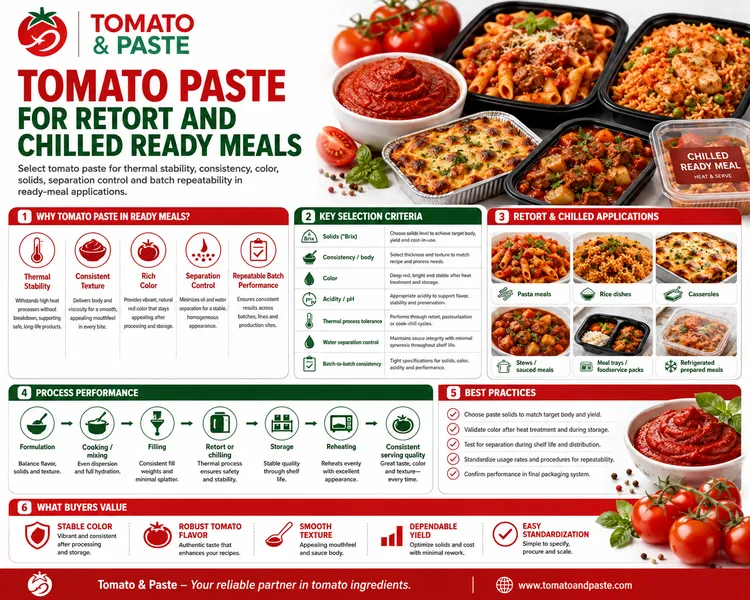
Why this matters
Tomato ingredients in prepared foods must perform through pumping, filling, cooking, chilling, freezing or retort, storage and consumer reheating. The tomato component may provide color, flavor, acidity, solids and part of the finished-product body, so its behavior can affect both processing efficiency and consumer acceptance.
An apparently small change in solids, finish, pulp structure or process history can alter yield, pumping behavior, sensory profile and the amount of water or thickener required. These differences may become more pronounced after intensive thermal processing or extended chilled storage.
Why hot break is a practical starting point
Hot break tomato paste is often a logical first ingredient to evaluate where the finished ready meal requires higher body and stronger water-holding performance. Its process history can support viscosity in applications where separation or thinning during heating is a concern.
That does not make hot break the automatic choice for every product. Some formulations may benefit from a different tomato flavor or consistency profile. The correct decision depends on the complete formula, the thermal process and the texture expected after storage and reheating.
Retort changes the evaluation point
In retorted foods, the tomato ingredient should not be approved solely on the basis of its pre-retort viscosity, color or flavor. The complete formulation is exposed to a significant thermal load, and the finished texture and sensory profile can differ substantially from the hot-filled or freshly prepared product.
Evaluate the product after the intended commercial thermal process or a representative pilot process. Record changes in viscosity, serum separation, tomato flavor, color and piece integrity where vegetables or other particulates are present.
Chilled products have different stresses
Chilled ready meals may receive a gentler initial thermal treatment than retort products, but they must remain stable during refrigerated storage and reheating. Water can redistribute between sauce, vegetables, starches, grains, pasta and proteins over time.
A tomato sauce phase that looks ideal immediately after production may become thinner, thicker or more separated after several days of chilled storage. Trials should therefore include measurements at the relevant shelf-life points and after the intended reheating method.
Normalize tomato solids
Candidate tomato pastes should be compared on an equivalent tomato-solids basis whenever concentration differs. A higher-Brix paste contributes more tomato solids per kilogram and should normally be used at a lower rate if the objective is to compare functionality fairly.
Once solids are normalized, adjust water and other formulation components as necessary. This helps isolate genuine differences in viscosity, color, flavor and process stability from simple concentration differences.
Consistency before and after processing
Brix alone does not describe tomato-paste consistency. Two products with similar concentration can have different pulp structure and serum behavior, leading to different sauce viscosity before and after retort, pasteurization or chilled storage.
Measure viscosity or Bostwick under consistent conditions and temperatures. For a ready meal, it is often useful to evaluate the sauce phase before processing, after thermal treatment, after storage and after reheating so that texture drift can be understood.
Water separation
Free water or serum separation can reduce visual quality and produce uneven distribution of sauce around other meal components. Tomato solids contribute to the structure of the sauce phase, but the risk of separation also depends on starches, hydrocolloids, fats, proteins, vegetables and process conditions.
A higher-body tomato paste may help in formulations where separation is a recurring risk, but the complete system should be tested. Over-thickening the tomato phase can create its own problems with pumping, filling and eating quality.
Color stability
Tomato paste is often a major contributor to the red or red-orange appearance of ready meals. Heat exposure can change the finished shade, and ingredients such as dairy, fats, starches, vegetables and seasonings can alter the way tomato color is perceived.
Compare color after the full thermal process and after representative storage rather than evaluating raw paste alone. If the product is sold through a clear tray, pouch or transparent window, visual consistency can become especially important.
Flavor after thermal treatment
Tomato flavor can develop toward a more cooked profile under prolonged heat. Retort processing, hot holding and reheating may all influence acidity, sweetness perception and savory character.
Sensory evaluation should therefore include the final consumed product. Check tomato intensity, cooked notes, acidity balance, bitterness, sweetness and interaction with herbs, spices, dairy, meat or vegetable components.
Piece integrity in composite meals
Many ready meals contain vegetables, pasta, grains, meat or other recognizable components. The tomato sauce phase must provide sufficient body and coverage without requiring processing conditions that damage those pieces.
Record the effects of mixing, pumping, filling and thermal treatment on piece integrity. If a tomato ingredient requires substantially more shear or adjustment to disperse, that can have consequences elsewhere in the finished meal.
Ingredient selection
Use high-body ingredients where water separation is risky; combine paste with puree or tomato pieces where both sauce body and recognizable tomato character are required. For this topic, a logical first ingredient to evaluate is hot break tomato paste.
Treat that as a formulation hypothesis rather than a fixed rule. The best answer is the ingredient that delivers the required thermal stability, flavor, color and finished-product texture at an acceptable total cost and with reliable supply.
Practical trial method
Pilot the full thermal and storage cycle rather than approving the ingredient from a fresh bench sample. Evaluate separation, color, flavor, viscosity and piece integrity after the same or representative process and hold conditions used in commercial production.
- Define the finished-product target for sauce body, color, flavor, separation, yield and reheating performance.
- Identify attributes that cannot change, such as thermal process, package, label declaration, starch system or visible piece content.
- Collect current technical data, certificate of analysis and a representative sample from each candidate source.
- Confirm Brix or solids, consistency, process type, color, pH/acidity and finish.
- Normalize tomato solids before comparing candidate usage rates.
- Adjust formulation water so each trial begins from a comparable solids basis.
- Run a controlled bench or pilot batch using the actual addition order and ingredient system.
- Use representative mixing, pumping, heating and filling conditions.
- Measure pre-process Brix/solids, pH, viscosity or Bostwick, color and batch yield.
- Apply the relevant retort, pasteurization, hot-fill, chilling or freezing process.
- Repeat viscosity, color and separation measurements after processing.
- Evaluate piece integrity where the finished meal contains recognizable inclusions.
- Store under representative conditions for the intended product.
- Evaluate flavor, texture, separation and appearance again after storage and reheating.
- Document the approved supplier, specification, usage rate and change-control triggers.
What to evaluate in the finished meal
- Stable sauce body after processing
- Controlled serum or water separation
- Consistent tomato color
- Balanced tomato flavor after heating
- Acceptable pH and solids
- Piece integrity where relevant
- Repeatable filling behavior
- Stable chilled or shelf-life texture
- Acceptable reheating performance
- Repeatable final yield
Retort applications
For shelf-stable retorted products, formulation approval should reflect the actual scheduled process and package geometry. The additional heat exposure can soften particulates, change viscosity and deepen tomato flavor.
The complete finished product—not the tomato ingredient alone—must be evaluated for process safety and thermal-process adequacy. Tomato pH and solids may contribute to the overall formulation characteristics, but they do not replace product-specific process validation.
Chilled applications
Chilled products should be assessed for texture and separation across the intended refrigerated shelf life. Sauce viscosity can change as starches hydrate further or water migrates between meal components.
Include consumer reheating in the evaluation. Microwave, oven or pan reheating can alter sauce concentration and texture, and the tomato profile should remain acceptable under the intended preparation method.
Cost and formulation yield
Compare candidate tomato ingredients on equivalent solids and final meal performance rather than purchase price per kilogram alone. A paste with stronger inherent consistency may reduce the amount of added thickener required, while a more concentrated paste can alter water addition and usage rate.
Total formulation cost should include any changes in water, starch, hydrocolloid, seasoning, process time, yield or rework required to reach the same finished-product target. The lowest headline tomato price does not necessarily produce the lowest finished-meal cost.
Batch repeatability
Ready-meal manufacturing benefits from ingredients that perform consistently across production lots. Variability in tomato solids, consistency, color or acidity can create additional adjustment work in the plant and increase the risk of finished-product variation.
Supplier approval should therefore include not only the target specification but also the guaranteed tolerance range, lot documentation and change-notification expectations. This supports more predictable formulation control over time.
Questions to ask the supplier
- What product definition, process and crop/origin apply to this lot?
- Is the paste hot break, cold break or another process style?
- What Brix or solids range is guaranteed?
- Which consistency or Bostwick parameters are guaranteed versus typical?
- What color specification applies?
- What pH and acidity ranges are typical or guaranteed?
- What screen finish or particle-size specification applies?
- Which microbiological parameters are included in the specification?
- What is the pack configuration, net weight and storage guidance?
- Which food-safety, quality and organic documents are available for this program?
- How are production lots identified and traced?
- What crop, plant, process or specification changes require customer notification?
Commercial takeaway
Tomato paste for retort and chilled ready meals should be selected according to performance after the complete process, not simply according to the incoming specification. Thermal load, storage and reheating can all change viscosity, color, flavor and separation.
Compare suppliers at equivalent tomato solids, reproduce actual manufacturing conditions and review results at the point when the consumer will eat the product. This provides a stronger basis for repeatable quality, efficient processing and long-term sourcing approval.