
Why this matters
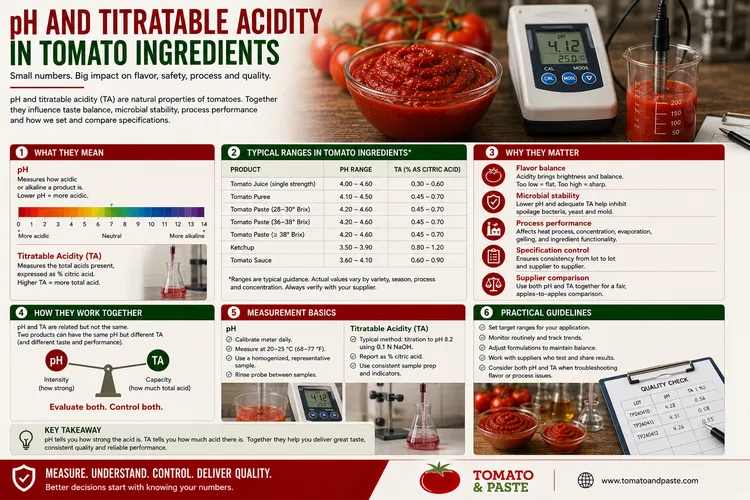
pH and titratable acidity are related measurements, but they describe different aspects of a tomato ingredient. Both can influence flavor balance, processing decisions and quality-control expectations in sauces, soups, beverages, prepared foods and other tomato-based products.
The specification is the commercial translation of finished-product performance. A relatively small change in acidity, solids, process type or tomato profile can shift perceived tartness, sweetness, savory balance and the amount of additional acid or other formulation adjustment required.
pH and titratable acidity are not the same
pH describes the acidity condition of the product at the time of measurement, while titratable acidity provides a broader indication of the total acid that can be neutralized under the selected analytical method. Two tomato ingredients can therefore have similar pH readings but different titratable acidity values.
For formulation work, the two measurements should be interpreted together with tomato solids and sensory performance rather than treated as interchangeable numbers.
Ingredient selection
Start with solids or Brix and process type, then add consistency, color, pH or acidity, finish, microbiology, package and lot documentation. These parameters provide the technical basis for comparing tomato ingredients.
For this topic, a logical first ingredient to evaluate is tomato paste and puree. Treat that as a formulation hypothesis rather than a fixed rule: the preferred ingredient is the one that meets the finished-product target for solids, flavor, acidity, texture and cost with reliable supply.
Why pH matters
pH can be an important process and quality-control parameter in tomato formulations. It may influence how a manufacturer designs or validates a process, and it can also provide a useful indicator of lot consistency.
The acceptable target depends on the exact finished product and manufacturing process. Ingredient pH should therefore be evaluated as one part of the complete formulation rather than as a stand-alone safety conclusion.
Why titratable acidity matters
Titratable acidity can help explain differences in perceived sourness and acid balance that are not fully described by pH alone. It is particularly useful when comparing tomato ingredients from different suppliers or crop conditions.
Where acidity is a purchasing parameter, confirm the analytical basis used by the supplier so results from different sources can be compared using compatible methods and reporting conventions.
Flavor balance
Tomato flavor is shaped by the interaction of acidity, sweetness, solids, aroma and savory character. A sample with stronger acidity may require a different balance of sugar, salt, spices or other ingredients in the finished formulation.
Sensory evaluation should therefore accompany analytical measurements. A technically similar pH does not guarantee that two tomato pastes will deliver the same perceived acid profile.
Relationship with Brix
Acidity should be considered alongside Brix or tomato-solids concentration. Concentrated paste contains more tomato solids per unit weight than puree or lower-Brix paste, so direct acidity comparisons can be misleading if concentration is ignored.
When screening suppliers, normalize candidate products to an equivalent tomato-solids contribution wherever practical before judging flavor and finished-product performance.
Process type
Tomato ingredients can also differ because of their processing history. Hot-break, cold-break and other process choices can influence viscosity, flavor and the way the ingredient behaves after dilution or heating.
Keep process type visible during acidity comparisons so a difference in finished performance is not incorrectly attributed to pH alone.
Sample preparation
Reliable comparison requires consistent sample preparation. Use the same dilution, water source, temperature, mixing conditions and measurement sequence for each candidate.
If measurements are taken on diluted samples, document the dilution method clearly. Results obtained under different preparation conditions should not be assumed directly comparable.
pH measurement
pH measurements should be made using the manufacturer's approved method and properly maintained equipment. Calibration, sample temperature, preparation and electrode condition can all influence measurement quality.
Record enough information to reproduce the test when pH is a critical incoming or in-process parameter. This is especially useful when investigating differences between supplier data and plant measurements.
Titratable acidity measurement
Titratable acidity should also follow a defined analytical method, including sample preparation, endpoint and reporting basis. Different methods or expression bases can produce values that appear different even when the underlying products are similar.
Before setting purchasing limits, align the supplier and customer on how acidity will be measured and reported.
Lot-to-lot consistency
Tomato is an agricultural raw material, so some natural variation between crops and lots can occur. The purchasing specification should distinguish acceptable variation from changes that could affect finished-product performance.
Track pH and acidity with Brix, consistency and sensory results over multiple lots to understand the supplier's normal operating range.
Finished-product impact
The ingredient should ultimately be evaluated in the actual formulation. Salt, sugar, starches, proteins, oils, vegetables and added acids can all change how tomato acidity is perceived and how the final product behaves.
For sauces, soups and prepared foods, confirm pH, sensory balance and texture after the intended heating and holding conditions rather than relying only on the incoming paste measurement.
Added acid and formulation adjustment
Some formulas include additional acids for flavor or process reasons. A change in the incoming tomato ingredient can alter how much adjustment is needed to reach the manufacturer's defined finished-product target.
Any acid addition should be controlled through the validated formulation and process rather than adjusted casually from sensory impressions alone.
Quality-control use
pH and titratable acidity can be useful lot-release or trend-monitoring parameters when appropriate limits and methods are defined. Repeated results outside the normal historical range may justify additional review even if other specification values remain acceptable.
Quality teams should interpret these measurements together with the COA, sample identity, Brix, process type and finished-product trial results.
Practical trial method
Run candidate ingredients in the actual formula at equal tomato solids whenever practical, and use consistent analytical methods so acidity and sensory comparisons are meaningful.
- Define the finished-product target, including tomato solids, flavor balance, pH or acidity requirements and process conditions.
- Collect the current specification, COA and representative sample from each candidate source.
- Record product type, Brix or solids, process type, pH, titratable acidity and any relevant finish or consistency data.
- Confirm that supplier acidity results use a clearly defined and comparable analytical method.
- Normalize candidate samples to an equivalent tomato-solids basis where concentration differs.
- Prepare samples using consistent dilution, water, temperature and mixing conditions.
- Measure pH and, where relevant, titratable acidity using the approved laboratory method.
- Run each candidate in the actual bench or pilot formula using representative process conditions.
- Evaluate finished pH, Brix or solids, viscosity, color, sensory profile and final yield.
- Repeat key checks after the relevant thermal process and storage condition.
- Document the approved supplier, specification, analytical methods and change-control triggers.
Specification development
Avoid setting unnecessarily narrow pH or acidity limits without understanding their relationship to finished-product performance. A specification should protect the attributes that matter while allowing realistic agricultural and process variation.
Historical lot data and controlled formulation trials can help establish limits that are technically meaningful rather than arbitrary.
Supplier comparison
Compare suppliers using the same analytical basis and equivalent tomato solids. Review not only the reported pH or acidity but also Brix, consistency, flavor, color, process type, pack and documentation.
The most suitable source is the one that repeatedly performs within the approved finished-product and process requirements, not necessarily the supplier with the highest or lowest acidity value.
Questions to ask the supplier
- What pH range is specified for this tomato ingredient?
- Is titratable acidity included in the product specification?
- How is titratable acidity measured and reported?
- What Brix or solids range applies?
- What process type applies to the product?
- How are pH and acidity monitored during production?
- Which values are guaranteed versus typical?
- What normal lot-to-lot variation should a buyer expect?
- How are consistency, color and finish controlled alongside acidity?
- What crop and origin apply to the quoted product?
- Can you provide a current specification and representative COA?
- What is the pack configuration, net weight and storage guidance?
- Which food-safety, quality and organic documents are available for the program?
- How are lots identified and traced?
- What specification, process or origin changes require customer notification?