
Why this matters
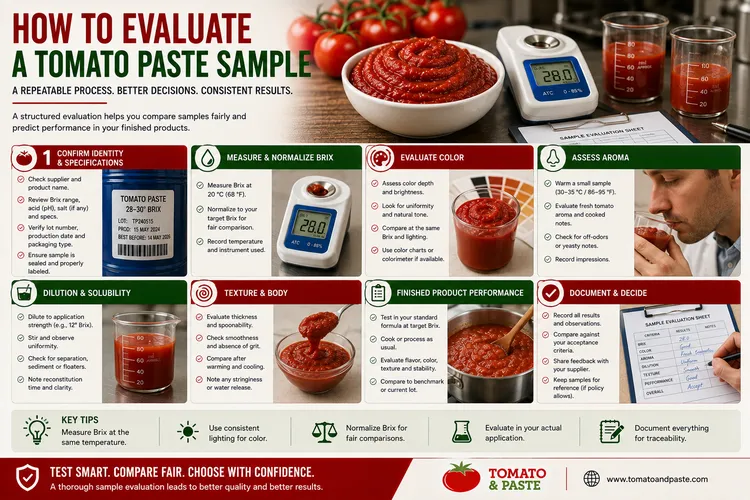
A tomato paste sample is most useful when it is evaluated against a defined specification and under repeatable conditions. Visual inspection alone can identify obvious differences, but commercial approval also depends on concentration, consistency, flavor, process behavior and finished-product performance.
The specification is the commercial translation of finished-product performance. An apparently small change in Brix, finish, process type, color or consistency can alter usage rate, water demand, pumping behavior, texture and overall sensory profile.
Confirm sample identity first
Before opening the sample, confirm the supplier, product description, lot or production reference, crop or origin where provided, process type and declared Brix or solids range. The sample should be tied to the commercial specification being considered.
Avoid approving an anonymous or laboratory-selected sample without understanding whether it represents normal commercial production. Sample evaluation is most valuable when the material can be traced to a defined product and source.
Ingredient selection
Start with solids or Brix and process type, then add consistency, color, pH or acidity, finish, microbiology, package and lot documentation. These attributes establish whether candidate samples are technically comparable.
For this topic, the logical starting point is representative tomato paste samples. Treat the first screen as an ingredient qualification step rather than a final sourcing decision: the preferred paste is the one that performs correctly in the intended formula and is supported by an acceptable commercial supply program.
Standardize the bench setup
Repeatable evaluation requires consistent equipment and preparation. Use the same sample quantity, containers, water quality, temperature, mixing method and observation sequence for every candidate.
Label samples clearly and, where useful, use coded containers during sensory comparison so supplier identity does not influence the initial judgment.
Inspect the undiluted paste
Begin with a direct visual and sensory check of the paste before dilution. Observe overall color, surface appearance, consistency and any visible separation or unexpected particles.
Aroma should be characteristic of the intended tomato paste style and should be evaluated consistently across candidates. Record unusual fermented, scorched, oxidized or otherwise atypical notes for follow-up rather than relying on memory.
Check Brix or solids
Brix or soluble-solids concentration is one of the most important variables in sample comparison because it determines how much tomato solid is delivered by a given weight of paste.
Compare measured or supplier-reported values with the quoted specification. Where candidates differ in concentration, use solids normalization before drawing conclusions about flavor strength, body or yield.
Normalize tomato solids
Two tomato pastes should not automatically be compared at the same weight if their Brix levels differ. A more concentrated sample will contribute more tomato solids and may appear stronger simply because more solids are present.
For a fair technical comparison, calculate the amount of each paste required to deliver an equivalent tomato-solids contribution, then adjust water accordingly.
Evaluate dilution behavior
Diluting tomato paste can reveal differences that are less obvious in the concentrated material. Use a defined paste-to-water ratio or normalize to the intended finished concentration.
Observe how readily the paste disperses, whether lumps remain, how quickly a uniform suspension forms and whether unusual separation becomes visible after standing.
Color evaluation
Compare color under consistent lighting, container geometry and dilution. Undiluted paste can look very dark, so a standardized dilution may provide a more practical comparison for some applications.
Color approval should ultimately be linked to the finished product. A paste that appears slightly different on the bench may become more or less noticeable after dilution, cooking and addition of spices, oils or other ingredients.
Aroma and flavor
Evaluate aroma first in the paste and again after standardized dilution. This helps distinguish concentrated notes from the flavor profile likely to be experienced in the final formulation.
Record tomato intensity, sweetness, acidity, cooked character and any undesirable notes. Where multiple people evaluate samples, use a simple agreed vocabulary so comments remain comparable.
Consistency and texture
Tomato pastes with similar Brix can still differ in consistency because of process type, raw-material characteristics and finishing. Bench observations can include spoonability, flow, body and visual smoothness.
Where consistency is a critical purchasing parameter, use the method specified by the buyer or supplier rather than relying solely on subjective appearance.
Finish and particle profile
Finish refers to the physical refinement of the paste and can influence smoothness, visible particles and downstream equipment performance. A finer product may suit smooth sauces, while another application may tolerate more texture.
Evaluate the diluted sample for skin fragments, seeds or other visible particles and relate those observations to the agreed finish or screen specification.
pH and acidity
pH or acidity can influence sensory balance and process requirements. Compare measured values where these parameters are part of the specification or important to the finished product.
Analytical results should be interpreted together with flavor. Two samples can have similar pH values yet differ in perceived acidity because of solids, sweetness and the wider flavor profile.
Compare process type
Hot-break and cold-break style pastes can behave differently in viscosity-sensitive applications. Make sure samples being compared belong to the intended process category unless the purpose of the trial is specifically to compare process types.
Process-type differences may become more apparent after dilution, heating or incorporation into the finished formula.
Run the actual formula
Bench screening should be followed by application testing in the intended product. Use the real formulation, ingredient addition order and representative processing conditions wherever practical.
Evaluate the attributes that matter commercially: finished Brix, pH, viscosity or Bostwick, color, flavor, yield, pumping behavior and any required water or thickener adjustment.
Evaluate after thermal processing
Heating can alter viscosity, flavor and color. If the finished product is cooked, pasteurized, hot-filled, retorted or otherwise thermally processed, evaluate candidate pastes after a representative heat treatment.
A sample that performs well in an unheated bench dilution may not behave identically after the full commercial process.
Check finished-product yield
Record the actual paste and water quantities needed to reach the finished-product target. This turns sample evaluation into a commercial comparison rather than a purely sensory exercise.
If one sample requires a different usage rate, additional thickener or process adjustment, include those changes when comparing total formulation cost.
Retain comparison samples
Where quality procedures allow, retain appropriately handled samples or finished trial product for later comparison. This can be useful when reviewing shelf-life behavior or reconciling differences between bench and plant-scale results.
Retained material should remain clearly labeled with supplier, lot, date and evaluation conditions so it does not become disconnected from the trial record.
Practical trial method
Use the same sequence for every supplier so technical teams can compare results rather than recollections. Normalize tomato solids before approving a source whenever concentration differs.
- Define the finished-product target and the tomato paste attributes that cannot change.
- Collect the current specification, sample COA or lot information and a representative commercial sample from each candidate source.
- Inspect the unopened sample and verify supplier, lot, product description and package condition.
- Record the declared or measured Brix or solids, process type, color, aroma and undiluted consistency.
- Normalize candidate samples to an equivalent tomato-solids basis where concentrations differ.
- Prepare a standardized dilution using controlled water quantity, temperature and mixing conditions.
- Compare dispersion, color, aroma, flavor, pH or acidity, texture and visible particle profile.
- Run each candidate in the actual bench or pilot formula using the real addition order and representative process conditions.
- Measure finished Brix or solids, viscosity or Bostwick, pH, color, sensory profile and final yield.
- Repeat the evaluation after the relevant thermal process and storage condition where applicable.
- Document the approved supplier, product specification, usage rate and change-control triggers.
Build a simple scorecard
A structured scorecard can help keep evaluations consistent. Separate analytical parameters, sensory observations, process performance and commercial factors rather than combining everything into one subjective rating.
Critical failures should remain visible even if the candidate scores well in other areas. For example, a strong color score should not compensate for an unacceptable specification or process issue.
Move from bench to plant scale
Bench approval reduces risk but does not fully reproduce commercial manufacturing. Before final approval, confirm the paste under representative plant conditions if the ingredient has a meaningful effect on pumping, mixing, heat transfer, filling or finished texture.
Record scale-related observations because a paste that is easy to handle in a small laboratory container may behave differently when unloaded from drums or processed at production throughput.
Commercial considerations
Sample evaluation should support a total-value decision. Compare the approved usage rate, solids yield, process performance, packaging, freight, documentation and supply reliability—not only the price per drum or metric ton.
The best sample is not necessarily the darkest, thickest or strongest-tasting paste. It is the ingredient that repeatedly meets the technical target and supports an acceptable finished-product cost and supply program.
Questions to ask the supplier
- Does this sample represent the quoted commercial product?
- What lot, crop and origin apply to the sample?
- What Brix or solids range is guaranteed?
- What process type applies?
- What consistency or viscosity specification applies?
- What finish or screen specification applies?
- How are color, pH and acidity controlled?
- Which values are guaranteed versus typical?
- Can you provide the current technical specification and sample COA?
- What is the normal commercial pack configuration and net weight?
- What storage guidance and shelf life apply?
- Which food-safety, quality and organic documents are available for the program?
- How are commercial lots identified and traced?
- Would future commercial production use the same manufacturing site and process represented by the sample?
- What specification, origin, process or packaging changes require customer notification?