
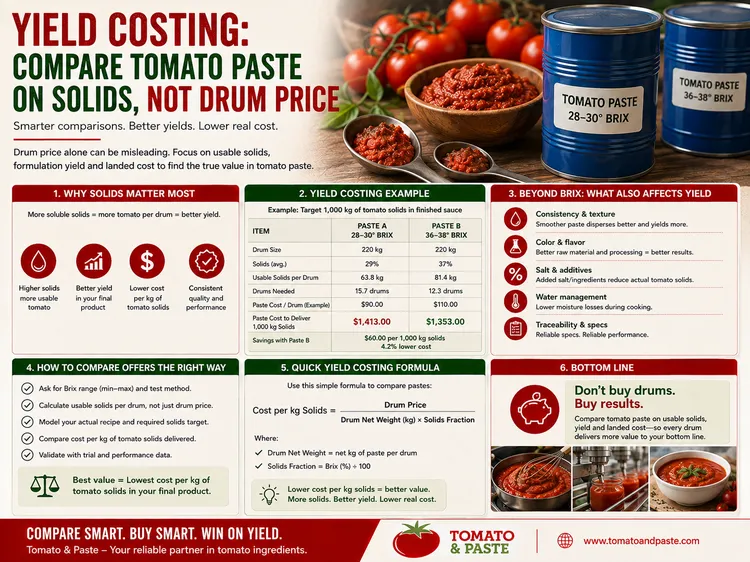
Why this matters
The tomato paste specification is the commercial translation of finished-product performance. A lower purchase price per drum does not necessarily mean a lower cost in the finished food if the paste contains fewer usable solids, requires a higher usage rate or creates additional formulation adjustments.
Normalize comparisons before approving a source. Even relatively small differences in Brix, consistency, finish, process type or moisture can change the amount of paste and water required in a batch, which in turn affects yield, freight efficiency, storage, handling and cost per finished unit.
Start with Brix and usable solids
Brix or soluble-solids concentration is one of the first variables to review when comparing tomato paste offers. A higher-solids paste generally contributes more tomato solids per kilogram, while a lower-solids paste may require a larger weight to reach the same formulation target.
The useful comparison is therefore not simply price per metric ton of paste, but price relative to the amount of tomato solids the product contributes to the finished formula.
Normalize before comparing price
Suppose two suppliers quote different Brix specifications. Comparing the quoted prices directly can obscure the fact that the formulations may require different paste quantities.
A practical costing model first converts each offer to a common solids basis. The commercial team can then estimate the amount of each paste required to deliver the same tomato-solids contribution and compare the resulting ingredient cost per batch or finished unit.
Ingredient selection
Start with solids or Brix and process type, then add consistency, color, pH or acidity, finish, microbiology, packaging and lot documentation. These attributes determine whether two pastes are truly interchangeable from a formulation and manufacturing standpoint.
For this topic, the logical starting point is tomato paste evaluated by solids yield. Treat that as part of a broader technical review: the preferred ingredient is the one that delivers the required finished-product performance at the lowest practical total cost with reliable supply.
Simple solids normalization
As a planning concept, usable tomato solids can be estimated by multiplying the paste quantity by its relevant solids concentration. If two products have different concentrations, the amount required to deliver the same solids contribution will differ.
This does not replace the supplier specification or plant trial, but it provides a more useful commercial starting point than comparing drum prices without considering concentration.
Cost per usable tomato solid
A buyer can convert the quoted paste price into an approximate cost per unit of tomato solids. This makes it easier to compare different Brix levels on a common basis before including freight, packaging and other commercial variables.
The lowest cost per tomato solid is not automatically the best option. The candidate must still meet viscosity, color, flavor, finish, microbiological and process requirements.
Finished-product yield matters
Ingredient costing becomes more meaningful when translated into finished-product yield. If one paste requires less product and more added water to reach the same target solids, that change can influence how many finished units are produced from a given amount of purchased tomato paste.
For sauces, soups, ketchup, prepared meals and similar products, calculate the cost contribution of the tomato paste at the actual finished-batch yield rather than stopping at the incoming ingredient price.
Water replacement and formula balance
A more concentrated paste may allow more process water to be added while maintaining the same tomato-solids target. Conversely, a lower-concentration paste may bring more water into the batch and reduce the amount of separate water required.
These changes can affect batch weights, mixing sequence and sometimes texture or processing behavior. Formula comparisons should therefore maintain equivalent finished solids wherever possible.
Consistency and viscosity
Two pastes with similar Brix can still produce different finished viscosities because process type, consistency and finish may differ. Yield costing should therefore include the possibility that one paste requires changes to water, starch, gum or other texture-building ingredients.
A nominally cheaper paste can become more expensive if additional thickener is needed or if the product creates lower line efficiency. Technical and commercial evaluation should be performed together.
Process type and functionality
Hot-break and cold-break style products can behave differently in finished formulations even when their concentration appears similar. The appropriate choice depends on the texture and process requirements of the finished product.
Do not normalize solely on Brix and assume functional equivalence. Use solids normalization to establish a fair costing basis, then confirm process and sensory performance through controlled trials.
Color, flavor and finish
Color, flavor and finish can also influence usable value. If one candidate requires a higher usage rate to reach the target tomato flavor or produces a color that needs correction elsewhere in the formulation, the apparent raw-material saving may disappear.
The most useful costing model therefore combines normalized tomato solids with the actual usage rate needed to achieve the approved finished-product profile.
Packaging efficiency
Industrial tomato paste may be supplied in drums, bins or other bulk formats. Net weight per package, pallet configuration and residual product left in the liner or container can influence effective usable yield.
When comparing sources, confirm net product weight and practical emptying performance. Small losses per package can become meaningful at high annual volumes.
Freight and landed solids
Freight is paid on the physical product and packaging, not only on tomato solids. Higher concentration can therefore improve the amount of tomato solids transported per shipment, although the actual advantage depends on pack configuration, route and freight rate.
A useful procurement comparison calculates landed cost per usable tomato solid after including product price, freight, duties where applicable and normal handling expenses.
Warehouse and handling impact
Concentration can also affect the number of drums or pallets required for a given production volume. Fewer packages may reduce warehouse space, handling movements and packaging disposal requirements.
These savings may be secondary to ingredient cost, but they can become material in high-volume programs and should be included where the differences are significant.
Plant efficiency
The lowest calculated ingredient cost is not necessarily the lowest manufacturing cost. Pumping behavior, drum emptying, dilution time, filtration, blending and line throughput can all affect total economics.
Plant trials should record any meaningful operating differences so purchasing decisions reflect both raw-material cost and production performance.
Practical trial method
Run candidate ingredients in the actual formula at equal tomato solids whenever possible. Keep process conditions controlled so sensory, viscosity and yield comparisons are meaningful.
- Define the finished-product target, including target tomato solids, viscosity, color, flavor and final batch yield.
- Collect current specifications, COAs, prices, pack information and representative samples from each candidate supplier.
- Normalize each candidate to an equivalent tomato-solids contribution before comparing usage rates.
- Calculate the paste quantity and water adjustment required for the same finished formulation target.
- Run a controlled bench or pilot batch using the real addition order and process conditions.
- Measure Brix or solids, pH, viscosity or Bostwick, color, sensory profile and final batch yield.
- Record any changes in thickener, water, processing time or line behavior required by the candidate paste.
- Calculate ingredient cost per finished batch, kilogram or saleable unit using the actual trial usage rate.
- Add freight, packaging and other relevant landed-cost differences.
- Document the approved supplier, specification, costing basis and change-control triggers.
A practical costing framework
For internal comparison, build a simple worksheet that lists quoted price, Brix or solids, required paste quantity, water adjustment, finished batch yield, freight, package efficiency and any formula changes. This creates a transparent basis for technical and purchasing teams to review the same assumptions.
The model should use the same units and commercial terms for every supplier. If one quotation is ex-works and another is delivered, or one includes different pack weights, normalize those differences before drawing conclusions.
Specification tolerance
Costing should consider the agreed specification range rather than relying only on a single nominal value. If a paste is sold within a Brix range, the commercial model should understand how normal lot variation could influence usage rate.
Where concentration has a material impact on cost, confirm how incoming lots are tested and how formula adjustments are managed when actual values vary within the approved specification.
Commercial considerations
Compare offers on total delivered value: usable tomato solids, finished-product yield, process performance, packaging efficiency, freight, documentation and continuity of supply. Unit price is only one component.
A higher-priced paste may produce a lower finished-product cost if it provides more usable solids, reduces usage rate or performs better in the plant. Conversely, a high-Brix product is not automatically the best value if its functionality, flavor or specification does not match the application.
Questions to ask the supplier
- What Brix or solids range is guaranteed for the product?
- Is the quoted price based on a fixed concentration or a specification range?
- What process type applies to the paste?
- What consistency or viscosity parameters are guaranteed?
- What finish or screen specification applies?
- How are color, pH and acidity controlled?
- What crop and origin apply to the quoted program?
- Which parameters are guaranteed versus typical?
- What is the exact net weight per drum, bin or package?
- What pallet and container loading configuration applies?
- What storage guidance and shelf life apply?
- Which food-safety, quality and organic documents are available?
- How are lots identified and traced?
- What specification or process changes require customer notification?