
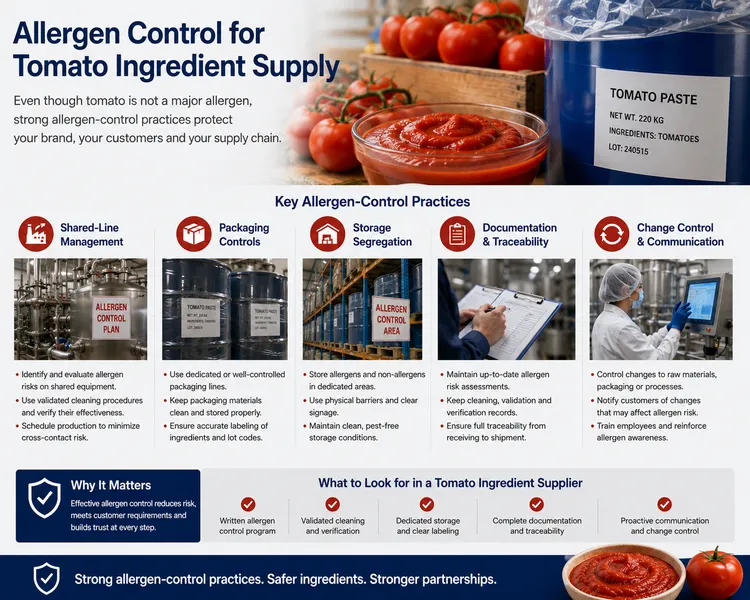
Why this matters
Allergen review for tomato ingredients should consider the complete supply environment, not only the inherent composition of the tomato product. A tomato paste, puree, diced product or concentrate may be simple in composition, but the manufacturing site can also handle other materials on shared equipment, in adjacent areas or through common warehousing and transport systems.
A robust control plan therefore links product-specific documentation with facility practices, sanitation, packaging controls, traceability and supplier change management. The objective is to understand whether the conditions under which the ingredient is manufactured, packed and stored are compatible with the buyer's finished-product requirements.
Product-specific review
Use product-specific specifications and allergen statements rather than assuming that one declaration applies to every tomato ingredient from the same supplier. Paste, puree, diced, clarified and dry tomato products may be made at different facilities, on different lines or in different packaging areas.
Buyers should confirm that the documentation identifies the exact product and manufacturing location whenever possible. This is particularly important when a supplier operates multiple factories or sources similar ingredients from more than one approved processing site.
Shared-line considerations
One of the first questions to clarify is whether the tomato ingredient is produced on dedicated equipment or on equipment that also processes other products. If equipment is shared, understand which materials are handled on the line, how production sequencing is managed and what sanitation procedures are used between product runs.
The existence of shared equipment does not by itself define the finished risk. What matters is the supplier's documented control system, including scheduling, cleaning procedures, verification practices and deviation handling. Customer requirements should therefore be communicated clearly before commercial approval.
Sanitation and changeover controls
Where shared equipment is used, cleaning and changeover procedures become an important part of the supplier review. Buyers may wish to understand how cleaning procedures are documented, how operators verify completion and what records are retained.
The relevant level of review depends on the customer's own allergen-management program and intended finished product. Supplier documentation should be sufficiently clear for the customer to determine whether the ingredient can be accepted under its internal risk assessment.
Packaging-area controls
Allergen control should extend beyond processing equipment. Packaging materials, rework practices, open-product handling and traffic patterns can create additional points that need to be understood. Ask whether different products share filling or packing areas and how identification and segregation are maintained.
Packaging controls should also support correct product identity. Lot coding, label verification and pack identification help reduce the risk of mix-ups and make subsequent traceability more effective if a question arises.
Warehouse and storage practices
Finished tomato ingredients may be stored alongside many other food products. Warehouse controls should therefore support clear product identification, intact packaging, segregation where required and appropriate handling of damaged units.
When allergen-sensitive programs are involved, buyers may also want to understand whether allergen-containing materials are stored in the same warehouse and what controls prevent accidental mix-up, leakage or cross-contact during handling.
Transportation and distribution
The supply chain can extend beyond the manufacturing plant. Depending on pack format, ingredients may move through external warehouses, distributors or common-carrier networks before reaching the customer.
Confirm who controls transport, how pack integrity is maintained and how damaged or incorrectly identified shipments are handled. For bulk formats, additional questions about prior loads, cleaning practices and transport suitability may also be appropriate to the customer's risk assessment.
Documentation to review
A current allergen statement is a useful starting point, but it should be read together with the product specification and site-specific quality documentation. The statement should be clear enough for the customer to understand whether relevant allergens are ingredients, are handled in the facility or are associated with shared equipment or storage.
Review dates and revision control are also important. An allergen statement prepared several years earlier may no longer reflect current production conditions if the supplier has added products, moved equipment or changed manufacturing sites.
Practical supplier-qualification method
- Define the exact tomato ingredient, pack format, manufacturing site and intended finished-product use.
- Obtain the current product specification, allergen statement and relevant quality documentation.
- Confirm whether the product is manufactured on dedicated or shared equipment.
- If equipment is shared, identify which allergen-containing materials are relevant and review sanitation and changeover controls.
- Review packaging-area, warehouse and product-identification practices.
- Confirm lot coding, traceability and the procedure used for handling deviations or customer complaints.
- Define which facility, formulation, line or process changes require customer notification.
- Document the approved supplier, product, site and allergen-control conditions in the customer's supplier-management system.
Change management
Allergen status should be treated as controlled supplier information rather than a one-time statement collected during initial approval. A supplier may add new products to a shared line, change sanitation procedures, relocate manufacturing or introduce a different packaging operation.
Buyers should therefore define which changes require notification and determine whether revised documentation, additional review or requalification is needed before the modified supply arrangement is accepted.
Traceability and incident response
Effective traceability supports rapid investigation if an allergen-related question or labeling concern arises. The supplier should be able to connect the delivered lot to the relevant production records, manufacturing date and site.
Complaint and deviation procedures should also define how potentially affected material is identified, contained and investigated. Clear communication between supplier and customer is especially important when an incident could affect finished-product labeling or market disposition.
Questions to ask the supplier
- What exact product and manufacturing site does the allergen statement cover?
- Is the tomato ingredient manufactured on dedicated or shared equipment?
- If equipment is shared, which allergen-containing products are handled on the same line?
- How are production sequencing and sanitation changeovers controlled?
- How is cleaning completion documented or verified?
- Are allergen-containing materials handled elsewhere in the same facility?
- Are filling or packaging areas shared with other food products?
- How are packaging materials, labels and finished lots identified and controlled?
- What warehouse segregation and damaged-pack procedures are used?
- How are lots identified and traced through production and distribution?
- Which food-safety, quality and organic documents are available for this program?
- How frequently is the allergen statement reviewed or reissued?
- What facility, formulation, equipment or process changes require customer notification?