
Why this matters
Foreign-material control is not a single inspection step. A robust control plan links incoming agricultural controls, processing safeguards, measurable acceptance criteria and finished-product verification to the actual risk of the ingredient. Controls should be appropriate for the tomato format, processing route and intended use.
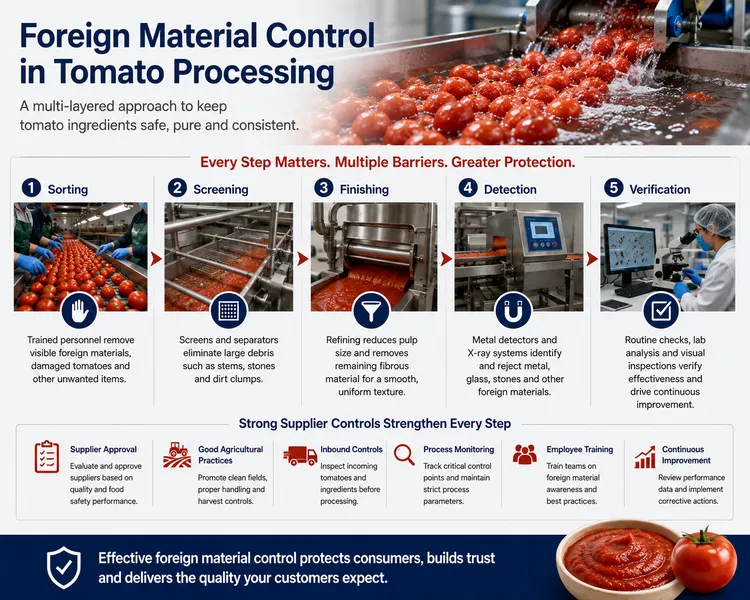
Tomato raw material originates in an agricultural environment, so processors typically rely on multiple preventive and removal steps rather than expecting one device or final inspection to provide complete control. Effective programs combine supplier and field practices, receiving inspection, washing, sorting, screening, finishing, equipment maintenance, detection systems, packaging controls and documented verification.
Product-specific risk assessment
Use product-specific specifications rather than copying a generic paste specification onto diced, dry, clarified or other tomato ingredients. The relevant controls can differ according to particle size, processing method, equipment configuration and final pack.
For example, an ingredient containing visible tomato pieces has different physical characteristics from a finely finished paste or clarified concentrate. Buyers should therefore understand where potential foreign material can enter the process, which controls are used at each stage and which defects the selected equipment is capable of removing or detecting.
Incoming raw-material controls
Foreign-material prevention begins before concentration or finishing. Processors may establish requirements for harvested tomatoes, field practices, transport equipment and receiving conditions. Loads can be inspected before processing, and unsuitable raw material can be rejected, segregated or subjected to additional review.
Washing and initial sorting help remove soil, plant material and other unwanted material associated with agricultural handling. The effectiveness of these steps depends on equipment design, operating conditions, inspection practices and the nature of the material being controlled.
Sorting and inspection
Sorting can occur at multiple stages and may involve manual inspection, mechanical separation or automated optical systems depending on the facility and product. The objective is to identify and remove unsuitable tomatoes, plant matter or other detectable material before it progresses further into the process.
Buyers evaluating a supplier should ask where sorting occurs, what technology is used, how performance is checked and what happens when inspection results exceed the processor's established limits.
Screening and finishing
Screening and finishing are particularly important for products such as puree and paste because they help control particle size and remove material that should not remain in the finished product. Screen or finisher configuration should be appropriate to the product definition and targeted texture.
A buyer should understand the relevant screen or finish specification, how equipment condition is verified and what controls are used if a screen, sieve or other physical barrier is damaged. Maintenance and pre-operational inspection records can be an important part of the overall control system.
Detection systems
Depending on the process, product and packaging format, processors may use detection or separation systems as an additional control. These systems should be selected for the hazards and materials they are technically capable of addressing and should be operated within validated or verified limits.
When reviewing a supplier, ask where detection equipment is positioned, how frequently its performance is checked, what test standards are used and what corrective action follows a failed verification. Detection equipment should be treated as one layer of a broader prevention program rather than a substitute for good manufacturing controls.
Equipment and maintenance controls
Equipment condition can itself influence foreign-material risk. Preventive maintenance, inspection of food-contact equipment and controlled replacement of worn or damaged components help reduce the possibility of process-related contamination.
Supplier programs should clearly define responsibility for inspecting screens, seals, gaskets, blades, filters and other relevant components. Where breakage or abnormal wear occurs, the processor should have documented procedures for product isolation, investigation, disposition and restart.
Sampling and acceptance criteria
Define sampling, acceptance limits, retain samples, escalation rules and documentation ownership before the first commercial delivery. A specification is most useful when both supplier and customer understand how conformity will be evaluated and what happens when a result falls outside the agreed range.
Sampling plans should reflect the product, pack size, lot structure and intended risk assessment. A small laboratory sample cannot prove the complete absence of foreign material from a commercial lot, so sample inspection should complement rather than replace evaluation of the supplier's preventive process controls.
Practical supplier-qualification method
- Define the tomato ingredient, intended use and foreign-material attributes that are important to the finished product.
- Obtain the current product specification, process description and relevant food-safety or quality documentation.
- Identify the principal prevention, sorting, screening, finishing and detection steps used for that specific ingredient.
- Review how screens, detectors and other control devices are verified and how failures are handled.
- Establish agreed sampling methods, acceptance criteria, retain-sample requirements and escalation procedures.
- Evaluate representative commercial samples for product conformity and relevant physical defects.
- Confirm lot coding, traceability and the supplier's procedure for investigating complaints or deviations.
- Document the approved supplier, product specification and changes that require customer notification or requalification.
What to document
Foreign-material control is easier to manage when the commercial specification and quality agreement clearly define responsibilities. Documentation should identify the product, lot, applicable criteria, test or inspection method and the party responsible for reviewing results.
For significant deviations, retain enough information to reconstruct the event. Useful records can include production date, lot coding, inspection results, equipment checks, affected quantity, product disposition, root-cause investigation and corrective or preventive action.
Change management
Supplier approval should not be viewed as permanent regardless of process changes. A new production site, major equipment modification, altered screen configuration, new packaging system or substantial process change may affect the foreign-material control profile.
Define which changes require advance customer notification and determine whether the change requires documentation review, new samples, additional testing or full requalification before routine supply continues.
Questions to ask the supplier
- What product definition, process and crop/origin apply to this lot?
- What foreign-material criteria are included in the commercial specification?
- Which controls are used at raw-material receiving and initial sorting?
- What screening, finishing or filtration steps apply to this specific product?
- How are screens, sieves and other physical barriers inspected and verified?
- Which detection or separation systems are used, and where are they located in the process?
- How is detection-system performance verified and documented?
- What happens when a control check or verification fails?
- Which parameters are guaranteed versus typical?
- What is the pack configuration, net weight and storage guidance?
- Which food-safety, quality and organic documents are available for this program?
- How are lots identified and traced?
- What retain-sample and complaint-investigation procedures are used?
- What process, equipment or site changes require customer notification?