
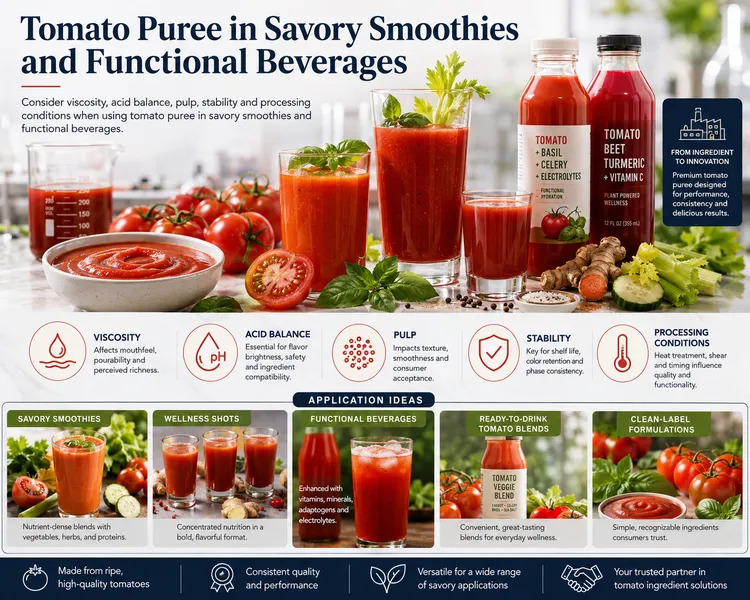
Why this matters
Liquid tomato systems require attention to pulp, turbidity, acidity, salt, aroma and suspended-solids behavior in addition to flavor. In a tomato-based formulation, an apparently small change in solids, finish, particle size or process history can alter yield, pumping behavior, sensory profile and the amount of water or thickener required.
These effects can become especially noticeable in savory smoothies and functional beverages because the product is consumed directly rather than incorporated into a larger recipe. Texture that is acceptable in a sauce may feel excessively heavy in a drink, while insufficient suspended solids can produce a thin appearance, serum separation or sediment during storage.
Ingredient selection
Choose juice for a direct beverage base, juice concentrate for reconstitution efficiency, puree for body, and clear concentrate for savory intensity with less visible pulp. For this topic, a logical first ingredient to evaluate is tomato puree. Treat that as a formulation hypothesis rather than a fixed rule: the best answer is the ingredient that meets the finished-product target at an acceptable total cost and with reliable supply.
When comparing puree options, review soluble-solids level, consistency, screen or finish, color, acidity and flavor profile together rather than evaluating Brix alone. Two products with similar nominal solids can behave differently in the finished beverage because pulp structure, processing intensity and raw-material characteristics influence mouthfeel and suspension.
Viscosity and drinking texture
The desired consistency depends on how the finished beverage will be positioned. A spoonable vegetable smoothie can tolerate considerably more body than a drink intended for a bottle, straw or single-serve functional shot. Establish the target texture before selecting the tomato ingredient so supplier samples can be evaluated against the same practical endpoint.
Evaluate viscosity at the actual serving temperature whenever possible. Temperature can change perceived thickness, and a formulation that moves easily through process equipment while warm may feel substantially heavier once chilled.
Acid, salt and flavor balance
Tomato naturally contributes acidity, sweetness, umami and characteristic volatile notes. In savory beverages these components interact with salt, spices, vegetable ingredients, acids and sweeteners. Increasing tomato solids can strengthen color and tomato identity, but it may also require adjustment of seasoning or dilution to maintain a clean, drinkable flavor.
Measure finished-product pH rather than assuming the tomato ingredient alone determines acidity. Other vegetables, seasonings, acids and functional ingredients can shift the final system. The required thermal process and shelf-life strategy should be validated for the complete finished formulation.
Pulp and physical stability
A beverage with suspended tomato pulp should be evaluated for both immediate appearance and stability over time. Look for sediment, serum separation, pulp flotation, ring formation around the container and changes in pour behavior. Homogenization, shear, particle size and the interaction of tomato solids with other vegetable fibers or stabilizers can all influence the final result.
If a product will be distributed through multiple temperatures or stored for an extended period, evaluate samples after the relevant storage cycle rather than relying only on observations made immediately after production.
Practical trial method
Evaluate the ingredient at final serving dilution and after the intended heat treatment. Measure sedimentation or phase separation over the expected shelf-life pathway, and keep the process conditions consistent when comparing suppliers.
- Define the finished-product target, including serving temperature, viscosity, flavor intensity, appearance and attributes that cannot change.
- Collect current technical data and a representative sample from each candidate source.
- Normalize tomato solids or concentration before comparing usage rates.
- Run a controlled bench or pilot batch using the real addition order and process conditions.
- Measure relevant attributes such as Brix/solids, pH, viscosity or Bostwick, color, yield and sensory profile.
- Observe suspension, sedimentation, serum separation and pour behavior at the intended serving temperature.
- Repeat the evaluation after the relevant thermal process and storage condition.
- Document the approved supplier, specification, operating range and change-control triggers.
Process variables to watch
Mixing order can matter in beverages containing tomato puree, vegetable powders, fibers, gums, proteins or mineral ingredients. Record when the puree is introduced, the temperature at addition and the amount of shear applied. This makes it easier to distinguish an ingredient difference from a process difference when reviewing trial results.
Also compare the product before and after the intended thermal process. Heating can change flavor perception, color and consistency, while pumping, homogenization and filling conditions can further modify suspended-solids structure.
Commercial considerations
Ingredient price per kilogram should not be the only purchasing comparison. A more concentrated product may require a lower inclusion rate, while a puree with the desired body may reduce the need for additional texture adjustment. Compare suppliers on equivalent tomato solids and finished-product yield, then include freight, pack utilization, handling, storage and production efficiency in the cost model.
Questions to ask the supplier
- What product definition, process and crop/origin apply to this lot?
- What are the typical and guaranteed Brix or soluble-solids ranges?
- How is consistency measured, and what range is supplied?
- What finish, screen or particle-size characteristics should be expected?
- Which parameters are guaranteed versus typical?
- What is the pack configuration, net weight and storage guidance?
- Which food-safety, quality and organic documents are available for this program?
- How are lots identified and traced?
- How much crop-to-crop or lot-to-lot variation should the customer expect?
- What changes require customer notification?