
Why this matters
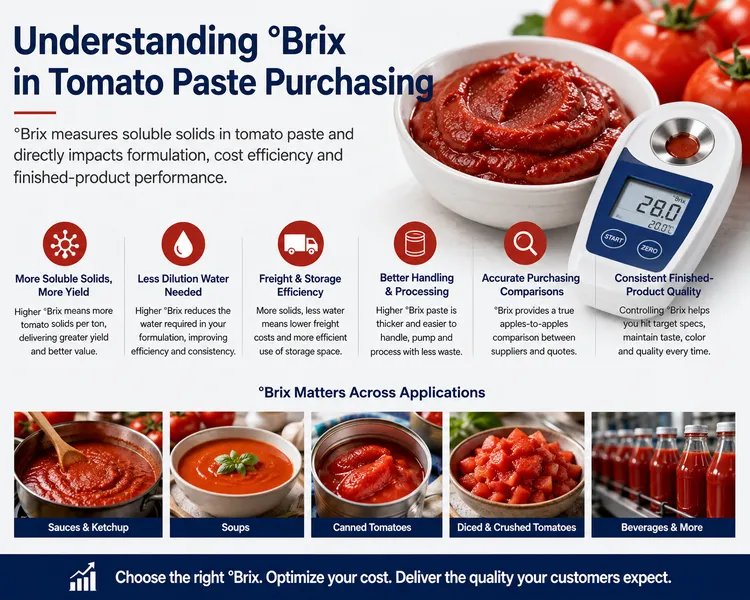
°Brix is one of the first numbers buyers see on a tomato paste specification because it provides a practical indication of concentration. That concentration directly affects how many kilograms of paste are required to deliver a given amount of tomato solids into the finished product.
The specification is still the commercial translation of finished-product performance. Brix should therefore be considered together with process type, viscosity, color, pH or acidity, flavor, finish, packaging and lot documentation rather than treated as a complete description of paste quality.
What °Brix represents
In tomato paste purchasing, °Brix is used as a working measure of soluble-solids concentration. A higher Brix generally means the paste carries more concentrated tomato solids and less water per kilogram.
This is important because the same finished-product solids target can be reached with different combinations of paste and added water depending on the incoming Brix.
Ingredient selection
Start with the concentration required by the formulation, then consider process type, consistency, color, pH or acidity, finish, microbiological requirements, package format and lot documentation.
For this topic, a logical first comparison is 28–30° Brix or 36–38° Brix tomato paste. Treat those ranges as commercial concentration options rather than automatic quality levels. The preferred grade is the one that works best in the actual formula and supply chain.
Higher Brix means more concentrated tomato solids
When the Brix increases, fewer kilograms of paste are normally required to contribute the same quantity of tomato solids. The formulation then uses more process water to reach the intended final composition.
This can influence freight, storage and ingredient handling, but it may also change how the paste must be unloaded, pumped, diluted and dispersed at the plant.
Lower Brix means more water arrives with the paste
A lower-Brix paste contains more water for the same purchased weight. More paste is therefore required to deliver the same tomato-solids contribution.
That is not necessarily a disadvantage. Depending on the formulation and equipment, a lower-concentration paste may fit existing dilution, pumping or batch procedures more naturally.
Normalize samples before comparing them
One of the most common mistakes in supplier trials is comparing two pastes at the same ingredient weight even though their Brix values differ. This introduces different quantities of tomato solids and can distort conclusions about flavor, viscosity, color and yield.
The first comparison should therefore normalize the amount of paste to equivalent tomato solids wherever practical. Water can then be adjusted so each trial begins from a comparable formulation basis.
Use a simple solids balance
A useful trial record includes the incoming Brix, paste weight, added water and finished batch weight. This allows product-development and operations teams to see whether differences result from concentration or from true ingredient performance.
Once the paste is approved, a controlled solids calculation can also help production adjust for normal Brix variation within the supplier's specification range.
Brix and finished-product yield
Higher concentration can improve finished-product yield per kilogram of purchased paste because more tomato solids are supplied in each kilogram. The actual economic benefit depends on the finished formula and the amount of water that must be added at the plant.
Compare the kilograms of saleable finished product generated from a defined amount of paste rather than looking only at the paste usage rate.
Brix and dilution water
Water addition should be calculated deliberately when changing concentration. A formula designed around 28–30° Brix paste cannot normally use the same paste and water weights unchanged when switching to 36–38° Brix.
Record the approved water adjustment for each concentration range so production does not depend on informal operator corrections.
Brix and freight efficiency
More concentrated paste moves more tomato solids per kilogram of transported product. For long-distance supply chains, this can improve freight efficiency on a usable-solids basis.
Freight should therefore be compared per equivalent quantity of tomato solids rather than per tonne of paste alone.
Brix and warehouse space
A higher concentration may reduce the amount of paste inventory needed to support a given production volume. This can reduce the number of drums or bins required for the same quantity of tomato solids.
Storage economics still depend on pack dimensions, stacking rules, inventory strategy and normal replenishment lead time.
Brix does not define viscosity
Two tomato pastes can have the same Brix and still behave differently in viscosity or Bostwick. Process type and the condition of insoluble tomato solids make an important contribution to consistency.
Do not assume that a higher-Brix paste will automatically produce a thicker finished product after both samples are normalized to the same tomato-solids level.
Hot break and cold break still matter
Hot-break and cold-break processing can influence consistency, flow, color and sensory characteristics independently of Brix.
If the purpose of a trial is to understand concentration alone, compare pastes with similar process type and viscosity targets wherever possible.
Brix does not define color
Concentrated paste may appear visually darker when inspected directly, but the finished-product comparison should be made after normalization, dilution and the intended thermal process.
Review supplier color data separately and confirm whether the candidate produces the required finished-product appearance.
Brix does not define flavor
Tomato flavor depends on more than concentration. Crop characteristics, processing history and the balance of tomato components can affect aroma, sweetness, acidity, cooked character and bitterness.
Compare sensory performance after equal-solids adjustment so one sample is not favored simply because the trial contains more tomato solids.
Brix and purchasing price
Price per kilogram or tonne should not be compared without accounting for concentration. A higher-priced paste may still deliver a competitive cost per unit of usable tomato solids.
Purchasing models should consider concentration, freight, pack size, product recovery and finished-product yield together.
Compare cost per usable tomato solids
A more useful commercial comparison starts with how much usable tomato solids each offer delivers after accounting for actual concentration and normal product recovery.
From there, add freight, handling, storage and any formulation changes required to determine the true delivered value.
Product recovery can change the economics
Paste remaining in an aseptic liner, drum or bin represents tomato solids that were purchased but never entered the formulation. Record residual material during plant trials where unloading efficiency is commercially important.
This can be particularly relevant for higher-concentration products because each kilogram of unrecovered paste contains a greater concentration of tomato solids.
Pumping and handling
Concentration can affect practical handling. Review whether the plant's unloading and transfer equipment can efficiently move the approved paste from its package to the production vessel.
Pump capability, hose dimensions, transfer distance, package emptying method and line-side space can all influence the preferred Brix range.
Incoming Brix should be connected to production
If the formula is adjusted according to the actual incoming Brix, the released supplier or internal test result must be available before batching begins.
Purchasing, receiving, quality and production should use the same approved lot information so water and paste adjustments are based on the correct material.
Understand the supplier's Brix range
A commercial grade is usually specified as a range rather than one exact number. Buyers should understand the guaranteed minimum and maximum and determine whether the formula can tolerate normal variation within that range.
If formula water changes with actual Brix, document the adjustment method and the responsible function.
Practical trial method
Run candidate paste in the actual formula at equivalent tomato solids whenever possible. Record paste and water weights carefully so concentration effects remain separate from other technical differences.
- Define the finished-product target, including final solids, viscosity, color, flavor and yield requirements.
- Collect current specifications, COAs and representative samples from candidate suppliers.
- Record incoming Brix, process type, viscosity or Bostwick, pH, color and finish.
- Calculate the paste quantity required to provide equivalent tomato solids in each trial.
- Adjust added water so the batches begin from the same intended formulation basis.
- Run controlled bench or pilot batches using the real addition order and process conditions.
- Measure finished Brix, pH, viscosity or Bostwick, color, yield and other relevant attributes.
- Evaluate tomato flavor, aroma and overall sensory balance after the intended thermal process.
- Record pumping, unloading and product-recovery observations where these affect the commercial decision.
- Document the approved supplier, Brix range, formulation adjustment and change-control triggers.
What to record during trials
- Ingredient lot & COA
- Incoming Brix
- Process type
- Viscosity / Bostwick
- Paste weight
- Water addition
- Equivalent tomato solids
- Batch weights
- Process temperature/time
- Final Brix
- pH / acidity
- Color & sensory
- Product recovery
- Finished yield
Use the same basis for supplier comparisons
Supplier quotations should be translated into a common commercial basis before a purchasing decision is made. Compare concentration, pack weight, freight, usable solids and expected finished yield using the same assumptions.
This prevents a lower unit price from looking artificially attractive when the paste contains less usable tomato solids.
Do not use Brix as the only acceptance criterion
A paste can be within the approved Brix range and still fail another critical technical requirement. Incoming and supplier specifications should maintain the other attributes necessary for the intended application.
- Process type
- Viscosity / Bostwick
- pH / acidity
- Color
- Finish
- Sensory profile
- Microbiological requirements
- Package integrity
- Lot documentation
Questions to ask the supplier
- What exact Brix range is guaranteed for this tomato paste?
- How is Brix measured and reported on the COA?
- What normal lot-to-lot Brix variation should buyers expect?
- Is the paste hot break, cold break or another defined process type?
- What viscosity or Bostwick specification applies?
- What pH, acidity, color and finish ranges apply?
- Which parameters are guaranteed versus typical?
- What crop/origin and manufacturing site apply to the product?
- What pack format and exact net weight apply?
- What storage and unloading guidance is recommended?
- Which food-safety and quality documents are available?
- How are lots identified and traced?
- What concentration, process, specification, site or packaging changes require customer notification?
Define the approved Brix strategy
Once qualification is complete, document the Brix range that the plant can use and the formula adjustment required when the incoming value varies within that range.
Keep the adjustment linked to the approved product specification so purchasing, quality and production teams use the same basis when alternate lots or suppliers are introduced.