
Product overview
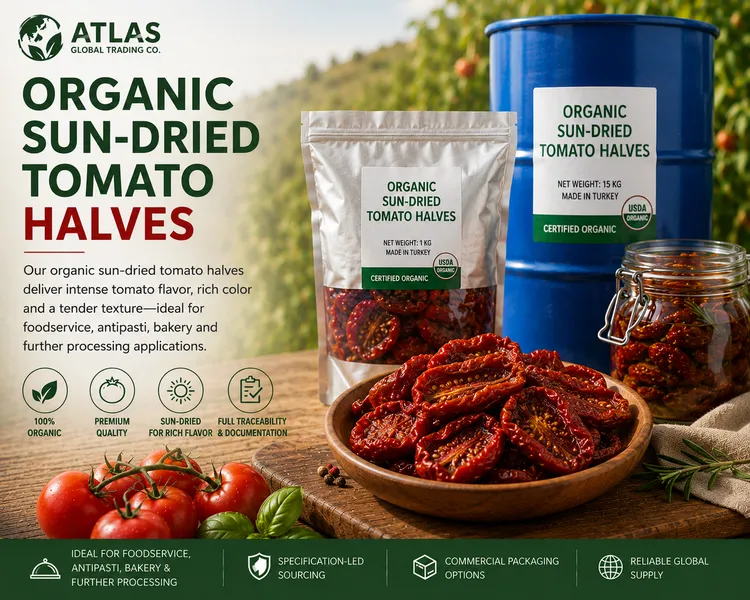
Organic sun-dried tomato halves are halved tomatoes dried to reduce moisture and concentrate natural tomato flavor. The half format retains a substantial visible piece size, making it suitable for antipasti, foodservice presentations, salads, bakery products and manufacturing programs that require further cutting or marination.
Compared with julienne or diced formats, halves give the buyer greater flexibility over final piece size. They can be used whole, sliced, chopped or further processed according to the needs of the finished application.
Atlas Global Trading Co. sources tomato ingredients through a multi-origin network of farms, processors and supply partners. We match the ingredient to the customer’s organic certification requirements, moisture and texture target, preservation preferences, commercial pack format, documentation, destination and supply program.
Specification focus
Moisture is a primary purchasing parameter because it strongly affects texture, handling and downstream hydration. Lower-moisture halves generally provide a firmer, chewier bite, while higher-moisture programs can offer a softer texture and faster hydration in wet applications.
Salt level and preservation system should also be defined. Depending on the processor and destination requirements, programs may differ in salt content and permitted preservation approach. Buyers should review the complete ingredient statement and current technical specification rather than assuming all sun-dried tomato halves are equivalent.
Color can be commercially important, especially where the halves remain visible in antipasti, salads or bakery products. Buyers may define an acceptable color range together with tolerances for darkened pieces, uneven drying or other appearance defects.
Size and piece integrity may also be specified. Programs can differ in tomato variety, half-piece dimensions and the amount of broken material, so applications requiring strong visual consistency should establish acceptable tolerances before approval.
Quality and defect review
Dried tomato specifications may address mold, foreign material, damaged fruit, excessive discoloration and other product-specific defects. Exact acceptance limits should be agreed with the selected processor and verified through the current specification and lot documentation.
Microbiological requirements can vary by application and destination. Buyers should communicate any customer-specific or process-specific limits during the inquiry so the proposed supply program can be reviewed against those requirements.
Texture and rehydration behavior
Sun-dried tomato halves absorb moisture from surrounding ingredients during soaking, marination, cooking or storage in a prepared food. The rate and degree of softening depend on initial moisture, piece thickness, temperature, contact time and the composition of the surrounding liquid.
For antipasti or salad applications, buyers may prefer a defined chewy texture that remains intact after marination. In sauces, fillings or ready meals, a softer texture may be desirable after rehydration and thermal processing.
Pilot or bench trials can help confirm whether the selected product reaches the desired final texture under the customer's actual process conditions.
Further processing
The half format is well suited to customers who want to control downstream cutting. Halves can be converted into strips, dices or irregular pieces at the processing plant, subject to the required equipment and incoming product texture.
When cutting is part of the manufacturing process, buyers should consider moisture and firmness because very soft or very dry material can behave differently under slicing or dicing equipment.
Typical applications
- Antipasti and marinated tomato products
- Foodservice and catering
- Breads, focaccia and savory bakery products
- Salads and chilled prepared foods
- Pizza and culinary toppings
- Further slicing, dicing or julienne cutting
Packaging and storage
Organic sun-dried tomato halves may be supplied in lined cartons, industrial bags, pouches or foodservice formats depending on processor capability and the commercial program. Packaging should protect the product from contamination, unwanted moisture pickup and unnecessary physical damage.
Receiving teams should verify package integrity, lot identification, storage conditions and shelf-life documentation. Once opened, exposure to humidity should be minimized and the product should be handled according to the approved storage instructions.
Organic program controls
Organic certification is a core part of the supply program. We confirm certification scope and supporting documentation for the selected processor, origin and supply lot, including relevant chain-of-custody records where applicable.
Buyers should state the destination market and any customer-specific organic requirements during inquiry. Where salt, preservatives or other processing inputs are relevant, their compatibility with the intended organic program and final ingredient declaration should also be reviewed.
Final organic claims should remain aligned with the approved ingredient, processor certification, supply documentation and destination-market requirements.