
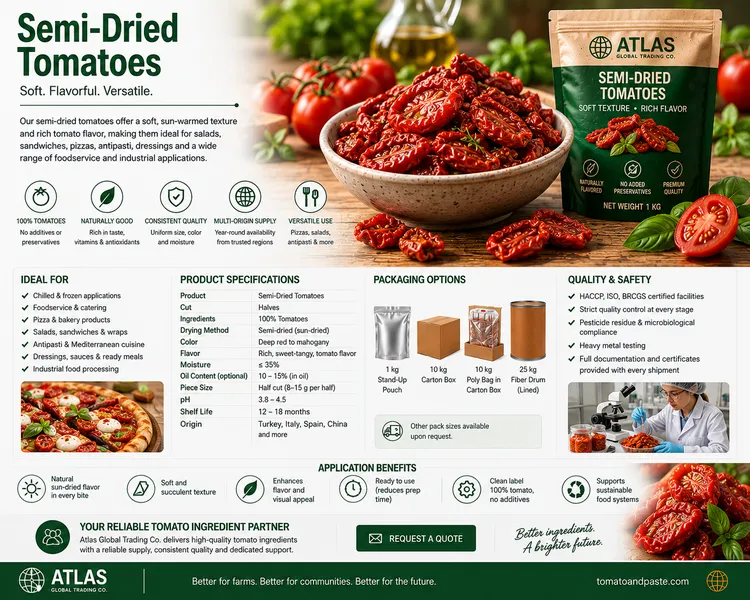
Product overview
Semi-dried tomatoes are partially dehydrated tomato products designed to retain more moisture and a softer texture than traditional sun-dried tomatoes. This balance can provide concentrated tomato flavor while preserving a tender, more succulent piece suitable for chilled and ready-to-use applications.
Programs can include plain, marinated, pasteurized or frozen formats depending on the processor and intended use. Product may also vary by cut, seasoning, oil or marinade system, moisture level, packaging and storage condition.
Atlas Global Trading Co. sources tomato ingredients through a multi-origin network of farms, processors and supply partners. We match the ingredient to the customer’s finished-product performance, commercial pack format, storage requirements, technical documentation, destination and supply program.
Specification focus
Moisture and texture are central purchasing parameters for semi-dried tomatoes. Compared with fully dried products, the higher retained moisture generally produces a softer bite, but it can also change storage, preservation and shelf-life requirements.
Buyers should define the required piece format, which may vary by processor and application. Size and cut influence visual identity, portioning, topping performance and how easily the product can be mixed into salads, pizzas, sandwiches or prepared meals.
The supply program may be plain or include oil, herbs, salt, seasoning or marinade components. Where formulation, allergen, sodium or ingredient-declaration requirements are important, the complete ingredient system should be reviewed before approval.
Preservation and storage method should also be specified clearly. Depending on the program, semi-dried tomatoes may be chilled, pasteurized, frozen or otherwise processed to support the intended distribution model. Product-specific microbiological limits and storage instructions should form part of the approved specification.
Texture and application behavior
Semi-dried tomatoes are commonly selected where a softer tomato piece is preferred over the firmer chew of a traditional fully dried tomato. The retained moisture can make them especially suitable for products that are served with limited further hydration or cooking.
In pizza and baked applications, buyers may evaluate how the pieces respond to oven heat, surface drying and moisture migration. In salads and sandwiches, the emphasis may instead be on tenderness, flavor, marinade balance and visual consistency.
Frozen semi-dried programs should also be evaluated after thawing to confirm that texture, piece integrity and liquid release remain suitable for the customer's process and finished product.
Plain and marinated programs
Plain semi-dried tomatoes give manufacturers greater control over final seasoning and oil addition. Marinated products can reduce preparation steps by supplying the tomato together with a defined oil, herb or seasoning system.
For marinated products, buyers should review the complete formulation, including oil type, salt, herbs, acids, preservatives where applicable and any allergen-relevant ingredients. The correct choice depends on whether the product will be used directly or incorporated into a larger formulation.
Typical applications
- Antipasti and deli preparations
- Pizza and flatbread toppings
- Salads and chilled prepared foods
- Sandwiches, wraps and fillings
- Foodservice and catering applications
- Frozen and refrigerated ready meals
Packaging, storage and handling
Packaging should be matched to the product's moisture level, preservation system and required temperature regime. Depending on the program, commercial formats may include pouches, tubs, cartons, bags or frozen bulk and foodservice configurations.
Receiving teams should verify package integrity, lot identification, product temperature where relevant and the specified storage condition. Chilled and frozen products require suitable cold-chain management, while other programs should follow the processor’s stated shelf-life and handling instructions.
Once opened, product handling should follow the approved specification, particularly where exposure to air, temperature changes or cross- contamination could affect quality or shelf life.
Organic and conventional programs
Where organic supply is requested, we confirm the product’s certification scope and supporting documentation for the selected origin and supply lot. For marinated organic programs, the certification status and suitability of the complete ingredient system should also be reviewed.
Conventional programs can be optimized around texture, moisture, cut, seasoning system, packaging, storage model, economics, origin and continuity of supply. Exact technical parameters and commercial availability are confirmed against the selected processor and product program.