
Product overview
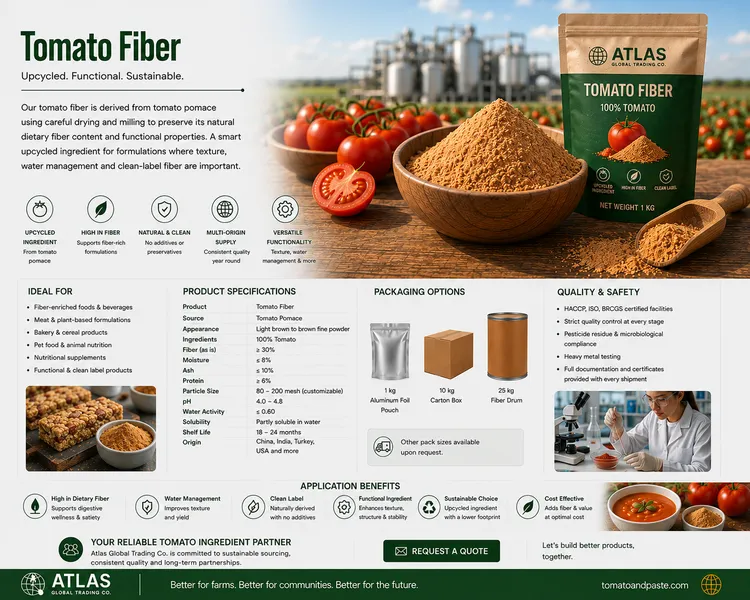
Tomato fiber is a tomato-derived co-product ingredient that can be evaluated for selected food, pet-food and specialty formulation projects. Depending on the source material and processing method, it may contain varying proportions of insoluble tomato solids and other naturally occurring tomato components.
Potential value comes from both functionality and efficient use of tomato processing streams. In suitable applications, tomato fiber may contribute to texture, water management, solids content and visible tomato character while supporting projects focused on greater utilization of tomato co-products.
Atlas Global Trading Co. sources tomato ingredients through a multi-origin network of farms, processors and supply partners. We match the ingredient to the customer’s finished-product performance, commercial pack format, documentation requirements, destination and supply program.
Specification focus
Functionality depends on raw material and processing, so pilot validation is recommended. Relevant commercial parameters can include total or insoluble fiber, moisture, particle-size distribution, color, bulk density, microbiological limits and other compositional criteria appropriate to the intended use.
Particle size can influence dispersion, mouthfeel, appearance and processing behavior. A finer material may integrate more uniformly into sauces, doughs or extruded systems, while a coarser product may have a greater effect on visible texture.
Moisture is also an important storage and handling parameter. As with other dry tomato ingredients, packaging should provide suitable protection against humidity and contamination, and warehouse conditions should follow the processor’s recommendations.
Where the ingredient is intended for food or pet-food use, buyers should define the relevant microbiological, contaminant, residue, nutritional and regulatory requirements for the destination market and finished product.
Texture and water management
Tomato-derived fiber may influence water distribution and perceived texture in a formulation. The magnitude of that effect depends on the specific material, particle size, inclusion rate, processing conditions and the other ingredients in the system.
In sauces and prepared foods, formulators may investigate whether the fiber contributes to body or reduces free water. In bakery and extruded products, the same ingredient may affect dough hydration, expansion, density or final bite. These effects should be established through controlled formulation trials.
Pilot validation
Because tomato fiber is not necessarily standardized across processors, bench and pilot trials are especially useful. A controlled trial can evaluate water absorption, texture, flavor, color and processing behavior at several inclusion levels before a commercial specification is finalized.
For source changes, manufacturers may also want to repeat qualification work if particle size, composition or processing method differs materially from the previously approved ingredient.
Typical applications
- Pet-food and treat formulations
- Bakery and savory dough systems
- Sauces and prepared foods
- Extruded foods and snack trials
- Fiber-enrichment projects
- Upcycled ingredient formulations
Storage and handling
Tomato fiber is generally handled as a dry ingredient. Receiving teams may review package integrity, lot identification, moisture protection, pallet condition and applicable shelf-life documentation before use.
Once a package is opened, exposure to humidity should be minimized. Product-specific shelf life, storage temperature and handling recommendations should always follow the current approved technical documentation.
Organic and conventional programs
Where organic supply is requested, we confirm the product’s certification scope and supporting documentation for the selected origin and supply lot. Because tomato fiber may be produced from a processing co-product stream, the certification status of the source material, processor and final product scope should all be confirmed.
Conventional programs can be optimized around composition, functionality, economics, origin and continuity of supply. Exact analytical parameters and commercial availability are confirmed against the selected processor and product program.