
Product overview
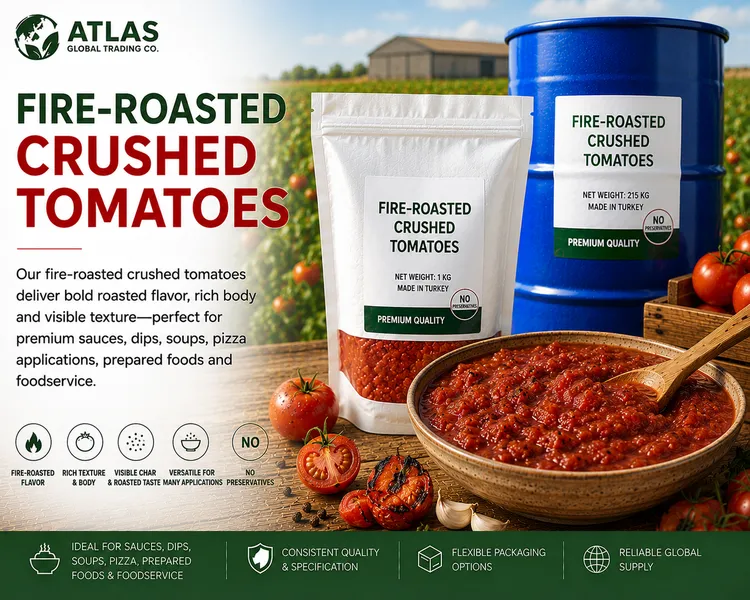
Fire-roasted crushed tomatoes combine the texture and body of crushed tomato with a deeper roasted flavor profile developed through controlled high-heat or flame roasting. The format can help manufacturers add roasted tomato character to formulations without introducing a separate roasting step in their own production process.
Atlas Global Trading Co. sources specialty tomato ingredients through a multi-origin network of farms, processors and supply partners. We match available programs to the customer’s desired roast profile, texture, consistency, solids, packaging format, finished-product performance and delivery destination.
Roasted flavor profile
Fire-roasted crushed tomato can range from relatively mild toasted tomato notes to a more pronounced roasted or smoky profile, depending on the processor and product specification. The appropriate intensity should be selected according to the overall seasoning system and desired finished-product character.
In premium sauces and culinary products, the roasted tomato component can support savory depth and help create a cooked or flame-finished flavor impression without overwhelming the underlying tomato profile.
Texture and consistency
Crushed tomato products can differ significantly in particle distribution, pulp content and overall consistency. Some applications require a visibly textured product with recognizable tomato fragments, while others benefit from a finer crush that integrates more smoothly into the sauce or base.
Manufacturers should consider the ingredient’s behavior after pumping, mixing, heating and filling. Particle size and apparent consistency can change during processing, particularly in high-shear or extended-cook applications.
Specification focus
Roast level, texture, consistency, color and formulation should be matched to the finished product. Depending on the program, buyers may also review soluble solids, particle size, pH, acidity, flavor intensity, microbiological criteria and packaging requirements.
Because fire-roasted crushed tomatoes are both a functional and sensory ingredient, technical specifications should be considered alongside representative samples whenever roast character, color or texture are important to product positioning.
Formulation advantages
Fire-roasted crushed tomatoes can contribute tomato solids, body and roasted flavor in a single ingredient. This can simplify formulations that would otherwise rely on separate tomato bases and roasted flavor components.
Depending on the recipe, the ingredient can be combined with tomato paste, puree, peppers, onions, spices, smoke notes, sweeteners, acids or other savory ingredients to create a more layered flavor profile.
Typical applications
- Barbecue and grilling sauces
- Pizza and pasta sauces
- Dips and savory spreads
- Soups, stews and chili
- Prepared foods and ready meals
- Culinary bases and foodservice sauces
Processing considerations
The ingredient’s final texture can be influenced by pump shear, agitation, cooking temperature, cook time and downstream thermal processing. Customers requiring a particular visible texture should evaluate samples under production-representative conditions before commercial approval.
In applications with extended heat treatment, manufacturers should also consider how the roasted flavor profile develops alongside other spices, smoke components and caramelized ingredients. Pilot testing can help determine the most appropriate inclusion level.
Organic and conventional programs
Where organic supply is requested, we confirm the product’s certification scope and supporting documentation for the selected origin, processor and supply lot. Conventional programs can be optimized around roast style, texture, technical performance, economics, origin and continuity of supply.
Depending on the selected program, documentation may include the current technical specification, certificate of analysis, applicable certification records and relevant lot or shipment documentation.
Sourcing and commercial planning
Multi-origin sourcing can provide flexibility when customers are balancing sensory requirements, crop availability, freight economics, lead time and continuity of supply. For recurring programs, forecast volumes and anticipated shipment timing help us review the most appropriate sourcing pathway.
A complete inquiry should include the desired roast intensity, texture or particle size, consistency, solids requirement where relevant, packaging format, annual volume, certification needs and delivery destination.